Josephus Famulus's spiritual despair
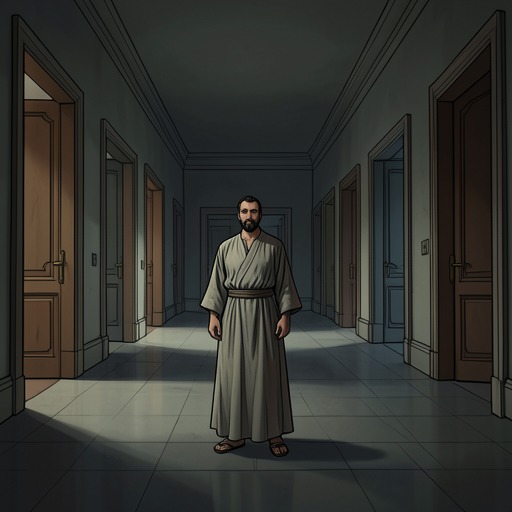
The Glass Bead GameJosephus Famulus’s spiritual despair is the crisis of an aging hermit whose vocation of listening to penitents becomes intolerable to him. As his inward peace fades into a gray, joyless weariness, the stream of confessions that once seemed a sacred trust feels like an assault; thoughts of suicide follow. He does not act on them. Instead, he abandons his cave and flees, discovering in the admission of his failure a path away from self-destruction and back into uncertainty, tears, and dependence on God.
A vocation that turns into a burden
Josephus’s despair grows out of the very work through which he had sought to serve God. Travelers and pilgrims come to his cave to confess, and he has learned to receive each person as a brother and, especially when he dislikes someone, to treat that penitent with deliberate deference. Yet the role also exposes him to vanity: when visitors seek his counsel, he can take pleasure in their dependence and feel pleased with himself. Recognizing that satisfaction alarms him. He prays to be spared further penitents, only to find that their absence does not make him better; when they return, the old temptation to self-importance returns too. He struggles with coldness and contempt, and sometimes imposes solitary humiliations and penances after hearing a confession. Only after many years does he arrive at a measure of equanimity, so that people nearby regard him as faultless and at peace.
That outward reputation conceals how vulnerable his peace remains. It waxes and wanes, at times seeming close and at times distant, and old age brings a different trial from the passionate temptations he had known earlier. This new condition is muted rather than violent: a slack, lukewarm dullness, felt as the gradual disappearance of joy. His days lose their distinctions. Mornings and evenings, feast days and ordinary days, rapture and dejection run together in a sluggish, colorless routine. He had expected age and the cooling of passion to bring greater harmony and mature peace; instead, he feels cheated of that promise by chronic satiation.
The deadening flow of confession
Josephus experiences his surroundings and duties as parts of the same exhausting repetition: breathing, sleeping, living in his cave at the edge of a small oasis, watching evenings and mornings pass, and receiving the travelers who visit him. The people who bring him their fears, sins, temptations, and accusations are no longer merely individual penitents. Their confessions seem to pour into his ear by the dozens and hundreds, like the spring that gathers in the oasis basin, runs briefly through the grass, and disappears into the desert sands. But unlike the sands, his ear is alive. It cannot absorb endlessly. It feels fatigued, abused, and glutted, longing for the words and self-accusations to stop and for stillness to replace them.
The wish for rest darkens into a wish for death. Josephus sometimes considers ending his life, imagining a tree as a place for a noose or a nearby cliff as a place from which to leap. He understands these thoughts as a form of spiritual assault, akin to the earlier temptations of sensual and worldly pleasures, but now turned against life itself. He resists and does not yield; nevertheless, he lives day and night amid self-hatred and a craving for death. His crisis is not simply boredom with a hermit’s routine: he has come to experience his calling, his surroundings, and his own continued existence as unbearable.
Flight from the hermitage
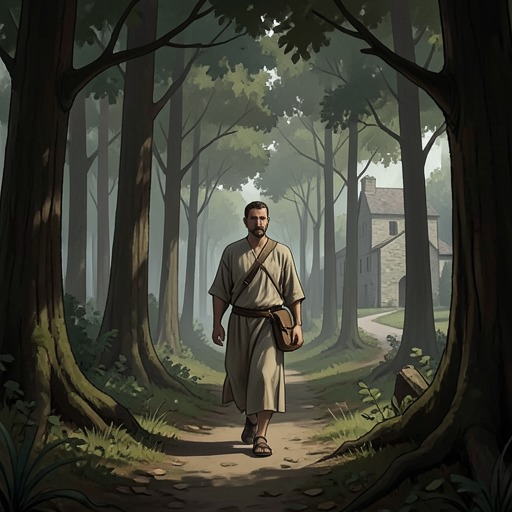
The decisive break comes when Josephus stands on a cliff and notices two or three tiny figures at a distance. They appear to be travelers, perhaps pilgrims or visitors coming, as usual, to seek his counsel. At once he feels an irresistible desire to leave. The impulse sweeps aside his objections and scruples before he can resolve them: he runs back to the cave, gathers a few handfuls of dates and a gourd of water into his old traveling pouch, takes his staff, and departs. He leaves the green quiet of the oasis as a fugitive, fleeing not only from visitors but from the function and mission he had once regarded as the best he could offer.
At first he hurries as though the distant figures might pursue him. After about an hour, his haste ebbs and he rests. He does not eat before sunset, maintaining the sacred habit he had observed in the hermitage. In the pause, his practiced self-examination considers what he has done and, unexpectedly, does not condemn it. The flight is rash, but not shameful: by abandoning a post he can no longer hold, Josephus has admitted his failure to himself and to God. There is nothing heroic or saintly in the act, but he recognizes it as sincere and perhaps unavoidable. He even wonders whether his long persistence had been a mistake, sustained by egotism—the old Adam—rather than by fidelity.
The danger behind the wish to die
Once away from the cave, Josephus sees his suicidal temptation more clearly. He recognizes that the impulse carried a disturbing possibility of self-sacrifice: a pagan echo of the ancient custom in which a king, saint, or chosen person gives up his life for the community. More frightening still, he sees that the desire to die might have involved an attempt to imitate the Redeemer’s voluntary death on the cross, or to imply that the Redeemer’s act of salvation had not been sufficient. He is shocked by this recognition, and grateful that flight has carried him away from the danger. The distinction matters to him: he has not offered himself up as a savior or repeated the act that horrifies him; he has relinquished the role he could no longer bear and placed himself once more in God’s hands.
His recognition does not bring an instant, triumphant serenity. Shame and dejection grow as he understands the spiritual hell from which he has escaped. Then the oppression breaks into a torrent of tears. He has been unable to weep for a long time; now the tears ease the choking pressure, and their release briefly makes him feel like a child who knows nothing of evil. Slightly ashamed, he smiles and continues his journey. He does not know where it will lead. Yet the conflict within him has quieted: he moves as if led by a distant, kind voice, and the journey begins to feel less like flight than a homecoming. His despair is therefore neither cured by a simple decision nor erased by a doctrine. The immediate change is that he stops trying to defend a lost position and becomes able to move without knowing what comes next.
The despair recognized by another
Much later, Dion Pugil recognizes the shape of Josephus’s crisis because he has suffered a parallel collapse in his own work. He recalls that an aging confessor may come to feel that the people who trust him bring more human misery than he can bear; what once seemed a sacred assignment can feel like an imposition, and he may recoil from penitents and wish to get rid of himself. Dion tells Josephus that he too had felt useless and spiritually dead, unable to endure the people who flocked to him with the troubles they could not manage. His confession makes Josephus’s flight more than an isolated episode of weakness: it reveals a danger built into a vocation of receiving other people’s suffering when the one who listens begins to experience that service as a curse.
The episode also complicates the image of the apparently peaceful hermit. Josephus’s neighbors may see a man without faults who has found peace in God, but the account shows that spiritual steadiness is living and changeable, not a permanent achievement. The outward form of service can persist after its inward meaning has become exhausted; continuing to perform it through sheer obstinacy may deepen division and despair. Josephus’s departure is consequential precisely because it is modest. He does not claim mastery over suffering. He recognizes his incapacity, leaves the cave with only dates, water, and a staff, and allows an uncertain journey to replace a mission he can no longer fulfill.