Josephus Famulus’s flight from his hermitage
The Glass Bead GameJosephus Famulus’s flight from his hermitage is a turning point in his spiritual crisis: unable to endure his life of service and tormented by thoughts of suicide, he abandons the oasis where he has lived for years. What first seems a desperate escape becomes, in retrospect, an honest relinquishment of a role he can no longer bear and an uncertain movement toward renewal.
The burden of the hermitage
As he approaches old age, Josephus finds that his days have lost their distinctions. Mornings and evenings, feast days and ordinary days, elation and dejection blur into the same sluggish, joyless routine. He had expected aging to quiet his passions and bring greater harmony, but instead feels chronically sated by existence itself: by sleep, breathing, the cave at the edge of the oasis, and the recurring passage of travelers and pilgrims.
The visitors’ confessions, once part of his work as a pious penitent, have become another source of exhaustion. Their accounts of sins, fears, temptations, and self-accusations arrive by the dozens and hundreds. He likens them to water that gathers in the oasis spring, runs briefly through the grass, and then disappears into the desert. But his ear, unlike the sand, cannot absorb an endless stream. He longs for the confessions to stop and for peace, stillness, and even death to replace them.
The sudden departure
Josephus’s weariness deepens into thoughts of self-destruction. He imagines trees as places where he might hang himself and nearby cliffs as places from which he might fall. He resists these impulses, but describes himself as living day and night amid self-hatred and a craving for death. His crisis is not simply a wish to leave his visitors behind: he has come to hate the life he is living and to feel that his mission has become unbearable.
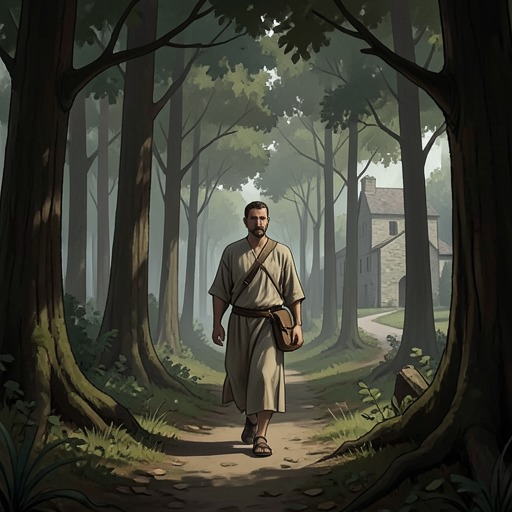
The immediate occasion for flight comes while he stands on a cliff and sees two or three small figures in the distance, perhaps pilgrims or visitors coming to seek him out. An overwhelming impulse seizes him: he must get away at once. Before his scruples can hold him back, he is running to the cave where he has known years of struggle, exaltation, and defeat. He gathers a few handfuls of dates and a gourd of water into his old traveling pouch, takes his staff, and leaves the green oasis as a fugitive, fleeing not only people but also the function and mission he had once considered his best offering.
At first he hurries as if the distant figures might pursue him. After about an hour, his haste ebbs, and the physical effort brings a welcome tiredness. He rests but does not eat, keeping the sacred habit of fasting until sunset. In that pause, his accustomed self-examination returns—not to condemn him, but to recognize that the flight, however rash, is harmless and sincere.
A change in how he understands the escape
Away from the hermitage, Josephus judges his departure as an admission of failure. He has abandoned a post he is no longer fit to hold and acknowledged defeat both to himself and to God. He does not regard the act as grand, heroic, or saintly. Its value lies instead in its honesty: he has stopped repeating a struggle that had become useless. He wonders why he persisted so long, and sees his dogged defense of a lost position as possibly rooted in egotism—the old Adam—rather than in spiritual fidelity.
This change of perspective also reframes his suicidal thoughts. He recognizes that, although Christian penitence may accept life as an offering and need not fear death, a desire to kill himself is not the same as faithful surrender. He had been tempted to imitate either Judas or Christ: to destroy himself in despair, or to turn his death into a self-appointed sacrifice that would imitate the Saviour and arrogantly suggest that redemption was incomplete. The horror of that possibility makes his flight feel, by contrast, like a deliverance from a peril he had not fully understood while he remained at the hermitage.
Tears and an uncertain homecoming
As Josephus considers the danger from which he has escaped, shame and dejection gather until he can no longer contain them. He breaks into a torrent of tears, a release he had been unable to reach for a long time. The weeping eases the feeling of strangulation; tasting salt on his lips, he briefly feels like a child again, innocent of evil. He smiles, slightly ashamed, then rises and continues onward.
He does not know where the journey will lead or what will become of him. Yet the inner conflict that had driven him into despair has quieted. He walks easily, as if being led by a distant, kind voice, and begins to experience the journey not merely as flight but as a homecoming. Even his reason, which had resumed its work of judging his action, falls still or seems no longer necessary. The flight ends this episode without supplying a destination or a resolution: its decisive change is that Josephus has relinquished the role that was crushing him and can move forward without knowing what will follow.