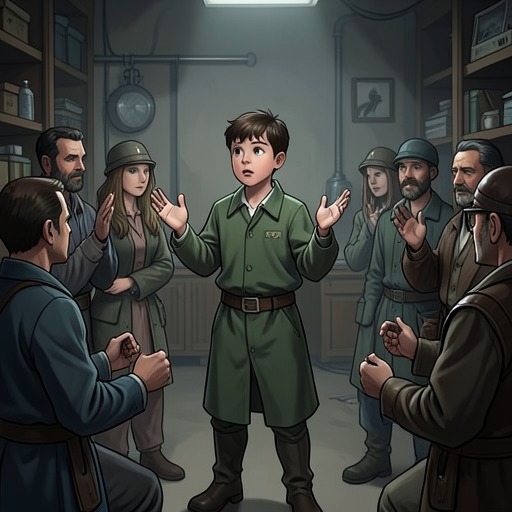
Knecht’s awakening to the Glass Bead Game
The Glass Bead GameKnecht’s awakening to the Glass Bead Game is the moment when an exercise in linguistic history becomes, for him, a revelation of the Game’s vocation: to preserve change without reducing it to lifeless abstraction, and to make diverse forms of knowledge disclose a shared spiritual order. The revelation does not simply confirm an existing enthusiasm. It resolves Knecht’s doubts about whether the Game is only an ingenious formal art, and sets the direction of his later studies and identity as a player.
The exercise and its trap
Years after the experience, Knecht recalled it in a letter to his friend and later assistant, Fritz Tegularius. The two had been assigned to the same student group, where they were preparing their first sketches for Glass Bead Games. Their group leader set them a transition between astronomy, mathematics, and physics on one side and the sciences of language and history on the other. He was skilled at enticing beginners onto uncertain ground: etymological and comparative-linguistic suggestions led them toward conjectures that the leader could then expose as faulty. In one example, the students counted Greek quantities before being confronted with the possibility, and even necessity, of accentual rather than quantitative scansion.
Knecht recognized that the leader was performing his duty as an instructor, but disliked the skeptical spirit of the exercise. The deliberate false trails were meant to teach the dangers of careless analogy; they also made the eager boys’ mistakes an occasion for ridicule. Yet it was precisely during one of these complicated experiments, as the group awkwardly tried to formulate a defensible Game problem, that the exercise became more than a test of method. Knecht’s awakening arose within the skepticism he resented, rather than through an untroubled demonstration of the Game’s powers.
A language’s rise, decline, and survival
The group was examining a problem in linguistic history and, in a short span, traced the course of a language across several centuries. Knecht saw a complex and venerable organism reach the height of its development, while that height already contained the beginnings of decline. The language’s carefully articulated structure began to droop and deteriorate toward its end. What seized him was not change alone, but the juxtaposition of flourishing and decay: a high point could not be separated from the vulnerability already gathering within it.
The vision turned when Knecht realized that the language’s death did not mean its loss. Its youth, maturity, and decline remained preserved in memory and historical knowledge, available for reconstruction through scholarly symbols and formulas and through the more recondite formulations of the Game. Preservation here did not reverse history or keep a language alive in ordinary use. It made the stages of its life intelligible together, so that what had passed could still be recovered as a meaningful whole.
From that perception came Knecht’s larger insight: in the spirit of the Game, everything could be meaningful. A symbol or combination did not lead merely to an isolated example, experiment, or proof. Under a genuinely meditative understanding, it could lead toward what Knecht called the world’s inner mystery. A change from major to minor in a sonata, a transformation of myth or religious cult, and an artistic formulation could each become a route toward that interior. His vision joined particulars without making them interchangeable: the movement between inhaling and exhaling, heaven and earth, and Yin and Yang supplied its image of a holiness continually coming into being.
From doubt to vocation
Before this episode, Knecht had listened to accomplished Games and been exalted by the insights they offered, but remained unsure of their ultimate value. Mathematics could yield intellectual pleasure on its own; music could enlarge the soul toward universality; meditation could bring the heart into harmony with the universe. Precisely because these practices possessed independent force, he suspected that the Glass Bead Game might be only a formal art: a clever combination that borrowed its materials from more authentic pursuits. His awakening altered the question. The Game was not valuable merely as an elegant device for combining disciplines; he had, as he later put it, heard its inner voice and meaning.
Knecht came to believe in it as a lingua sacra, a sacred and divine language. The revelation also resembled, for him, an earlier summons: as a boy, he had been tested by the Music Master and called to Castalia. He told Tegularius that this new change within him had been visible to his friend at the time, even though Tegularius had said nothing. The parallel marks the experience as more than an intellectual conclusion. Knecht understood it as a vocation, a call that reorganized his sense of his own path.
The wider account of the Game helps define what that claim means. Its grammar draws especially on mathematics and music, and its symbolic language relates the contents and conclusions of many scholarly disciplines. Themes can be elaborated, varied, and combined much as a musical theme develops; a Game may begin from an astronomical configuration, a Bach fugue, or a sentence from Leibniz or the Upanishads. Yet even identical selections of themes need not produce identical Games: the players’ minds, characters, moods, and virtuosity shape their distinct courses. Knecht’s revelation concerns this structured freedom. The Game can relate different kinds of knowledge without turning every performance into the same fixed result.
Music, sense, and the limits of abstraction
Knecht’s awakening belongs to a sustained attention to music as something heard and made, not merely extracted into intellectual patterns. At Waldzell, he had made practical study of Western music, learning the notations, clefs, abbreviations, and figured basses of different centuries and styles. His concern with how music sounded and felt delayed his commitment to the elementary Glass Bead Game course. He later argued that a person who knew music only through the abstractions distilled by the Game might become a capable player without becoming a musician—or a historian.
The distinction is not a rejection of abstraction. For Knecht, sound’s sensuous particulars are necessary to interpreting the spirit of an era or style. Music is made with hands and fingers, mouths and lungs, as well as understood intellectually; its physical qualities are part of how its history becomes legible. His own awakening similarly begins with close attention to a particular historical process—the rise and decline of a language—and reaches toward universality through, rather than in place of, that concrete material.
The Game’s larger musical ideal offers a related ethical frame. Its themes may develop like those of a Bach fugue or concerto movement, and one favored practice set opposed ideas, such as law and freedom or individual and community, against each other before seeking a synthesis. At the height of the Game, negative or skeptical conclusions were generally unpopular and sometimes forbidden; players understood their art as a search for perfection and a movement from Becoming toward Being. Knecht’s revelation gives this universal aspiration a historical counterweight: meaning includes the fragility and decay of what it preserves, not just the harmony toward which its forms strive.
Reconstruction as a life’s work
After his awakening, Knecht explained that his apparently disconnected studies followed a definite plan. He intended to reconstruct, systematically and from beginning to end, the very Glass Bead Game exercise in which he had heard its voice. The original Game began with a rhythmic analysis of a fugal theme and had at its center a sentence attributed to Confucius. Knecht was translating each phrase back out of the Game’s language into its source disciplines, including mathematics, musical ornament, Chinese, and Greek.
He had completed the first part after two years and expected the entire project to take several more. The undertaking used Castalia’s freedom of study in a distinctive way: instead of treating the Game as a finished universal language to be accepted on authority, he would retrace its materials and examine how its syntheses were made. His teachers might object that centuries of development had already fashioned the Game as a method for expressing intellectual concepts and artistic values; checking it all anew could consume a lifetime. For Knecht, however, reconstruction was a consequence of the awakening itself. The Game had shown him how historical forms could remain available to thought, and he answered by returning to the concrete disciplines from which one of its own performances had been built.