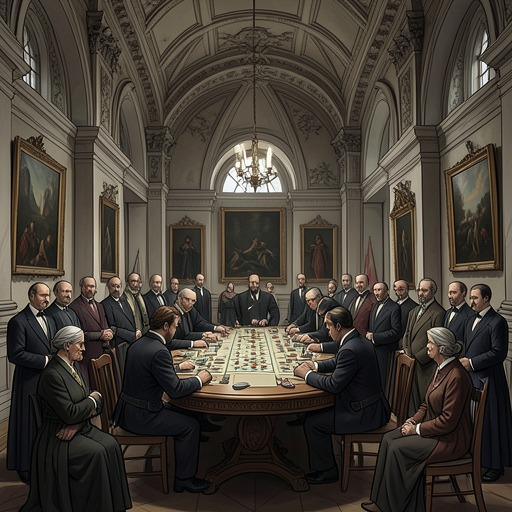
Knecht’s circular letter to the Board of Educators
The Glass Bead GameKnecht’s circular letter to the Board of Educators is a document of dissent within Castalia: the Magister Ludi uses an official channel to argue that the Glass Bead Game is in crisis and asks to exchange his prestigious office for the work of an ordinary schoolmaster. Its petition is refused, but its insistence that education beyond Castalia matters more than the preservation of Castalia’s own institutions makes the letter a turning point in Knecht’s effort to serve beyond the position assigned to him.
Origin and Form
As the tale approaches its end, its narrator calls the knowledge of Knecht’s final period fragmentary, closer to legend than to historical narrative. The circular letter therefore has a special status: it is presented as an authentic document that lets Knecht state his reasons in his own formal argument, rather than leaving his decision to be reconstructed from the incomplete account of what followed. The narrator identifies it as a voluminous memorandum addressed to the authorities, asking to be released from his office.
Knecht submits it separately from his official report, although he appends it to the accounting then due. He calls it a circular letter to his colleagues in office, while also making it a personal request to the Board. That combination is part of the document’s significance and, as the Board’s eventual reply makes clear, part of why the form meets resistance: it fuses a professional communication with a petition for reassignment.
Diagnosis of the Crisis
The letter begins from the rule that every Magister must tell the Board about obstacles or dangers to carrying out his duties. Knecht locates the danger partly in himself, but says it is not necessarily personal in origin. He doubts his own ability to officiate satisfactorily because he believes the Glass Bead Game itself to be in crisis. His memorandum is meant to persuade the Board that this crisis exists and that recognizing it makes his continued service in his current post untenable.
The deeper argument challenges the hierarchy of Castalian work. Knecht maintains that as Castalia’s treasures grow stale and crumble, the country will need not only its seminars or its Glass Bead Game but, above all, good teachers. Schoolmasters should help young people judge and distinguish, honor truth, remain obedient to the life of the spirit, and respect language. This service matters in the elite schools, which he believes may eventually close, but even more in the secular schools outside Castalia, where children from many walks of life are educated while still malleable.
Knecht argues that Castalia has relied too heavily on a continuing influx of the best pupils from schools outside to sustain itself. Instead, the Province should recognize service to those schools as a chief and especially honorable part of its mission. The letter thus turns a diagnosis of institutional danger into a change in priorities: the school outside Castalia is not merely a source from which the elite draws talent, but a place where the country’s cultural life is formed.
The Petition and Its Rejection
Knecht’s request is concrete. He asks the Board to relieve him of the office of Magister Ludi and entrust him with an ordinary school, large or small, in the country outside Castalia. He would recruit a group of young members of the Order to serve there as teachers, choosing those he believes can instill Castalian principles in young people beyond the Province. The proposal would carry the Order’s educational ideals outward, but it would also require the Board to let Knecht leave the office and place to which its hierarchy has assigned him.
The Board’s response arrives sooner than Knecht expects, but he does not tell his friend Tegularius that it has come. The reply acknowledges the letter’s stimulating and admonitory force, yet says that its argument has not won the majority over. The Board objects both to the substance of Knecht’s opinions and to his unusual decision to combine an official communication with a personal petition. It then refuses his request outright, reasoning that if each member assessed his own aptitudes and chose his own position, the hierarchy’s system of assignment would be undermined. Knecht is instructed to continue administering the office entrusted to him.
Context and Significance
The letter’s argument emerges from Knecht’s encounter with history and with a religious institution beyond Castalia. In his exchanges with Father Jacobus, Knecht had tried to explain the Province’s constitution, elite schools, and Glass Bead Game. That work made him recognize how schematic his own understanding of Castalia’s historical foundations had been; Jacobus, in turn, came to understand and appreciate the Province more deeply. Their exchange helped foster benevolent neutrality, scholarly contact, and eventual cooperation between Rome and Castalia. The letter extends the same outward-facing pressure into Knecht’s own institution: intellectual integrity requires Castalia to examine its place in the wider historical and educational world, rather than treating its internal order as sufficient.
The stakes are sharpened by what the Glass Bead Game means to Castalia. The Game had become a sublime synthesis of intellectual and artistic life, sometimes called the Magic Theater, and its symbols could encompass religious as well as scientific and artistic forms. For genuine players it approached worship, though it deliberately developed no theology of its own. The annual solemn Game likewise served as a consecrating festival for believers and a substitute for religion for others. Knecht’s concern about the Game is therefore not a rejection of its spiritual and intellectual value. His petition asks whether preserving that value requires a different kind of service: teaching young people outside Castalia, before the Province’s own treasures lose their force.
The Board’s refusal leaves the conflict unresolved. It appreciates the warning yet reasserts the principle Knecht challenges: offices are assigned by the Order, not chosen by individuals who judge their own gifts. The circular letter is consequently both a request the hierarchy denies and a clear record of the alternative Knecht has put before it. Its proposed school would connect Castalian teaching with the wider country; its rejection keeps him in the Magister’s office, even as the document makes plain why he doubts that office can answer the crisis he sees.