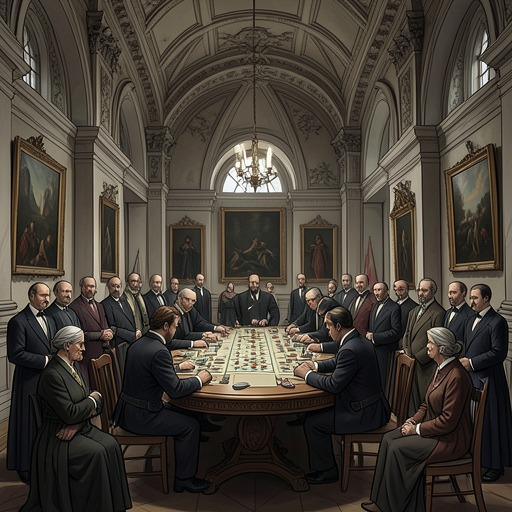
Lusor Basiliensis
The Glass Bead GameLusor Basiliensis, also known as Joculator Basiliensis, was an anonymous Swiss musicologist whose invention of a new symbolic language laid the foundations for the universal Glass Bead Game. By bringing mathematics and music into a common system, he enabled players to connect disciplines that had previously followed separate rules; the Game’s later development into a contemplative, public art grew from that breakthrough, though its symbols remained dependent on training, interpretation, and lived experience.
Identity and Historical Setting
The account preserves no civil name for Lusor Basiliensis. By the time of his work, the cult of personality in intellectual life had been set aside, and he survives in the history of the Game under a Latin title: Lusor Basiliensis, or Joculator Basiliensis. He was a Swiss musicologist with a passion for mathematics, working in an age when scholars increasingly felt that confinement to separate specialties was inadequate.
The Game already existed, but it lacked universality. Astronomers, classicists, scholastics, and music students each played according to ingenious rules particular to their disciplines and subdivisions. The tools for connecting those practices may have been available, but a puritanical distrust of intermingling subjects—and a justified fear of superficiality—helped delay the first steps toward a common system for half a century.
The Symbolic Language
The intellectual need for synthesis was not confined to one scholar. Some sought a new alphabet or symbolic language through which scholars could formulate and exchange their experiences across disciplinary boundaries. A Parisian scholar, a distinguished authority on Chinese philology, sounded this warning in an essay called “Chinese Warning Cry.” He argued for an international language of symbols, comparable in its capacity for graphic expression to ancient Chinese script, that could render complex matters intelligible to scholars while leaving room for individual imagination and invention. Many mocked him as a Don Quixote, but the impulse he described was real.
Lusor Basiliensis took up the problem and devised principles for a language of symbols and formulas in which mathematics and music had equal parts. The new system made it possible to combine astronomical and musical formulas and, in effect, reduce mathematics and music to a common denominator. His work did not complete the project. Its historical importance lay instead in establishing the foundations on which subsequent generations could build.
The later Glass Bead Game is described as a highly developed secret language whose rules and grammar draw especially on mathematics and music, while expressing relations among the content and conclusions of nearly all scholarly disciplines. Its fixed symbolic apparatus resembles an immense organ: the intellectual inheritance of culture becomes material for a player to arrange and relate. The structure is tightly controlled, and proposed additions to its vocabulary are subject to strict oversight. Yet within that framework, a player’s mind, character, mood, and virtuosity can make even games based on the same selection of themes take entirely different courses. The universal language does not dictate a single performance.
From Intellectual Synthesis to Contemplation
After Lusor Basiliensis’s achievement, the Game rapidly attracted intellectuals beyond the specialist circles that had first played it. Universities, lodges, the League of Journeyers to the East, and some Catholic Orders turned toward it. At Benedictine abbeys, monks devoted themselves to the practice so intensely that people debated whether the Church and Curia should tolerate, support, or forbid it. The Game became, in the narrator’s account, a synthesis of intellectuality and art, taking on part of the role formerly played by art and speculative philosophy. In the Age of the Feuilleton, it was sometimes called the Magic Theater.
The new symbolic language did not itself supply every element of the mature Game. Early games ordered, grouped, and contrasted concentrated concepts in a virtuoso sequence through the realms of thought. They could dazzle through sheer speed of recall: people with extraordinary memories but few other virtues sometimes overwhelmed other players by rapidly summoning countless ideas. In response, such displays increasingly came under a strict ban, and contemplation entered the Game from educational practice and the customs of the League of Journeyers to the East.
Contemplation changed both the conduct of play and the audience’s role. After each symbol presented by a Game director, players were required to meditate silently on its content, origin, and meaning, calling its full significance to mind rather than treating it as an empty sign. The practice, carefully cultivated in elite schools, made inward attention a safeguard against merely mechanical brilliance. What had chiefly demanded speed, memory, and understanding now required a deeper, more spiritual engagement with each sign.
The Game also grew from a private exercise into a public ceremonial. Individuals could still play alone or together, and exceptional games had previously been recorded and circulated for admiration or criticism. But public matches came to define the Game for most people: they were led by senior Masters under the authority of a country’s Ludi Magister, followed by invited listeners and a wider audience. Some lasted days or weeks, with players and guests living in disciplined, self-denying absorption. The symbolic practice that began with a scholar’s effort to span intellectual gulfs thus acquired institutional custodianship and a ritual form.
Musical Form and the Limits of Symbols
The Game’s later musical structure makes the significance of Lusor Basiliensis’s background especially clear. A game might begin with an astronomical configuration, a Bach fugue theme, or a sentence from Leibniz or the Upanishads. Players could develop the initial motif or enrich it through related concepts; advanced players wove it into extensive combinations. One favored method set opposing ideas—such as law and freedom, or individual and community—alongside one another, developed them in counterpoint, and sought a synthesis that treated both sides impartially. Discordant, negative, or skeptical conclusions were generally unpopular and sometimes forbidden, because the Game had come to represent a symbolic approach to perfection and unity.
The distinction between a shared system and private experience remains important in the same account. Knecht recalls how the fragrance of an elder twig and the opening chords of Schubert’s “Die linden Lüfte sind erwacht” became inseparable signs of spring for him. He could communicate that association to others, but could not make it their own response. The example marks a boundary for any universal symbolic language: an association may be described and understood without becoming an identical, universally operative experience.
A related insistence appears in Knecht’s account of music itself. He argues that the Glass Bead Game may distill intellectual relations from music, but that a player who knows music only through those abstractions is not thereby a musician or necessarily a historian. Music also consists in breath, rhythm, timbre, friction, and the physical sensations produced by voices and instruments. In the Game’s own ideal, musical patterns model the elaboration and transformation of themes; Knecht’s caution prevents that formal analogy from erasing the sound and bodily practice on which music depends.
Legacy and Significance
Lusor Basiliensis is remembered less as a personality than as the point at which the Glass Bead Game began to recognize its universal potential. His achievement gave scholars a way to relate forms of knowledge without claiming that their differences had disappeared. The later Game’s fixed language, its regulated admission of symbols, and its learned practice of contemplation all develop the promise he opened while placing it within disciplined limits.
That legacy also culminates in an ethical ideal expressed through music. Knecht describes classical music as a gesture of courage, affirmation of human destiny, and cheerful serenity in the face of tragedy and chance; he asks that the same spirit sound in the Glass Bead Game and in people’s lives and actions. The connection casts the Game not simply as an intellectual instrument, but as a practice in which formal order is meant to shape human conduct. Lusor Basiliensis supplied the language’s foundations; the history of its use asks what kind of attention and life that language can serve.