Mariafels
The Glass Bead GameMariafels is an ancient Benedictine monastery whose layered history makes it more than a place of retreat: it is a living meeting ground between religious scholarship, political history, and Castalia’s intellectual culture. Joseph Knecht arrives first as a teacher of the Glass Bead Game and later as an emissary charged with winning Father Jacobus’s support for closer relations with Rome. In learning from Jacobus, Knecht discovers how little Castalia’s refined, self-contained world understands history as lived reality; in teaching him, he helps open a path from cautious contact to enduring concord.
Historical Setting and Traditions
Mariafels is described as one of the country’s oldest centers of learning, with a history that has moved through periods of flourishing, decline, renewal, and renewed weakness. It was once known for Scholastic learning and disputation, and its large library preserves an extensive collection of medieval theology. After later periods of stagnation, the monastery gained renown for music: it retained a distinguished choir tradition, Masses and oratorios composed and performed by the Fathers, chests of music manuscripts, and the finest organ in the country.
The monastery’s history is also political. During wars and periods of barbarization, Mariafels served at times as a small refuge of rationality, where thoughtful people from opposing sides cautiously met and sought reconciliation. Its last great historical achievement was the making of a peace treaty that for a time answered the exhausted nations’ desire for peace. This record of scholarship, music, and mediation gives the monastery a public character unlike Castalia’s carefully bounded academic life.
Relations between Mariafels and Castalia were initially guarded. After Castalia was founded, the monastery adopted a wait-and-see stance and was at first rather hostile, apparently under instruction from Rome. It politely declined a Board of Educators request to host a scholar working in its Scholastic library and refused an invitation to send a representative to a musicologists’ conference. Contact became more friendly during the later years of Abbot Pius, who developed a keen interest in the Glass Bead Game. Books were exchanged and hospitality reciprocated, though the relationship remained limited rather than intimate.
Knecht’s First Stay
The monastery requested a young Castalian teacher for an extended stay, both to offer introductory courses in the Glass Bead Game and to encourage the few advanced players among the monks. The Magister Ludi chose Joseph Knecht. His appointment followed discreet testing and an accelerated entry into the Order, and the assignment sent him beyond Waldzell and Castalia at a moment when departure from the Province felt to him like relief from the commitments he was not yet ready fully to affirm.
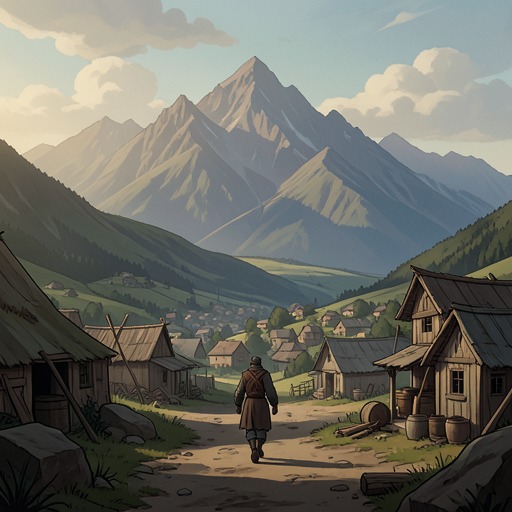
Knecht’s welcome surpassed his expectations. Dubois had cautioned him to behave not as a private individual but as Castalia’s representative, receiving both courtesy and any aloofness in the manner of an ambassador. That discipline helped him through his first constraint and uncertainty. Abbot Gervasius’s warm, good-natured manner soon made him feel at ease. He stayed in two rooms on the top floor of the guest wing and explored the monastery’s compact world of churches, cloisters, archives, library, courtyards, workshops, gardens, barns, refectories, and cellars. The landscape of rough mountains, cliffs, and rich pastures also drew him in.
Mariafels offered Knecht access to places and materials that connected directly with his intellectual and musical interests. He entered the library, saw the great organ, and was allowed to play it. He was especially attracted to the chests of unpublished and little-known music manuscripts. The Music Master had himself spent several weeks at Mariafels in his youth, copying manuscripts and playing the organ, a connection that gave Knecht added pleasure in the prospect of living in a place his revered teacher had remembered fondly.
Father Jacobus and Reciprocal Teaching
In the library, Knecht met Father Jacobus, a modest-seeming Benedictine historian of about sixty who would become one of the most important people in his life. Jacobus worked in a small room off the main hall, treated almost as private territory by other library users. Knecht initially kept his distance, imitating the respectful quiet with which others approached the scholar. Their acquaintance began to deepen after Knecht heard Jacobus playing a Purcell sonata in his apartment and visited him. They spoke about music and the Benedictine artistic tradition before the conversation widened to the history of the Order and the assumptions underlying Castalia.
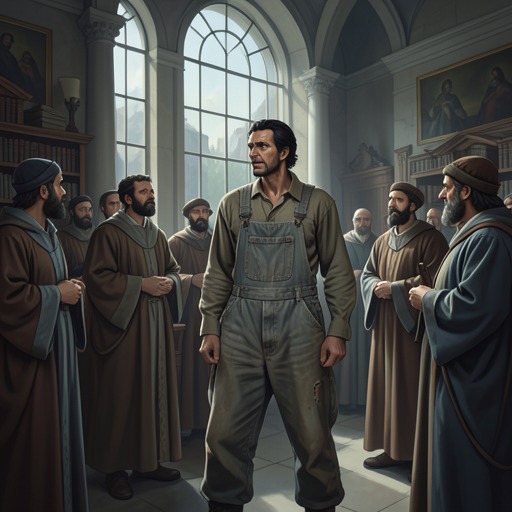
Jacobus was frank about his reservations. He had scarcely studied Castalia’s history and regarded its Order as an imitation of Christian models, one lacking religion, God, and Church as its foundation. Knecht answered respectfully that religious life and intellectual purpose were not confined to Benedictine or Roman Catholic forms, and that Castalia’s intentions and influence on the life of the mind should not be dismissed. Their exchanges began with a fundamental disagreement about whether the Glass Bead Game could sustain a spiritual life, but neither man reduced the other to that disagreement.
When Knecht returned to Mariafels on a later assignment, Jacobus greeted him warmly and himself proposed that they work together. Knecht reorganized his daily routine: instruction in the Game no longer occupied its center, and he gave up both his work in the music archives and his collaboration with the organist. Instead, Jacobus taught him historical methods, the early history of the Benedictine Order, and the sources for the early Middle Ages. They read an old chronicler in the original. Knecht asked that the young library helper Anton be allowed to join the lessons; Jacobus agreed to include him in the readings, though the most private instruction remained between teacher and pupil.
The exchange ran in both directions. Knecht introduced Jacobus to Castalia’s history and structure and to the main ideas of the Glass Bead Game. After his own lessons in epigraphy and source work, he became the teacher, while Jacobus listened closely and questioned him critically. Jacobus’s distrust did not disappear quickly, even after he had come to understand Castalia more fully. But through Knecht’s teaching and example he underwent a gradual change: he became prepared to recommend rapprochement, asked to learn the Game’s theory, and pursued its intellectual world with characteristic energy. He never became a player, in part because he was already too old to take that path, but he became one of its most serious and influential friends outside Castalia.
A School in History and Diplomacy
Knecht’s education at Mariafels changed his understanding of what historical study meant. Jacobus gave him not only research methods and practical training, but an experience of history as life and reality. Jacobus was a scholar who had also acted in the world, accepted responsibility for events of his time, and dealt with the resistance of circumstances and people rather than limiting himself to interpreting the distant past. Together with a recently deceased Jesuit associate and antagonist, he was regarded as a principal architect of the Roman Church’s renewed diplomatic and moral influence.
Knecht had arrived with little political knowledge. Castalians generally had few political rights or duties, scarcely saw newspapers, and often avoided contemporary affairs; Glass Bead Game players especially guarded the rarefied atmosphere of their scholarly and artistic pursuits. Working with Jacobus awakened Knecht politically, but as a consequence of his relationship rather than through a prior appetite for politics. At the same time, preparing to explain Castalia to Jacobus forced Knecht to read books on the Province’s constitution and history, the elite-school system, and the development of the Game. Some had been used in his student debates with Plinio Designori, while others had been inaccessible to him as a student.
That preparation exposed a weakness in his own education. Knecht found that he possessed a pale, schematic understanding of the historical conditions that had led to Castalia’s foundation. Jacobus’s questions made their lessons an animated collaboration: as Knecht tried to explain his Order, Jacobus helped him see its history in the context of the histories of nations. Their discussions could become passionate disputes, but their effects lasted beyond Mariafels and remained an influence through the end of Knecht’s life.
The monastery also became the setting for the diplomatic purpose of Knecht’s return. Castalia hoped eventually to establish a permanent embassy at the Vatican, ideally on reciprocal terms. Its leaders were prepared to accept a deferential position, even second place, rather than risk appearing to demand equality; they did not want to risk an immediate rebuff. Because Jacobus had great influence in Rome, Knecht was instructed to live again at Mariafels, continue his studies, teach an unassuming course in the Game, and slowly win Jacobus’s support. The work might take a year or several years, and he was warned against any appearance of impatience.
Jacobus eventually wrote to the Directorate of the Order, consenting to the proposed diplomatic step and asking that Knecht be allowed to remain at Mariafels longer. He described Knecht as universally popular there and noted that he was receiving a private course on Castalian affairs. The authorities commended Knecht for the mission’s success and indicated that he could return to the Vicus Lusorum after completing it. The outcome exceeded the monastery’s own relationship with Castalia: the work of Jacobus and Knecht fostered benevolent neutrality and occasional scholarly exchange, which sometimes grew into cooperation and alliance and ultimately produced a concord that the narrator describes as continuing to the present.
Departure and Continuing Significance
The personal bond between Knecht and Jacobus was as important to him as the diplomatic result. Knecht experienced himself in the relationship as pupil and teacher, recipient and giver, the one conquered and the one who had conquered, friend and collaborator. Of the relationships that had begun through his efforts, none since his successful approach to Elder Brother in the Bamboo Grove had made him feel so honored, abashed, rewarded, and intellectually stimulated. In later years he spoke often and gladly of Jacobus to his own pupils.
As Knecht prepared to leave, Jacobus tried to pass on the understanding he had gathered over a lifetime of study: how men and nations rise and fall, and what political concord between Rome and Castalia might mean. He urged Knecht to study the period when Castalia was founded alongside Rome’s recovery, recommended works on the Reformation and the sixteenth-century schism, and insisted on the importance of primary sources and manageable portions of historical study. He also warned him against philosophies of history. Their final months were marked by intense work and free-ranging conversation; Jacobus regretted losing his disciple and associate, while Knecht was grateful for what he had learned.
Knecht delayed his final return to Waldzell until the spring public Glass Bead Game. He said farewell to the Abbot and monks, leaving with sadness at the end of a stage of his life but also with anticipation of the festival. He had undertaken the prescribed meditation exercises in preparation for the Game, though he could not persuade Jacobus to attend. The separation did not undo the relationship or the changes it had set in motion. Years later, Knecht told Master Alexander that his awareness of a world beyond Castalia came chiefly through his fellow student Designori and his time among the Benedictines, especially through Jacobus. Returning from Mariafels, he found himself in a cultivated and pleasant Province that seemed to him cut off from history. Jacobus had helped him see the world as disorderly but immense, changing, and the home of human destinies; Mariafels therefore became a decisive place in his growing sympathy for life beyond Castalia.