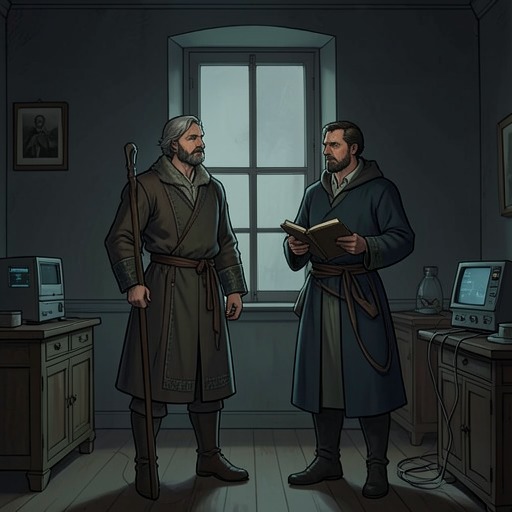
Monteport
The Glass Bead GameMonteport is a high mountain settlement whose former monastery serves as the home and teaching place of the Music Master. For Joseph Knecht, it is not simply a destination for study: it is the setting of his first deliberate meditation lessons, his admission to the Order, and a later meeting that makes the cost of institutional advancement newly visible. Across these returns, Monteport binds music and spiritual discipline to the hierarchy that Knecht enters and eventually begins to question.
Setting and Early Significance
Knecht first reaches Monteport after a two-day hike with a classmate. The Music Master lives there in a former monastery and is giving a course for conductors. The classmate stays in the guest house; Knecht is assigned a small cell in the Master’s apartment. The arrangement brings the boy close to his host’s private routine before any formal instruction begins: the Master has barely recovered from his crowded day, yet asks to spend the limited hours available to him with Knecht.
The first meeting takes place in a large vaulted cell furnished only with an old piano and two chairs. That spare room becomes the site of a deliberate beginning. The Master tells Knecht that he will soon enter a new stage of education, where he will encounter the Glass Bead Game, but insists that meditation matters more than these new studies. He plans to teach Knecht himself, for an hour each day over the next three days, using music as the subject. A glass of milk is brought in so hunger and thirst will not distract the student; the Master tells him to drink slowly and not speak. At Monteport, instruction is framed not as the rapid acquisition of ideas but as a practiced stillness.
Monteport remains one of the places to which Knecht returns during his years of free study. He sometimes stays as the Music Master’s guest and sometimes attends a musicological seminar. Alongside the Bamboo Grove and Hirsland, it belongs to the small number of settings where he can work alone or with few others, and to which he later retains a grateful attachment. Its significance is therefore both institutional and personal: a place of organized study that also holds the memory of an unusually close teacher-pupil bond.
Admission and the Music Master
When the Magister Ludi recommends that Knecht apply for admission to the Order, Knecht realizes that his free period of study is ending and that he is about to enter the hierarchy. He asks that the Music Master receive him into the Order, obtains a short furlough, and sets out for Monteport. The Master is ailing when Knecht arrives, but welcomes him with evident joy. He explains that Knecht has come just in time: he is about to resign his office, and soon would no longer have the authority to receive a younger brother.
The admission ceremony takes place the following day in the Magister’s music cell, the same room where Knecht had first been introduced to meditation. Two brothers attend as witnesses, as the statutes require. Before the ceremony, the Master gives Knecht a passage from the Order’s rules as a meditation exercise. It teaches that every step upward in office brings not greater freedom but tighter bondage, and that greater authority demands stricter service. Knecht then plays a chorale prelude by Bach; a witness reads the rules, and the Master asks the ritual questions and receives Knecht’s oath.
Afterward, the two sit in the garden. The Master advises Knecht on identifying himself with the rules and living by them, and says that Knecht’s entry into the Order as he himself departs is like having a son stand in his place. Knecht looks sad, but the Master is not: tired of office, he is looking forward to the leisure he expects to enjoy, and to sharing it with his young friend. Monteport thus witnesses a transfer of institutional responsibility, but also a contrast between the new initiate’s apprehension and the older man’s relief at laying office aside.
Return and Warning
On a later journey, Knecht visits the former Music Master at Monteport. He finds him more subdued and withdrawn, yet stronger and gayer in appearance than at their last meeting. The fatigue has left his face; he seems not younger so much as handsomer and more spiritualized. His questions focus on Mariafels: its organ, its chests of music manuscripts, its choral singing, and even whether the tree in the cloister garden still stands. He shows little curiosity about Knecht’s work, his Glass Bead Game course, or the purpose of his leave.
Before Knecht continues on, the Master offers what sounds like a jocular observation: he has heard Knecht has become something of a diplomat, an occupation he does not consider especially pleasant, though Knecht’s superiors seem satisfied with him. Then he turns the remark into a warning. If diplomacy is not Knecht’s ambition for life, he should be on his guard, because the Order may be trying to capture him for that work; Knecht has the right to defend himself. The Master refuses to explain further. Knecht carries the warning like a thorn in his flesh, so that the visit leaves behind both affection and unease.
The warning resonates with the lesson of the admission ceremony. At Monteport, the Music Master had taught that higher office means stricter service; now he suggests that the institution may be steering Knecht toward a role he has not chosen. The place’s repeated connection with the Master makes this not an abstract critique of hierarchy but counsel from the person who first prepared Knecht for it—and who, having resigned, has experienced the release that Knecht has not yet attained.
Music, Institutions, and Memory
Monteport’s role in Knecht’s life belongs to a wider contrast between education within Castalia and its encounters with other spiritual traditions. The Glass Bead Game has become, for its players, a sublime art and a form of intellectual union, drawing together fields of knowledge through a universal symbolic language. Its symbols can also incorporate Christian theology, scripture, and liturgical phrases, although the Game deliberately creates no theology of its own. In this way its practice approaches worship for its most devoted players without resting on the Church, God, or a creed.
That distinction becomes consequential in Knecht’s work with Father Jacobus at Mariafels. Jacobus initially distrusts the Castalian Order as an imitation of Christian models without a religious foundation. Knecht teaches him about Castalia and the Glass Bead Game; Jacobus, in turn, teaches Knecht history and helps him see the historical roots of his own institution more clearly. Their exchange eventually supports a more cordial relationship between Rome and Castalia, including scholarly cooperation and alliance. The argument over whether the Game can bear religious significance therefore reaches beyond Monteport, but the Music Master’s lessons there have already given Knecht a practice—meditation—that links the Game’s intellectual discipline to inward attention.
The annual solemn Glass Bead Game offers another point of contact between art and religious observance. It gathers Castalia’s different tendencies in a symbolic act of harmony: for believers it has the force of consecration, while for unbelievers it can serve as a substitute for religion. Knecht prepares for the festival through the prescribed meditations, although he cannot persuade Father Jacobus to attend. Read against these later scenes, Monteport’s small room, milk, piano, and carefully limited lessons mark the personal origin of a discipline that will acquire public and institutional meanings. The former monastery is where Knecht first learns to enter that discipline, and where the Master’s example makes its central tension tangible: service can shape and sustain a life, even as it binds the person who serves.