Order
The Glass Bead GameThe Order is the lifelong scholarly community at the heart of Castalia: a hierarchy recruited from gifted pupils, bound by austere rules, and entrusted with education and the cultivation of intellectual life. It preserves a demanding ideal of anonymous service, yet depends on the wider nation for its existence. Its central tension is therefore institutional as well as spiritual: the more completely its members withdraw into pure study, the more urgently the Order must answer for its place in the world beyond Castalia.
Identity and Structure
Castalian intellectual life prizes the subordination of individual identity to the hierarchy. The practice has been pursued so thoroughly that records of exemplary servants may no longer preserve even their original names. This anonymity is not presented simply as an administrative convenience: it is a ruling principle of the Province, intended to direct attention away from personal fame and toward the shared work of scholarship. Yet the historical account of Joseph Knecht makes an exception in order to serve truth and learning, revealing the tension between preserving the ideal and recording the people who embody it.
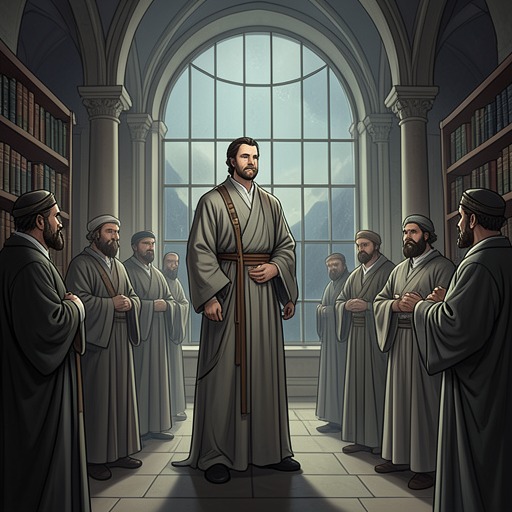
The Order is recruited through Castalia’s elite schools. Exceptional pupils are selected by teachers rather than admitted through examinations; a child must choose the path, and both parents must give unqualified consent before probationary admission. Those who complete the schools’ advanced courses, generally between the ages of twenty-two and twenty-five, enter the Order. From this scholarly body come public-school teachers, academic officers, the twelve Masters, and the director of the Glass Bead Game. Members who leave Castalia to teach remain in the Order for life unless they resign, and so continue to stand apart from ordinary professional society.
This is a system of privilege deliberately yoked to renunciation. Members are forbidden the ordinary pursuit of professional careers, property, titles, and material advancement; the Order’s rules also require poverty and bachelorhood. It supplies modest food, clothing, and shelter, alongside libraries, collections, laboratories, and freedom for study. Those who want wealth, family life, or public honors can return to the outside world, but the scholarly community itself excludes them from competition for such rewards. The people’s half-mocking, half-respectful name for its members is “the mandarins.”
Work, Service, and the Glass Bead Game
The Order’s place in society rests on the belief that intellectual discipline is not a luxury detached from practical life. After earlier generations’ laxity had damaged competence in professions including technology, responsibility for education and aspects of public intellectual life passed increasingly to anonymous scholarly Orders. Their authority survives public complaints about strictness and reputed arrogance because their renunciation of worldly benefits lends credibility to their leadership. The account makes the stakes concrete: if intellectual honesty and disciplined thought fail, the workings of engineering, commerce, and technology may also lose their reliability.
Within this institutional mission, the Glass Bead Game is both the Order’s most distinctive achievement and its most vulnerable possession. It grew from a specialized intellectual pastime into a synthesis of the arts and sciences, a sublime cult that partly assumed the roles of art and speculative philosophy. Its symbolic language could incorporate mathematical axioms, musical forms, and Christian theological passages without establishing a theology of its own. For genuine players, the Game approached worship; its annual solemn performance could act for believers as a consecration, and for others as a substitute for religion. This spiritual charge draws the Order toward religious forms even as Castalia lacks the Church and God that ground Christian institutions.
That resemblance is also a source of conflict. Father Jacobus initially regarded the Castalian Order as an imitation of Christian models without their religious foundation, and he doubted that the Game could become more than a game. Knecht answered by explaining Castalia and the Game, while learning from Jacobus’s historical knowledge. Their reciprocal instruction helped shift Jacobus’s view: he came to recognize the Game as a key to the Order’s inner life, though he never became a player. Their work contributed to benevolent neutrality, scholarly exchange, and eventual concord between Castalia and Rome. The episode shows the Order neither simply replacing religion nor standing wholly apart from it: its practices invite theological comparison, while relations with the older religious institution remain consequential and contested.
Privilege, Obligation, and Historical Blindness
The Order’s austere life is meant to repay the nation for the resources that make Castalian study possible. Yet the privileges of the scholarly caste create a danger of moral self-satisfaction: poverty can become a source of pride even when it is only the least members owe to the society that supports them. In his analysis of the Order’s purpose, Knecht argues that many Castalians cultivate scholarship for its own sake without feeling like brothers of, or responsible to, people outside the Province. The exception he emphasizes is the teacher serving in the country, whose work directly repays the nation for Castalia’s support.
Knecht’s historical study exposes how far the relationship has weakened. The Federal Council still consults the Board of Educators on cultural and pedagogical matters, and Castalia still supplies teachers, but these connections have become routine and mechanical. Fewer young Castalians volunteer for teaching beyond the Province, while people and authorities outside it seek Castalian counsel less often than they once did. Rather than converging, the cultural levels of Castalia and the wider country are moving apart. To outsiders, the Province increasingly resembles a precious but dispensable antique, not a necessary part of active life.
This estrangement is sharpened by Castalia’s limited respect for world history. Many inhabitants regard history as a record of contests for power, land, goods, and money, and therefore as belonging to a contemptible material realm. Knecht warns that this outlook conceals the conditions on which Castalian life depends. The Order may possess libraries, schools, and archives, but none of these resources is self-sustaining: the country feeds and clothes its members and underwrites their education. War, impoverishment, or a change in public will could end their studies at once. A society that once took pride in Castalia might instead regard it as an unaffordable luxury or a parasite.
Authority and Crisis
Knecht identifies the Glass Bead Game as the most precious and least utilitarian element of the Order’s inheritance, and therefore the first likely casualty in a national emergency. Other disciplines have uses recognizable outside the Province; mathematics, for instance, can help devise firearms. To outsiders, abolishing the Game and closing the players’ village might seem to cost the country nothing. The Game’s cultural and spiritual importance does not protect it from this judgment. Its fragility makes the director of the discipline especially likely to sense danger, but it also shows why the Order cannot secure its future through inward devotion alone.
The conflict becomes personal when Knecht asks the Board to release him from his office and transfer him to a secular school system. The Board refuses. It argues that allowing members to assess their own aptitudes and choose their positions would undermine the hierarchy and Castalia itself, and directs him to continue administering the office entrusted to him. The reply recognizes the admonitory value of his circular letter but treats his petition as formally improper and his claimed incapacity as a cause for concern. Thus the Order’s commitment to assigned service meets a member’s attempt to answer the same public responsibilities by leaving his post.
The Order’s governing principles remain powerful precisely because they combine genuine intellectual discipline with genuine dependence. Its anonymous hierarchy, lifelong obligations, and freedom for scholarship protect a culture that the surrounding society values as a foundation of civilization. But the structure can also encourage class distance, underestimate history, and mistake seclusion for self-sufficiency. Its survival rests not only on obedience within Castalia but on whether its learning continues to serve the world that sustains it.