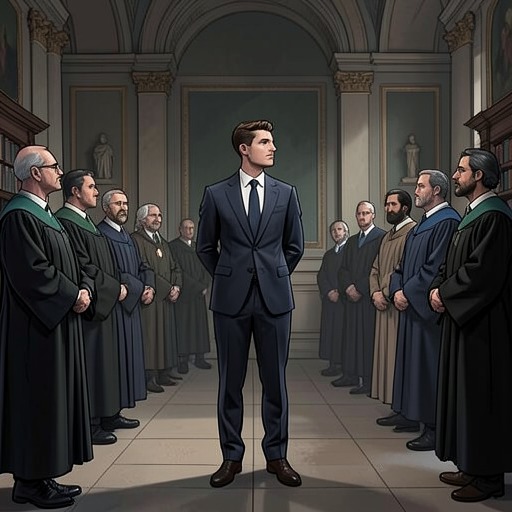
Relationship between Plinio Designori and Veraguth
The Glass Bead GamePlinio Designori’s relationship with Veraguth transforms youthful political disaffection into a new allegiance, giving him a cause and a place in the world beyond his father’s conservative household. Yet the bond does not resolve his uncertainties: even after becoming Veraguth’s disciple, close associate, and son-in-law, Designori comes to wonder whether conviction or personal fascination first drew him in.
First Encounter and Political Conversion
As a student, Designori was disappointed with university and had lost confidence in the morality associated with Castalia. He was looking for a sustaining ideal when Veraguth, a publicist and deputy who led the youthful left wing of an old middle-class liberal party, began speaking to students in university towns. Veraguth’s emotional populism, libertarian outlook, and forceful oratory found an eager audience in Designori.
The attraction was at once political and personal. Designori admired Veraguth’s passion, wit, fighting spirit, eloquence, good looks, and fine speech. He joined a faction of students converted by the lectures and working for Veraguth’s party and aims. Veraguth thus offered more than a platform: his example made political engagement appear to answer Designori’s need for a new idealism and direction.
Allegiance and Its Rewards
After completing his studies, Designori became Veraguth’s disciple, assistant, and intimate associate; a few years later he married Veraguth’s daughter. Veraguth became his teacher, leader, and older friend, and seemed both to appreciate Designori and to need him. In this relationship, Designori gained political convictions and party membership, work and a mission, and a sense of faith in justice and progress.
That new attachment was bound up with a rupture elsewhere. Designori’s opposition to his father’s political world permanently damaged his former intimacy with the family home. He accepted the loss of his old position among family and peers and, to some extent, met the hostility of his privileged background with a sense of martyrdom. The account presents the Veraguth alliance as a source of purpose, but one secured at considerable personal cost.
Doubt About Veraguth and Himself
Designori’s commitment endured, but its meaning changed. As his youthful political fervor subsided and professional experience sobered him, he began to question the beliefs and work to which he had remained loyal. In particular, he wondered whether Veraguth had persuaded him through truth and justice, or whether he had been at least partly seduced by the leader’s talent as a speaker, his charm and quick wit in public, his resonant voice and virile laughter, and the intelligence and beauty of his daughter.
This doubt reaches beyond the origins of a political alliance. Designori becomes uncertain about the absolute distinction between right and wrong, and wonders whether conscience is the only reliable judge. His own unease—his lack of confidence, calm, and security—makes it harder for him to treat his earlier certainty as proof that he chose rightly. The relationship with Veraguth remains part of the life he affirms, but also part of the life he examines with growing suspicion.
An Unsettled Legacy
The narrative does not describe Designori breaking with Veraguth: he remains loyal to the party and its leader even as he doubts the motives that brought him into their circle. Nor does it present his marriage as simply a mistake. Instead, the bond and the life built around it remain meaningful but complicated, unable to provide the tranquility and innocence he misses. Veraguth’s importance therefore lies in this double role: he gives Designori a political vocation and personal belonging, while the charisma that helped secure that allegiance becomes a reason to question it.