Relationship between Plinio Designori and his father
The Glass Bead GamePlinio Designori’s relationship with his father is shaped by a conflict between inherited class loyalty and a son’s search for political conviction. When Plinio joins Veraguth’s modernizing party, his father treats the choice as a betrayal of family tradition; their rupture is never repaired, and Plinio’s later doubts do not undo the grief attached to it.
Family and Political Background
Plinio’s father belongs to a conservative, pro-government family tradition. Though not himself a political leader, he opposes innovation and the effort of tenant farmers to secure better conditions, and distrusts people without established name or rank. He is friendly toward the Church and capable of justice, charity, and helpfulness, but his conduct is governed by loyalty to his class and family inheritance. Chivalric honor accompanies his attachment to the old order, as does contempt for what he considers modern or progressive.
That background makes Plinio’s political choice more than a disagreement over party. While still a student, Plinio joins the oppositional, modernizing faction associated with Veraguth, a publicist, deputy, and forceful speaker. Disappointed with university and seeking an ideal to replace the Castalian morality that had lost its hold on him, Plinio is drawn to Veraguth’s rhetoric of justice and humanity. His father sees the decision through the obligations of family and rank; Plinio sees it as an exercise of judgment that those obligations cannot rightfully dictate.
The Quarrel and Its Break
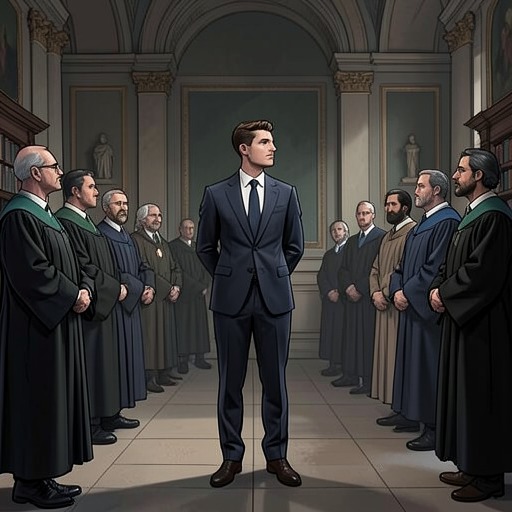
On learning of his son’s involvement, Plinio’s father travels to the university town and confronts him in a rage. For the first time, he shouts at Plinio, accusing him of conspiracy and betrayal of his father, family, and ancestral traditions. He orders his son to sever his ties with Veraguth and the party. The confrontation turns Plinio’s political dissent into a direct test of filial authority.
Plinio refuses. He argues that years of elite schooling and university study have not been undertaken so that he can surrender his power of judgment. He will not accept, he says, that a self-interested group of landowners should prescribe his positions on government, economics, and justice. Veraguth’s example has helped shape the language of Plinio’s reply: the political case is presented not as a defense of his own class interest but as a claim to justice and humanity.
His father answers with bitter laughter, telling Plinio to finish his studies before presuming to judge human life and justice more wisely than generations of noble families. The quarrel grows increasingly insulting, until the father suddenly falls silent, apparently confronted by shame at his own rage. He leaves without restoring the intimacy between them. The scene closes not in reconciliation but in a silence that marks the lasting change in their relationship.
The Long Consequences
The old warmth between Plinio and his paternal home never returns. He stays loyal to his political faction and, after completing his studies, becomes Veraguth’s disciple, assistant, and close associate; several years later he marries Veraguth’s daughter. His break with his father thus accompanies the formation of a new political and personal affiliation. That affiliation gives him a sense of faith, direction, work, and purpose, but it also places him in a complicated position after his earlier estrangement from the world and difficulties readjusting to life outside Castalian education.
The cost is not simply a loss of place among his father’s family and peers. Plinio is troubled by the belief that his defiance hurt his beloved mother, caught her between father and son, and may even have shortened her life. She dies soon after his marriage. Afterward Plinio scarcely visits his home; when his father dies, he sells the ancient family seat. The physical inheritance is disposed of, while the emotional rupture has already endured through the deaths and absences that follow the original quarrel.
Meaning of the Relationship
The father-son conflict gives political dissent a concrete social location: Plinio’s opposition arises from within a privileged family whose traditions he rejects, not from a position outside its history. His father’s appeals to inherited honor and established authority stand against Plinio’s insistence that education must leave room for independent judgment and a fairer order. Neither position is detached from social interests: the father’s language of tradition protects a class order, while Plinio’s new idealism offers him both a public cause and a way to establish a life after his Castalian formation.
Yet the break does not produce uncomplicated liberation. Plinio remains committed to Veraguth and his politics, but later begins to doubt the convictions, work, marriage, and idealism bound up with that commitment. His recollection of the family rupture retains a different kind of uncertainty: he continues to carry the sense that his choice injured his mother. The relationship therefore links political independence to intimate loss, showing how the refusal of inherited authority can establish a new direction without erasing the suffering incurred at home.