The Night of Falling Stars
The Glass Bead GameThe Night of Falling Stars is the extraordinary celestial event that transforms Joseph Knecht’s responsibility as Rainmaker into a personal ordeal. When an immense shower of unfamiliar lights appears to tear through the sky, he alone among the villagers recognizes that the old stars have not fallen. Yet explanation cannot quiet the panic. Knecht uses ritual to give collective terror a form, and the villagers emerge from the night believing that their prayers have helped restore order. For him, the spectacle remains not a danger safely past but an omen of the sacrifice that will eventually claim his life.
Signs Before the Catastrophe
Knecht’s knowledge of the heavens has been formed through a practical and sacred apprenticeship. The heart of the Rainmaker’s inherited learning is the moon: its phases and effects, and the belief that it receives the souls of the dead and sends them onward into new births. Knecht has learned to read the skies not as distant decoration but as a field of relationships connecting human life, nature, and death. His office gives this knowledge communal force: each spring he determines the proper time for sowing by considering the moon, using both inherited rules and his own experience.
The Rainmaker’s standing is important but not absolute. He serves the community on particular occasions and is especially called upon when drought or prolonged wet and cold threatens the crops. In ordinary years, however, the ceremonial opening of the sowing season belongs to the tribal mother, not to him. The tradition also preserves a more severe possibility: if every remedy fails during an unyielding drought or rain, the community may sacrifice its Weathermaker. The Night of Falling Stars arrives within this world of shared offices, seasonal rites, and feared obligations, foreshadowing the custom that will later become Knecht’s fate.
In the autumn, after the equinox that Knecht habitually observes with special solemnity, the signs begin to feel wrong. The evening sky is clear except for high clouds that retain the sunset’s rosy light unusually long. For several days Knecht has sensed an unsettled expectancy in the natural world, but he does not know what it means and warns no one. When the clouds’ light vanishes, the stars appear quickly and shine with exceptional brilliance. Knecht watches them from his garden, unable to recover his customary composure beneath their gaze.
The Falling Stars
As Ada sings softly inside the hut to quiet a child, points of light begin flickering through the starry sky. A few streak down and disappear; then dozens and hundreds follow, and finally a countless host streams silently toward the wooded mountains to the southeast. The display lasts for hours. Its scale makes the familiar heavens seem to be coming apart, as if the stars were being torn loose and cast away.
Knecht initially shares the horror of the other witnesses, but he sees a distinction they cannot. The familiar stars remain scattered across the sky; the falling lights are new, transient, and different from the old constellations. This recognition steadies him without removing the sense of disaster. Cries and groans rise from the huts as the spectacle wakes the village, and panic spreads. Knecht understands that the event falls especially heavily upon him: as Rainmaker, he has been expected to anticipate catastrophes and place his knowledge and courage between the community and fear. This time he has foreseen nothing clearly enough to prepare them.
He first tries to meet the crisis by explaining what he has observed and urging people toward reasoned attention. The attempt fails. At the tribal mother’s hut, half the village is already gathered in a state of terror; some villagers are rigid with shock, while others move wildly, and one woman pulls at her hair as she dances. The elderly tribal mother believes that the end has come. Knecht persuades her to help lead the people, but he recognizes that few will be able to listen to an explanation before the panic overwhelms them.
Ritual Gives Fear a Form
Knecht changes his approach. Rather than attempting to disprove the villagers’ terror, he directs it into the familiar form of a public rite. He steps before the crowd and calls out the prayers used to open ceremonies of mourning and penance. Clapping in rhythm, he bows and straightens, repeating the movements until others begin to join him. The tribal mother follows with small ritual bows, and villagers arriving from their huts take up the beat and the words. Those already overcome by panic either collapse or become absorbed into the ceremony.
The transformation does not make the falling lights disappear. It changes the villagers’ relation to what they are seeing. Instead of remaining a disorganized crowd, they become a congregation able to express fear within a common pattern. The rite’s regular movement and rhythm establish a sense of community precisely when the heavens appear to offer no order. For another two hours, the sky continues to shed lights, but the village’s terror gives way to submission, prayer, and penitence. By the time the display begins to abate, the exhausted participants feel that their worship has placated the powers and restored the balance above them.
The event is remembered in the village through the autumn and winter. At first people speak of it in frightened whispers; later they recount it more comfortably, comparing their experiences and recalling how the community endured an extraordinary danger. The villagers’ recollections settle into the familiar shape of a disaster faced and overcome. That communal account differs from Knecht’s: he does not take the rite’s immediate consoling effect as proof that the omen has been exhausted.
Omen and Aftermath
For Knecht, the falling lights remain a warning whose meaning grows rather than fades with time. He believes that the sign concerns him more directly than anyone else, because his office binds him to the realm from which it came. He had felt an obscure foreboding, yet failed to understand it or tell the village. Instead of treating that failure as the end of the matter, he resolves to stay alert, meet the danger courageously, and accept it without allowing it to dishonor him. He has not yet identified the precise form the danger will take, but comes to think that it will chiefly be his to bear.
Knecht does not wake his son and apprentice, Turu, to watch the spectacle. He later believes he was right to spare the boy: the first sight did not seem to signal an immediate threat to the villagers, and Knecht fears the larger danger will require a mature person to face it. Turu, however, is unhappy that he slept through something so extraordinary. Knecht responds to the resentment with greater attentiveness and affection, draws his son more fully into the work of the office, and makes his training more complete. Although he speaks little with Turu about the event, he gives him increasing access to his practices, knowledge, and investigations.
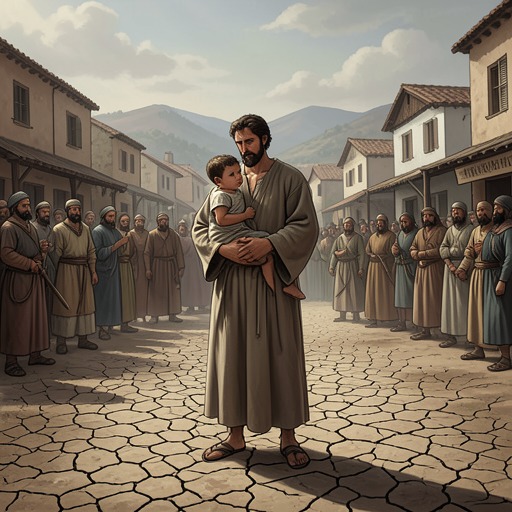
When a later year brings failed harvests, severe drought, and despair in the village, Knecht tells Turu that the crisis began with the falling stars and may cost him his life. He instructs his son to assume the Rainmaker’s office if he is sacrificed and to protect the community’s seed grain. As the villagers turn against him and the old remedies prove ineffective, Knecht offers himself for sacrifice and presents Turu as his successor. At the ceremony, he explains that he has done his work as well as he could, that his efforts now fail, and that his death is meant to placate the demons. The later sacrifice gives the earlier spectacle its terrible retrospective significance: what the village could remember as a peril overcome, Knecht had carried as a personal summons toward death.
Narrative Significance
The event is a turning point in the Rainmaker’s arc because it separates outward communal reassurance from Knecht’s private interpretation. The rite succeeds in organizing terror and helping the villagers recover, but it does not resolve the question that occupies him. The same night can therefore hold two kinds of aftermath: a community’s memory of collective endurance and an individual’s growing conviction that a sacrifice remains to come.
The scene also makes the Rainmaker’s authority practical rather than merely prophetic. Knecht cannot prevent the spectacle or persuade the village to understand it as he does. His effective action is to recognize what reason can no longer accomplish and to place fear within a shared ceremonial order. The stars remain beyond explanation; the ritual gives the people a way to endure their sight. Knecht’s response thus joins his inherited celestial knowledge to a different kind of service, one measured not by forecasting the catastrophe but by leading the community through it.