The friendship between Joseph Knecht and Fritz Tegularius
The Glass Bead GameJoseph Knecht’s friendship with Fritz Tegularius joins genuine concern to deliberate reserve. As Knecht prepares to leave his post and Castalia, he weighs how that decision will affect a friend prone to jealousy and emotional upheaval. He eventually brings Tegularius into the plan, gives him work that makes the separation easier to bear, and, when departure comes, chooses to visit him rather than slip away without a farewell.
A Friendship Carefully Directed
Knecht had shaped his friendships with kindness and consideration, but also kept an independent view of them and guided their course. When Plinio Designori returned to his life, Tegularius faced a rival for Knecht’s attention and emotional attachment. He responded with signs of violent jealousy. For a time, while Knecht was rebuilding his connection with Plinio, Tegularius’s sulky withdrawal offered a measure of relief. Yet Knecht could not treat that withdrawal as a solution: leaving Waldzell would mean being lost to Tegularius forever, and taking his friend along on the narrow, perilous path ahead was unthinkable, even if Tegularius had wanted to come.
Knecht therefore waited a long time before revealing his departure plan. His hesitation did not mean that he intended to keep Tegularius permanently in the dark. Once the decision to leave was settled, he judged that it would be unlike him to prepare, behind his friend’s back, steps whose consequences would affect him deeply. If possible, Knecht wanted Tegularius to become an initiate in the plan and perhaps an aide: having something to do, he believed, could make the situation more bearable.
A Part in the Departure Plan
Knecht connected his news to ideas he had already shared with Tegularius about the danger threatening the Castalian organization. Contrary to Knecht’s expectations, Tegularius did not regard the prospect of his friend’s resignation as a tragedy. The notion of a Magister casting aside his office, leaving Castalia, and seeking a life better suited to his tastes amused him. Tegularius’s individualism and opposition to standardization made him instinctively sympathetic to an individual challenging authority, especially when the challenge promised a chance to taunt or outwit officialdom.
Seeing this reaction, Knecht let Tegularius view the plan as a kind of coup against bureaucracy. He made him an accomplice and collaborator, entrusting him chiefly with preparing a petition to the Board that would set out the reasons for Knecht’s resignation. Tegularius was to study Knecht’s historical account of Castalia’s origins, development, and present condition, then collect historical material to document the case. History was a field he had previously rejected and scorned, but the assignment did not deter him. Knecht quickly taught him the necessary procedures, and Tegularius applied his characteristic eagerness and tenacity to the solitary project. He relished the chance to use historical study to confront the hierarchy with its shortcomings.
The work served Tegularius, but Knecht did not mistake it for the mechanism that would secure his release. He had little faith in rational arguments against the Board and knew that Tegularius could not do the real work of making his departure possible. Knecht expected the petition to fail: in his view, a Board willing to release its Magister Ludi in response to a persuasive appeal would itself be a hierarchy he could accept, and Master Alexander was not a man who could be bent. He told Plinio that the petition might at most bring a mild reprimand. Its practical value lay instead in keeping Tegularius occupied and helping him bear the change in their friendship. Knecht also used the time to arrange his departure so it would cause no harm to Waldzell.
The Farewell at Waldzell
When departure was imminent, Knecht decided that Tegularius should not be told in advance that he was leaving indefinitely. He wished to spare his oversensitive friend an agonizing period of anticipation and to protect the plan from being endangered by an abrupt disclosure or an emotional scene. For a while, he considered leaving without seeing Tegularius at all. But he recognized that doing so would amount to avoiding a difficult encounter and making matters too easy for himself. Though sparing his friend agitation remained important, Knecht believed he had no right to evade the farewell.
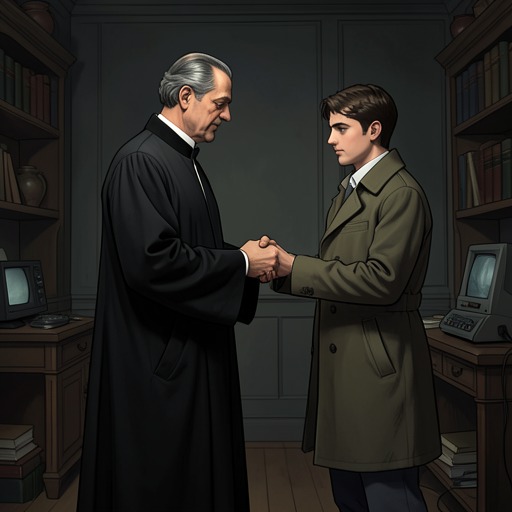
That evening, after night had settled over Waldzell’s broad inner courtyard, Knecht crossed to Tegularius’s cell. The two were alone. Tegularius, pleased by the visit, put aside his book and invited Knecht to sit. Knecht began casually by mentioning a poem and asking where its remaining lines could be found. Tegularius recognized it, retrieved from his desk drawer the manuscript of Knecht’s poems that Knecht had once given him, and found two sheets containing the poem’s first draft. Their exchange placed an old gift and a shared literary memory at the threshold of separation: instead of ending the friendship through an unexplained disappearance, Knecht came to his friend in person.
Affection, Reserve, and Separation
The friendship’s defining tension is that Knecht’s affection does not erase his independence. He takes Tegularius’s jealousy seriously, considers the distress his departure may cause, and gives him a meaningful task; at the same time, he does not invite him onto the path he has chosen or pretend that the petition can change the outcome. The assignment lets Tegularius act without making him responsible for Knecht’s decision. In this way, Knecht’s practical care protects his friend while preserving the boundary between their different temperaments and futures.
The final visit completes this pattern. Knecht had planned to minimize the emotional disturbance of parting, but refuses to turn discretion into evasion. His approach to Tegularius is therefore neither an unguarded confession nor a clean break: it is a measured act of regard, shaped by the knowledge that the friendship cannot accompany him beyond Waldzell. The remembered poem manuscript gives that goodbye a concrete bond to hold onto, even as Knecht prepares to leave.