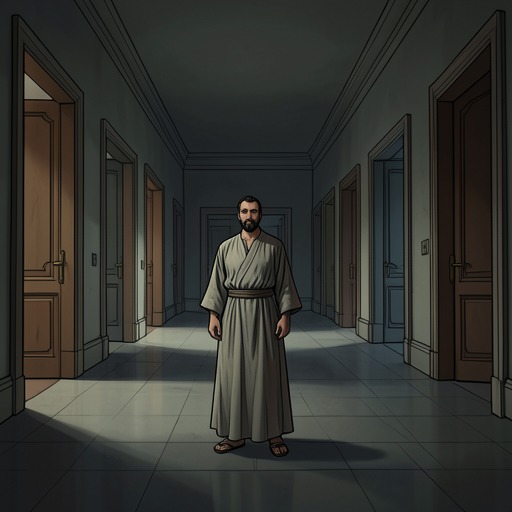
Transcending and the stages of life
The Glass Bead GameTranscending and the stages of life is Joseph Knecht’s principle that a life should move through distinct forms of service and understanding rather than cling to any one identity or achievement. Each stage deserves complete attention, but its ending brings the need for departure and a new beginning; the principle joins his personal development to the recurring image of life as movement from one theme to another.
A life understood as successive stages
Knecht explains the idea while accounting for the path that has led him away from Waldzell and toward leaving Castalia. “Transcend” had become a formative word for him during his student years, under the influence of an Enlightenment philosopher and Master Thomas von der Trave. It was at once an impetus, a consolation, and a promise: life could continue through successive areas of experience, without treating any one of them as final.
His image for this progression is musical. A life should pass from theme to theme and tempo to tempo, completing each movement before leaving it behind. The point is not to skim over experience in restless pursuit of novelty. Knecht stresses completion: each stage is to be played out to its end. Yet completion also means relinquishment. A period carries within itself, as it nears its close, both a note of fading and an eagerness for death; this ending opens the possibility of transition, awakening, and a fresh beginning.
The idea gives Knecht a language for interpreting his own changes of direction. He identifies his commitment to the Glass Bead Game as one important stage, and his acceptance of an assignment within the hierarchy as another. Later, the office of Magister Ludi becomes a further period of development rather than the permanent culmination of his life. His account makes the changes intelligible as movements within a continuing process, not as proof that earlier commitments were meaningless.
Awakening, service, and education
Knecht’s understanding of stages is closely tied to his experiences of awakening. He says that these experiences showed him that life contains distinct periods and areas; as one approaches its end, it can bring both the recognition that it is fading and an impulse toward what comes next. In this pattern, an ending is not merely loss. It can make room for a new way of seeing and a new beginning.
His service in office taught him that music and the Glass Bead Game were not the only activities capable of giving happiness. Teaching and education could be equally exhilarating. Over time, he found that his pleasure in teaching increased as his pupils were younger and less spoiled by miseducation. He came to imagine that he would most like to teach elementary-school children, although this desire lay outside the duties of his position. The shift extends his idea of transcendence beyond movement among intellectual disciplines: it also involves discovering a different kind of work and a different scale of human responsibility.
This account unsettles Master Alexander, who observes that Knecht describes his life through subjective experiences, wishes, developments, and decisions rather than primarily through institutional duties. Knecht answers that the conversation concerns his path as an individual, not an evaluation of his office. The distinction is crucial to the concept: an official position can be served conscientiously without exhausting the person’s development or dictating every future stage.
The poem “Stages” and the work of parting
The poem “Stages” gives the principle a compact, recurring form. It compares human life to flowers that fade and youth that passes, and extends the same impermanence to virtues and to the grasp of truth. What has blossomed in one period may not last forever. Because life can summon a person at any age, the heart must be ready for parting and new endeavor, seeking new light that old ties cannot provide.
The poem calls beginnings a source of protection and help, but it does not present change as effortless. A home made by habit can become a place of indolence; familiar permanence can turn people into its slaves. Parting is therefore a discipline as well as a consequence of change. Even death is figured as a possible summons onward, and the poem ends by making farewell an unceasing readiness rather than a single, completed act.
That ending sharpens the tension in Knecht’s account. He wants each stage to be lived fully, yet warns against mistaking fullness for permanence. A completed life-area must be released, not preserved as a possession. The poem’s repeated readiness for leave-taking makes this principle less a doctrine of career advancement than a demanding practice of attention, completion, and letting go.
Imagined lives and the loosening of identity
A related exercise appears in the education of young students who have not yet entered the Order. Each year they are required to compose a “Life”: a fictitious autobiography set in a period of the writer’s choosing. The student imagines living amid another era’s surroundings, culture, and intellectual climate, sometimes writing in the language and style associated with that historical setting. Knecht’s three “Lives” were official assignments of this kind, unlike the poems he had written at Waldzell, which were unofficial.
The exercise preserves, in playful form, an ancient Asian teaching about reincarnation and the transmigration of souls. Castalian students do not have to accept reincarnation as literal doctrine. Instead, the imagined prior existence becomes an exercise in placing oneself under different conditions and in approaching past cultures through historical and stylistic study. In writing, students learn to regard the present self as a mask: a temporary form rather than an identity that must remain fixed.
The “Lives” thus echo the larger principle of stages. To imagine having been someone else in another time is to loosen the claim that one’s present circumstances are permanent or exhaustive. The exercise also gives young people a legitimate channel for creative impulse in a culture where serious literary creation has long been discouraged and scholarship and the Glass Bead Game have partly taken its place. Some students even invest their fictional biographies with wishful self-portraits, writing themselves as the people they hope to become. That possibility complicates the exercise: it can open the imagination to other lives, but it can also reveal desire for an ideal self.
Endings, renewal, and the limits of permanence
Across Knecht’s account, the poem, and the student exercise, change depends on a double movement: inhabiting a form and recognizing its limits. A stage cannot be transcended without first being lived; yet remaining in it after its time has passed risks turning achievement and habit into confinement. Knecht’s musical image captures both obligations, since a theme must reach its end before the music can move on.
The concept also resists a simple equation between upward movement and freedom. Knecht’s successive stages include study, participation in the Glass Bead Game, hierarchical service, and the discovery of teaching as a source of happiness. His imagined wish to teach younger pupils does not fit neatly within his formal office, and his account of personal development cannot be reduced to institutional performance. Transcending therefore means becoming answerable to new forms of work and experience, not merely climbing within an established order.
“Stages” leaves the movement open-ended: the heart must bid farewell without end. This does not erase attachment or make every departure easy. Rather, it frames readiness for change as a lifelong task. The principle’s significance lies in joining fidelity to impermanence: a person can commit fully to a vocation, period, or form of knowledge while remaining prepared to leave it when it has reached its end.