Universitas Litterarum
The Glass Bead GameUniversitas Litterarum names the ideal of a unified intellectual world: not a storehouse of learning assembled for its own sake, but an active relationship among disciplines that prevents any one of them from mistaking itself for the whole. In the Glass Bead Game, this ideal becomes a language and a practice. Its promise is synthesis; its difficulty is that no formula can compel the wider world to desire synthesis, or make a private association into a universally shared sign.
Meaning and Intellectual Inheritance
The ideal has no single historical beginning. The narrator traces its anticipations across markedly different cultures and periods: Pythagorean thought, late classical Gnostic circles, ancient Chinese culture, Arabic-Moorish high culture, Scholasticism, Humanism, the academies of seventeenth- and eighteenth-century mathematicians, and the Romantic philosophies and visions of Novalis. This genealogy describes a recurring aspiration rather than a continuous institution: whenever thought tries to grasp its full range, the dream of universality reappears.
The ideal is also associated with attempts to overcome divisions between intellectual practices. Platonic academies, leagues of intellectual elites, rapprochements between exact and liberal disciplines, and efforts to reconcile science with art or religion are all presented as expressions of the same underlying movement. Abelard, Leibniz, and Hegel are named as thinkers familiar with the dream of gathering the intellectual universe into concentric systems, while joining the beauty of thought and art to the expressive power of the exact sciences. The historical examples matter because universality is not the property of one discipline: it is the desired relation among distinct kinds of knowledge.
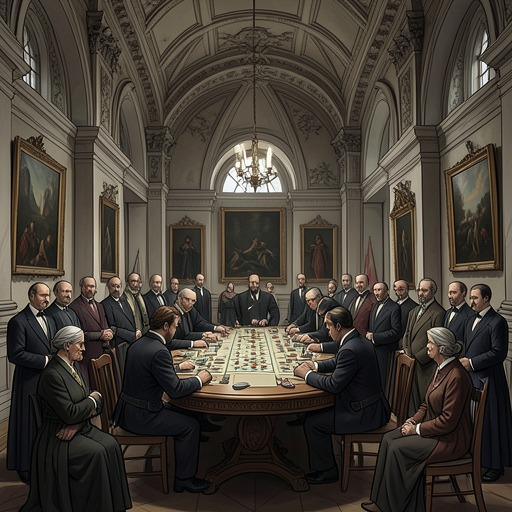
The Glass Bead Game gives that old aspiration a particularly elaborate form. Its rules, signs, and grammar constitute a highly developed language drawing especially on mathematics and music, yet capable of establishing relations among the content and conclusions of nearly all scholarly disciplines. The Game treats the inherited achievements of culture as material for intellectual play, much as a painter works with colors. Its imagined instrument ranges across an intellectual cosmos, with fixed manuals and stops but almost inexhaustible possibilities of combination. A shared structure makes communication possible; the distinctive minds and moods of players make each game take its own course.
The Game as a Practice of Universality
The Game’s history illustrates how a universal language can emerge from a particular need. Intellectuals came to feel that withdrawal into separate specialties was inadequate; scholars sought philosophy and synthesis, and some imagined a new symbolic alphabet through which complex intellectual experience could be exchanged. In an essay called “Chinese Warning Cry,” a Parisian scholar of Chinese philology warned that culture risked danger if it failed to develop an international language of symbols. He held up ancient Chinese script as an example of a medium capable of expressing complex matters graphically while leaving room for individual imagination.
Lusor Basiliensis responded to this problem by devising principles for a symbolic and formulaic language for the Game. Mathematics and music played equal parts in the new system, making it possible to combine astronomical and musical formulas and bring mathematics and music to a common denominator. His work was not a finished universal system, but it laid foundations for later development. The ideal therefore takes shape through invention and revision: universality is pursued by building means of translation between fields, not by pretending that their differences never existed.
The Game’s language also draws on Christian materials. A principle of the Creed, a biblical passage, a phrase from a Church Father, or words from the Latin Mass could enter the same symbolic practice as a geometrical axiom or a melody by Mozart. For devoted players the Game could be virtually equivalent to worship, even though it deliberately developed no theology of its own. Its religious reach rests in the act of joining forms of thought, rather than in establishing a separate doctrine.
That joining depends on trained interpretation. The Game’s rules cannot be reduced to a textbook: learning them requires a long prescribed course, and changes to its symbolic vocabulary are subject to stringent control. The World Commission of the Magisters decides whether new symbols and formulas enter the established stock, whether rules should change, and whether new fields should be included. National commissions and their archives preserve accepted symbols and interpretations. The system is thus neither an unrestricted private code nor a spontaneous universal language; it is a disciplined, collective practice whose intelligibility depends on education, shared conventions, and institutional guardianship.
From Intellectual Mosaic to Contemplation
The Game’s purpose also changes over time. At first, it arranges and confronts concentrated concepts from different fields in a rapid intellectual sequence—a virtuoso passage through the realms of the mind. But displays of memory by players with few other virtues could dazzle and disconcert their audiences. In response, such virtuosity came under increasing restriction, and contemplation entered the Game as an essential element. Players were required to meditate silently and formally after each symbol presented by the director; for audiences, contemplation eventually became the central experience.
This development makes universality more than the ability to connect a large number of ideas. The Game’s symbols and formulas are understood as striving, through their structural, musical, and philosophical combination, toward perfection and pure being. Players use the word “realizing” for this movement from potentiality to reality, or from Becoming to Being. The ideal is not simply to display the breadth of knowledge but to bring diverse forms into an apprehended unity.
That aspiration has consequences for the players’ understanding of their work. Their Games offer an elite and symbolic path toward perfection, nourished by the sciences and arts and oriented toward a Mind that is one beyond images and multiplicities. Yet the Game does not claim to settle this religious horizon through its own theology. Its characteristic gesture is integrative and contemplative: it brings heterogeneous materials into relation, then asks participants to attend inwardly to what that relation might mean.
Castalia’s Mission and Its Limits
For the Glass Bead Game players, Universitas Litterarum is an obligation as well as an ideal. When Joseph Knecht addresses trainees in a course for teachers of beginners, he describes the Glass Bead Game as the special sanctuary and mystery of the Players’ Village, a small republic within Castalia. Castalian institutes should pursue command of their subjects, he argues, while keeping those subjects vital and flexible by recognizing their ties to other disciplines and maintaining amicable relations with them. The second obligation—awareness of the inner unity of cultural effort—is the ideal that the Game expresses most fully.
Knecht accordingly rejects specialization as a permanent principle for Game players. Scholars in other fields may temporarily immerse themselves in a specialty, but the players must not endorse or practice the self-sufficiency of disciplines. Their task is to preserve universality and to save the separate fields from the tendency to close themselves off. That rescue cannot be imposed by making the Game an official subject in lower schools, or by appealing to what earlier players intended. It must be demonstrated: the Game has to incorporate new scholarly achievements, approaches, and problems, and remain fresh and persuasive enough to attract even the most diligent specialist.
The speech also identifies the ideal’s institutional support. The Game Archive is the apparatus’s heart, used continually and served by everyone from the Magister and Archivist to the humblest errand boy. Selection and training gather pupils who have a natural love for the Game and develop them toward greater skill. Courses and seminars serve hundreds who later leave, while the most promising continue toward the standard of genuine players and artists. Their work does not end with entry into the elite: they are expected to refine and deepen both themselves and the art throughout their lives, whether or not they hold office.
This vocation is inseparable from a warning about decline. Knecht acknowledges that the Game may lose understanding in the world outside Castalia, and that its public annual festival might cease to be held. What the players can still resist, he argues, is the devaluation of the Game at home. Dull beginner courses, lifeless advanced games, or repeated annual ceremonies that strike visitors as formal relics would threaten the institution from within. The Game’s continued authority depends not only on its inheritance or prestige but on its capacity to make universality felt as a living intellectual force.
Private Experience and the Problem of Shared Meaning
The distance between universality and private experience appears in Knecht’s recollection of a spring walk. The fragrance of sap from a cut elder twig gathered the season’s contradictory scents into a concentrated sensual impression. Around the same time, he encountered Schubert’s spring song “Die linden Lüfte sind erwacht”; its opening piano chords seemed to him to have exactly the fragrance of the elder. From then on, spring, the elder’s scent, and Schubert’s chords formed a fixed personal association.
Knecht regards that association as precious, but distinguishes communicating it from transmitting it. He can explain the connection so that others understand what it means to him, yet he cannot make it function for them as an equally reliable symbol, automatically calling up the same experience. The distinction clarifies one of the Game’s central challenges. A private symbol may be vivid and compelling without becoming public knowledge; shared intellectual language, by contrast, depends on conventions and training that allow relations to be recognized across individual differences.
Universitas Litterarum therefore holds together two demands that the novel does not collapse into one another. Knowledge must be connected across disciplines, but a connection’s existence does not guarantee that it will be experienced or valued by everyone. The ideal asks the Game to create and sustain a common intellectual world; Knecht’s examples also reveal that universality cannot be secured by mere accumulation, institutional prestige, or personal intensity. It must remain active as a practice of relation, interpretation, and renewed attention.