Waldzell Glass Bead Game elite
The Glass Bead GameThe Waldzell Glass Bead Game elite is Castalia’s inner community of advanced players and tutors: a small, self-critical body that preserves the Glass Bead Game as a shared intellectual and meditative practice. It supplies candidates for leadership, but is not merely a reserve of officials. Its assent confers practical authority, and its withdrawal can leave even a trusted deputy exposed. The contrasting fates of Bertram and Joseph Knecht show how this community’s collective judgment shapes Waldzell’s leadership and the Game’s future.
Place in the Castalian system
Castalia’s elite schools recruit gifted pupils through teacher recommendation rather than competitive examinations. A child of eleven or twelve may be invited to consider entry; admission on probation follows only if the pupil agrees and both parents give unqualified consent. Those who complete their education enter the Order, from which the hierarchy of teachers and officials is recruited. Some become schoolmasters or serve in other posts, while others remain tutors engaged in free study. In Waldzell, the tutors who have completed formal education but have not yet taken up service constitute the Glass Bead Game elite.
Their standing distinguishes them from ordinary students and from officials already appointed to the Order or the Board of Educators. Castalian membership brings lifelong obligations, including poverty and bachelorhood, and a separation from the ordinary professional world. Yet the Waldzell tutors’ immediate importance is not simply that they may eventually fill vacancies. They are the young generation still developing the Game before being absorbed into its administration.
The elite as the Game’s living center
Knecht describes the tutors as the Game’s true home and future. In their small community, the Game meets the intellectual spirit of its age and engages with different disciplines; here, he argues, it is pursued fully and seriously, rather than as dilettantism, cultural display, self-importance, or superstition. Their value is therefore present, not merely prospective: they are not simply future Masters, course directors, or archive officials, but practitioners for whom the Game itself is an end and a mission.
This role carries a moral demand as well as intellectual freedom. Knecht identifies two principles of Castalian life that must remain in balance: objectivity and love of truth in study, and the cultivation of meditative wisdom and harmony. Scholarship alone does not protect a person from selfishness or abuse of power, and the Glass Bead Game itself can degenerate into empty virtuosity, artistic vanity, or self-advancement. The elite’s devotion to the Game therefore depends on disciplines beyond intellectual technique, including meditation and the morality of the Order.
Collective judgment and Bertram’s fall
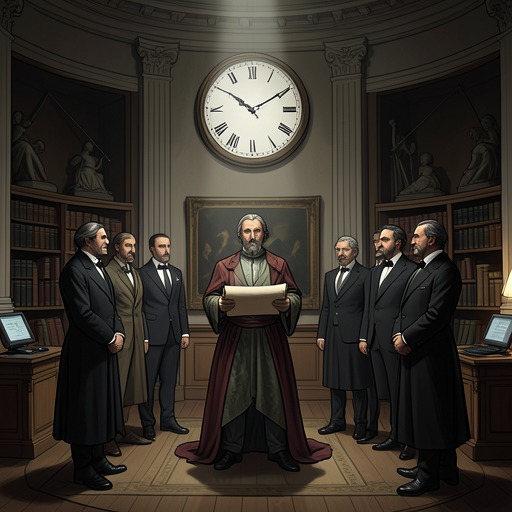
The elite’s authority becomes painfully visible during the annual solemn Game after Thomas von der Trave falls seriously ill. For years, Thomas had retained Bertram as his Shadow, or deputy. Bertram was an excellent player, an adequate teacher, conscientious in office, and devoted to his Master; nevertheless, he had grown unpopular, particularly with the younger generation. Thomas had protected him from friction where he could, assigning him increasingly to chancery work and the Archives and putting him before the elite less often.
When Thomas could no longer conduct the festival, Bertram suddenly faced its most exposed post. The delayed announcement of the Master’s illness left Waldzell uncertain until the day before the Game. Bertram might have managed the task with the tutors’ support, but he did not have it. The festival became a severe trial and nearly a disaster. Afterward, the elite sought and achieved his removal; the Magister’s duties within the Game village were temporarily distributed among three deputies, while the Board of Educators was expected, by tradition, to fill the office within three weeks.
Knecht initially interpreted Bertram’s conduct as a sacrifice that the tutors ought to answer with generosity. Tegularius corrected him: the elite had understood the sacrifice, but Bertram would not return. The tutors had cooperated enough to spare Waldzell a public scandal, not to rescue the deputy. Bertram had needed not only Thomas’s confidence but the confidence of the elite, and once that support failed, the hierarchy did not shield him as it would have shielded the Master. After leaving for the mountains, he did not return; a report circulated that he had fallen to his death from a cliff, and the matter was not pursued further. His fate reveals the force of a custom under which a Shadow may represent a Magister repeatedly yet cannot simply inherit the office—and the particular vulnerability of a deputy whom the community ceases to respect.
Knecht’s accession and reciprocal authority
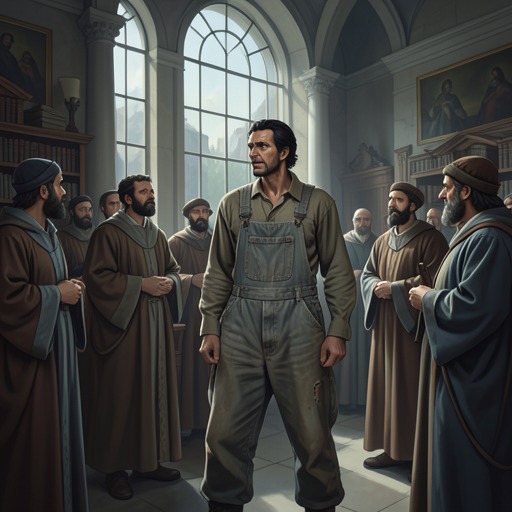
Knecht returned to Waldzell after his service at Mariafels hoping to resume his place among the players, but he arrived as an outsider to the elite’s fellowship. During the inquiry following the festival, he was summoned by senior officials and questioned alongside Tegularius. The tutors met him with mocking politeness or cool reserve. His transition from student and tutor into the Order’s hierarchy had altered his position: he was no longer simply a comrade, but a superior whom the elite had reason to scrutinize.
To become their Magister in practice, Knecht had to win them. He taught seminars, including a dialectics seminar in the blue room of the Archives with only five participants, and devoted himself to overcoming resistance, convincing the undecided, and earning the candidates’ confidence. The exertion temporarily eclipsed his other official responsibilities. Eventually the tutors acknowledged him as their Master; only then did his work ease enough for walks, music, and reading to return to his life. The ordeal also changed his understanding of authority: reaching the highest rank did not leave him untouched, but made him newly conscious of the demands of service.
At the moment his acceptance became clear, Knecht faced the choice of a Shadow. The office carried both distinction and constraint: a deputy could represent a Magister when he was absent, but could not act in every capacity, and a Shadow’s position had historically blocked advancement to the Master’s place. Still mindful of Bertram’s fate, Knecht gave up his personal right to choose and asked the tutors to select his deputy collectively. After meetings and secret polls, they chose one of their most promising candidates for the Master’s office. The gesture made the appointment a sign of reconciliation as well as trust: Knecht had earned the elite’s recognition, then acknowledged its stake in the authority he would exercise.
A measure of Castalian authority
The Waldzell elite’s power is informal but decisive. The formal system appoints Magisters and defines the deputy’s restricted role; in practice, a leader must also secure the confidence of the tutors who sustain the institution’s daily intellectual life. Bertram’s collapse shows that the Master’s confidence cannot substitute for that broader allegiance. Knecht’s success, and his decision to let the tutors choose his Shadow, show a different relation between hierarchy and collective consent.
That authority makes the elite more than an administrative pipeline. It is both the setting in which the Glass Bead Game is renewed and a community capable of judging whether a representative still belongs among its members. Its ideal of free, committed practice exists alongside the pressures of rank, succession, and exclusion. Waldzell’s future depends on keeping those forces in balance: the Game needs an elite devoted to truth and meditative discipline, while its leaders need the elite’s confidence if formal office is to become effective service.