Weather demons
The Glass Bead GameWeather demons are the unseen powers believed to affect rain, crops, and the precarious balance between human communities and the natural world. In Joseph Knecht’s life as Rainmaker, they are neither merely decorative mythology nor forces he can simply command: they give the village’s weather crises religious meaning, require ritual responses, and mark the boundary between practiced knowledge and what remains beyond human control.
Place in the Rainmaker’s world
The village’s understanding of bad weather rests on fear of nature, death, and spirits that people do not imagine themselves entitled to master. Fear cannot be abolished, but it can be soothed, outwitted, and brought within life’s ordered forms. Sacrifice and ritual serve this purpose; some of the rites belong specifically to the Weathermaker’s office. The demons therefore have a social as well as a spiritual function: they help explain danger and shape the community’s response to it.
The Rainmaker’s authority is most urgently needed when a prolonged drought or sustained cold and damp threatens famine. In such circumstances, Turu uses sacrifices, exorcisms, and processions, while the community also turns to drumming and collective ceremony. The old tradition holds that if persuasion, pleading, and threats fail, and every other measure proves futile, the Weathermaker himself may be sacrificed. The demons are thus associated not only with disruption but with a custom that places the office-holder’s life at stake.
The office has less dramatic but more regular responsibilities. In spring, the Rainmaker determines the proper sowing days by reading the moon, applying inherited rules and personal experience. The ceremonial scattering of the first seed, however, belongs to the tribal mother or her oldest female relative. This division of roles places the Weathermaker’s dealings with the powers of weather within a larger social order rather than making him the sole authority over fertility and survival.
Knowledge, ritual, and weather
Knecht inherits an approach to nature grounded in the senses rather than in written systems or abstract doctrine. His teacher, Turu, trains him to observe and test: weather signs, plants, animals, and the changing relations among clouds, storms, and lunar phases. The aim is not to stand apart from nature and overpower it. Rainmaker and apprentice seek knowledge as participants in a world to which they remain reverently subject.
Ritual is an indispensable public part of this work, but it is not the whole of the Rainmaker’s skill. Knecht performs sacrifices, processions, invocations, and drumming according to established practice; he does not treat them as dispensable when he seeks rain. Yet he also learns that good judgment means choosing when to act, rather than making appeals blindly when conditions offer little prospect of success. His office combines inherited ceremony with careful attention to the weather itself.
Knecht’s most distinctive ability is to read atmospheric changes through minute sensory signs. He detects shifts in heat, clouds, wind, and the smells of water, earth, and dust, and experiences the weather as intimately connected to his own inner life. In moments of unusual composure, he seems able to anticipate what the next days will bring and to affect the wind, clouds, or hail through that union with the forces around him. The narrative presents this capacity through Knecht’s experience, without reducing it either to a mere ceremonial performance or to a settled explanation of supernatural power.
Crisis and the limits of authority
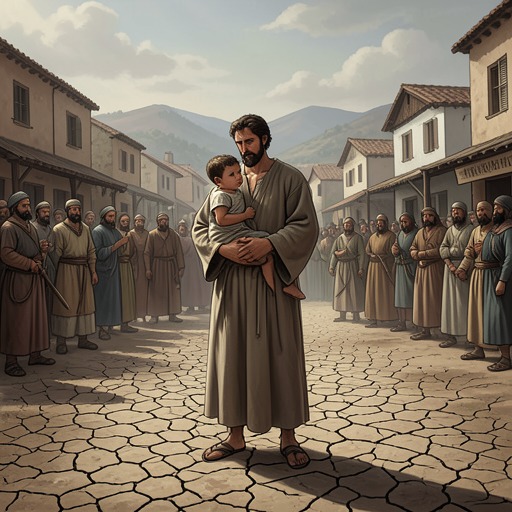
A two-year period of failed crops shows how little ritual guarantees success. Sowing is repeatedly delayed, harvests are nearly destroyed, and hunger follows. In the second year, drought hardens the common land while mice multiply; the Rainmaker’s private rites and the village’s processions and sacrifices alike appear ineffective. Knecht faces the fear that the community’s old rule will be invoked against him, since the Weathermaker’s sacrifice is supposed to appease the powers when other remedies fail.
In the crisis, Knecht does not answer fear with claims of mastery. He helps the village find scattered sources of water, resists the slaughter of all its livestock, and supports the tribal mother when she is close to giving way to despair. He ultimately offers himself for sacrifice rather than oppose the community’s demand. The episode gives the demons’ presumed power a severe consequence: belief in them can turn a weather disaster into a test of the Rainmaker’s willingness to surrender his own life, even as his practical service helps the village endure.
A later calamity renews this conflict. After an extraordinary display in which thousands of new lights seem to fall across the sky, Knecht connects the omen to a coming disorder in the relations between heaven and earth. The next spring is bleak: the moon is late, the signs for sowing do not agree, and flowers and buds fail. Knecht conducts private rites, delays public ceremony as long as possible, and eventually faces a season of failed crops and extreme drought. The falling lights do not simply provide spectacle; they become part of the village’s interpretation of a crisis that unfolds through the weather and the food supply.
Sacrifice and succession
As drought deepens, Knecht warns his son Turu that the crisis may cost him his life and instructs him to take over the office if he is sacrificed. He tells the boy to protect the community’s seed grain and says that his body should be burned and his ashes scattered over the fields. When Maro incites the villagers to demand the Rainmaker’s death, Knecht presents Turu as his successor and offers himself to the tribal mother. The sacrifice is carried out in a clearing Knecht himself selected, with the tribal mother, village leaders, and villagers in attendance.
Knecht describes his decision as an attempt to placate the demons and names his son as the new Rainmaker. He also nominates Maro, the drummer and his former apprentice, as his executioner. The ritual therefore enacts the tradition at the point when the village’s need and fear are most acute, while also transferring the office to the next generation. Weather demons are central to this ending not because the account proves that they have demanded a death, but because the community’s inherited explanation of disaster makes sacrifice seem like a final remedy.
Narrative significance
The demons belong to a worldview in which knowledge and humility are inseparable. Knecht can learn the signs of weather, choose the time for rites, discover water, and sometimes feel the movements of the atmosphere as if they were within him; none of this abolishes vulnerability to failed crops or communal fear. The distinction between practical attentiveness and ritual submission remains active throughout his life as Rainmaker.
The narrative also makes the demons a measure of the costs imposed by belief. Sacrifice can give collective fear an ordered form and bind the crisis to established custom, but it can also demand the life of the person who serves the community. Knecht’s response joins ritual responsibility to practical care: he does not merely invoke the powers, nor does he dismiss the villagers’ world of meaning. His relation to the Weather demons thus concentrates the episode’s unresolved tension between human skill and natural force, service and authority, and the effort to live with fear rather than pretend it has been mastered.