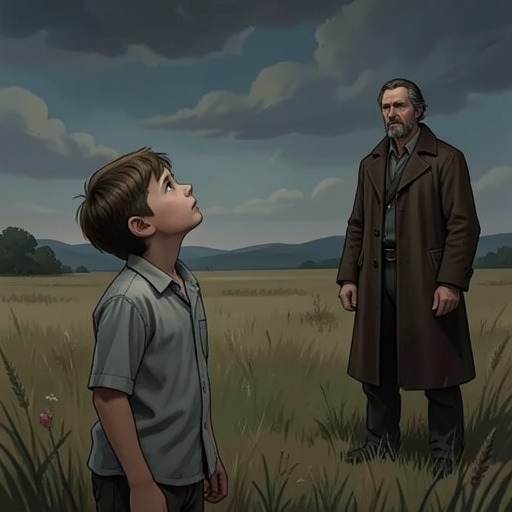
Yoga
The Glass Bead GameYoga in the Indian Life is a way of turning from the world of appearances toward what seems timeless and essential. For Dasa, it first appears not as doctrine or instruction but as the yogi’s extraordinary stillness; only after the fugitive prince has encountered the instability of worldly life does that attraction become a path of service and apprenticeship.
First encounter and the world of appearances
Dasa finds the yogi while searching the forest for honey. Beneath a great banyan, beside a small hut woven from fern leaves, the old man sits motionless in meditation. The scene arrests Dasa: he remains at the edge of the ferns, watching without daring to interrupt. The yogi seems untouched by the forest’s activity, as if his attention has passed through the visible world rather than merely shut it out.
The encounter gives Dasa a bodily intuition, not a formulated teaching. He senses that the things eyes and ears ordinarily register—beauty and ugliness, pleasure and fear—may be only a surface, and that the yogi has penetrated to a deeper ground of being. The boy cannot explain this in ideas, but feels awe, love, and longing for the life the yogi appears to embody. That first attraction links Yoga with both renunciation of appearances and a powerful desire for another way of being.
Refuge, imitation, and the body’s limits
After becoming a fugitive, Dasa eventually returns to the forest hut. He finds little there: a leaf pallet, a water-filled gourd, and an empty pouch. He gathers food, brings water, repairs the old shelter, and builds a second hut nearby. The yogi barely seems to notice him. Dasa nevertheless stays, finding temporary relief in quiet work and in the presence of someone who does not demand an account of his past.
He tries to imitate the yogi’s posture, sitting cross-legged and attempting to turn his gaze toward an unknown world. Yet the discipline does not come simply by copying its outward form. His back aches, his limbs stiffen, mosquitoes and itches distract him, and he has to get up. Occasionally he experiences a moment of lightness, as if body and soul were losing their weight; each time, however, he falls back into ordinary restlessness. The contrast makes Yoga an aspiration rather than an accomplishment: Dasa glimpses the desired detachment but cannot will himself into it.
His hopes of initiation are further tested when memories of Pravati and his fugitive life return. The yogi responds to Dasa’s account with laughter and the repeated word Maya. Dasa understands this as a suggestion that love, happiness, suffering, and life itself belong to illusion, but he cannot simply adopt the yogi’s apparent indifference. The episode exposes a distance between recognizing the world as transient and being able to live free of attachment to it.
Service and acceptance as a disciple
The story’s decisive change comes through an ordinary errand. Dasa goes to fetch water in a gourd and, in the brief interval, undergoes an imagined span of worldly life and loss. When he returns to the hut, the yogi regards him with a look combining sympathy, amusement, and recognition. The narrator presents this encounter as the moment when Dasa has been awakened and made ready to begin the long journey of discipline.
The yogi accepts him without a formal declaration or explanation. His look establishes the relation of master and disciple, banishes Dasa’s fruitless speculation, and binds him to service. The account ends there: Dasa never again leaves the forest, while whatever follows belongs to a realm the narrative does not depict. Yoga is thus represented not as a sudden escape achieved through posture or insight alone, but as a commitment entered through service, discipline, and a teacher’s tacit recognition.
The Indian Life and the meaning of Yoga
The episode belongs to Dasa’s fictional Indian Life, one of the imaginative autobiographical exercises written by Joseph Knecht during his years of free study. Such Lives let students transpose themselves into other historical and cultural settings, treating the self as a changeable mask rather than a fixed identity. Dasa’s encounter with Yoga therefore makes spiritual transformation part of a larger imaginative experiment in inhabiting another life and worldview.
Within the tale, the yogi’s withdrawal and Dasa’s attachment remain in tension. The old man seems to inhabit a stillness beyond ordinary appearances, while Dasa continues to be affected by love, fear, memory, and loss. His apprenticeship begins not when those attachments have been neatly explained away, but when experience has altered his readiness to serve and learn. The narrative leaves the completion of that discipline unwritten, preserving Yoga as a long path whose destination lies beyond the story’s images.