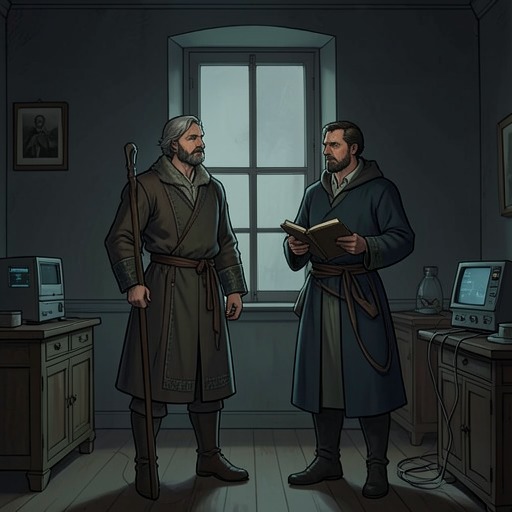
former Music Master
The Glass Bead GameThe former Music Master is Joseph Knecht’s first teacher, enduring patron, and final spiritual model. Once the figure who led a frightened schoolboy into the Castalian elite, he eventually turns away from speech and public activity toward a silence that Knecht understands as movement toward unity. His presence helps define both Knecht’s ascent into office and the possibility of a life whose authority rests not on rank or words, but on inward composure.
Identity and Early Bond
Knecht’s memory of the former Music Master returns with unusual force when he hears that his own appointment as Magister Ludi is imminent. In meditation, he sees again a bare room, a piano, and the cool light of forenoon. The Master appears at the door as the kindly, gray-haired teacher who first showed him what music was and led him step by step into the elite schools and the Order. Knecht now holds the office his mentor once held, but the relationship has not become one of simple succession: the older man remains several stages of life ahead, immeasurably greater in dignity and modesty, and a patron whose example continues to draw Knecht after him.
That memory places Knecht’s promotion within a longer chain of formation. As a child, he had been both frightened and overjoyed at meeting the celebrated Master; as an adult, he recognizes that becoming his colleague does not erase the difference between them. The mentor’s authority survives the transfer of office, not as a claim to control Knecht, but as a steady example that continues to shape how Knecht understands his own vocation.
Counsel at the Investiture
The former Music Master attends Knecht’s private investiture in the festival hall, despite his age and declining strength. The ceremony is sober rather than publicly celebratory: the new Master takes his oath, receives the insignia, and is robed before the authorities and senior pupils. The old teacher stands near the organ, where he would have liked to provide the music himself. Unable to risk the exertion, he leaves the playing to the Game Village’s organist and turns the pages behind him, watching Knecht receive the robe, keys, and seal.
For the former Master, this is an emotionally charged transformation: the boy he once taught is becoming an office-holder, almost a jewel in the hierarchy, and in that sense is beginning to disappear into his role. He has only a few minutes alone with Knecht. His advice is practical and concentrated: Knecht must give his full attention to the Waldzell elite during the difficult first weeks, trust the superiors who chose him and the assistants they send, and rely on his own strength. He names Alexander, whom he has personally instructed in yoga, as one of the men assigned to help initiate the new Magister. The advice joins discipline to confidence, while warning that the elite itself will test Knecht.
The counsel also marks a shift in what the former Music Master can offer. He cannot take over the new duties or spare Knecht from their demands; instead, he identifies where the new office will require complete attention and directs him toward trustworthy guidance. The intimate words spoken at the edge of a formal ceremony make the mentor’s continuing influence visible even as Knecht assumes an independent public responsibility.
Visits and the Language of Silence
Knecht later visits the former Music Master at Monteport, accompanied by Petrus, the old man’s devoted secretary. They find him in a quiet pavilion in the gardens, a cell-like dwelling whose tranquillity contrasts with the official world Knecht has entered. Music comes from the back room: the former Master plays a two-part melody on the piano with two fingers, delicate in sound yet rhythmically firm. Knecht guesses that it comes from a collection of duets written at the end of the sixteenth century. They wait until the music ends before Petrus announces their arrival.
The smile that welcomes Knecht recalls the one he first saw nearly thirty years earlier. The former Master’s hair has whitened, his voice softened, and his handshake weakened, but the smile retains its brightness. Now, though, Knecht perceives something more mysterious and intense in it. His visit, prompted by concern that the old man might soon die, becomes an encounter with a changed mode of being rather than a conventional conversation.
The former Master has largely ceased to speak. When Knecht tries to begin a conversation, the old man answers his words and questions with a look and a smile. Knecht initially feels importunate and exhausted, as if his speech were only noise and the Master had withdrawn behind a radiance he cannot reach. The silence is not simply indifference: it rebukes Knecht’s effort to make the encounter conform to ordinary conversation. After Knecht has worn himself out trying, the former Master gently tells him that he is tiring himself, touches his arm with a light hand, and looks into his eyes. Knecht then understands that the Master has moved away from people toward silence, from words toward music, and from ideas toward unity. He had arrived fearing a loss; instead, the visit gives him an experience he regards as a privilege and a benefaction.
Petrus’s devotion is part of this scene’s significance. Knecht recognizes that the young secretary is not merely attached to a beloved teacher or fascinated by an idol. He sees Petrus as responding, more readily than most, to a real transformation in the former Master. The secretary’s service has brought him close to a phenomenon that Knecht himself only begins to understand when he witnesses the old man’s silence at first hand.
Final Years and Death
The former Music Master remains serene as his bodily strength ebbs. The narrative distinguishes his decline from ordinary illness: he is not sick, and his death unfolds as a gradual diminution of bodily substance and function, while his life seems increasingly concentrated in his eyes and in the gentle radiance of his face. For most inhabitants of Monteport, this is a familiar and respected sight. Knecht, Petrus, and Carlo Ferromonte are among the few who are described as sharing more fully in the old man’s last phase.
Those visitors enter his small room in a receptive state and spend brief, rapt moments in what the narrative presents as the quiet movement of a selfless life toward perfection. Their encounter is compared to listening to unearthly music or returning from a high mountain with hearts cleansed and strengthened. The former Master’s influence has become less instructional and more experiential: he teaches not through lectures or decisions, but through the composure of his presence and the changes it awakens in those able to attend to it.
When news of his death reaches Knecht, he hurries to Monteport. The former Master has passed peacefully; his shrunken face lies on the bed like a silent rune, no longer readable yet still conveying a sense of happiness. At the funeral, Knecht speaks after the present Music Master and Ferromonte. He does not dwell on the deceased’s achievements as a teacher or on his wisdom as an elder in Castalia’s ruling body. Instead, he honors the grace of the man’s old age and death, and the enduring spiritual beauty revealed to those who shared his final days.
Legacy and Significance
The former Music Master’s arc turns a succession in office into a contrast between two forms of authority. Knecht receives the keys and robe that identify him as Magister Ludi, while his former teacher relinquishes the public role and becomes increasingly defined by silence. Yet the old man’s retreat does not make him irrelevant: his presence steadies Knecht at the threshold of office, and his later silence gives Knecht a new understanding of what the mentor’s life has become.
The former Music Master also embodies the limits of the hierarchy’s demands. Knecht later recalls that official duties crowded the day with teaching, archives, meetings, and journeys, leaving little room for self-chosen work; he wanted to write the old man’s biography but found no time. This unrealized project sharpens the cost of service: even a life marked by devotion and admiration cannot exempt Knecht from the obligations of his post. The mentor’s death leaves no biography by Knecht, but Knecht’s funeral address preserves the quality he considers most essential—not institutional distinction, but the serene beauty disclosed by a life reaching its end.