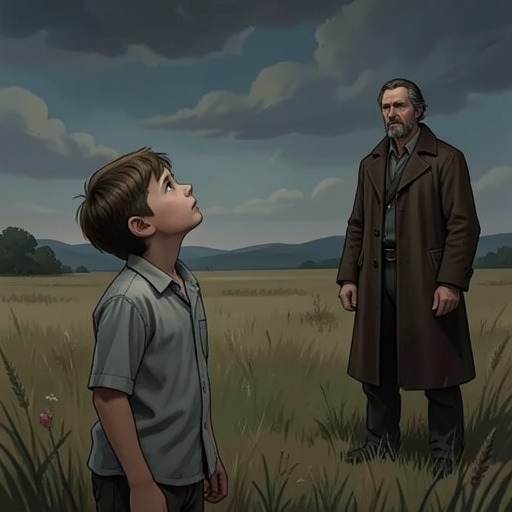
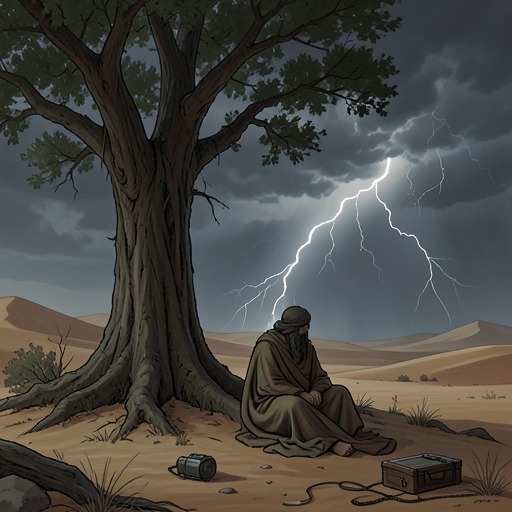
the yogi's forest hermitage
The Glass Bead GameThe yogi's forest hermitage is a small, secluded refuge beneath a banyan tree, hidden among ferns and reached by a narrow path. It is where Dasa first glimpses a life seemingly untouched by worldly change, later returns after years of suffering, and undergoes the yogi’s lesson in Maya. The hut and its spring become the setting for a decisive reversal: a life that feels complete from within is revealed to have unfolded during a short trip to fetch water, after which the yogi accepts Dasa as his disciple.
Setting and First Encounter
While searching in the forest for honey, Dasa follows a barely visible footpath through tall ferns and discovers a small hut woven from fern leaves beneath a many-trunked banyan. Beside it sits an old yogi, motionless in meditation. The clearing’s seclusion is not merely geographical: to Dasa, the yogi seems withdrawn from the sights and sounds of the forest, as though he had passed through the world of the senses into an unchanging ground of being. The boy is drawn to the sage’s stillness with both awe and longing.
Dasa does not interrupt the meditation or try to speak with the yogi. Following advice to offer gifts without disturbing him, he leaves them at the hut’s entrance and departs. While the herdsmen remain nearby, he returns with gifts each evening and once more during the day, standing in the yogi’s presence and experiencing it as a source of strength and happiness. After the herd moves on, the memory gradually fades as Dasa grows into a vigorous young man. A faint possibility nevertheless remains with him: the dignity and power he once associated with lost princely status might be found in yoga instead.
Refuge and Daily Life
Years later, after becoming a fugitive, Dasa comes back to the same clearing. The landscape feels unexpectedly like home, and reaching the hut restores the memory of the peace he had sensed there as a boy. Everything appears unchanged; for Dasa, the place seems outside the passage of time and the suffering of his life. The old man is again seated before the hut, while the simple shelter contains little beyond a leaf pallet, a water gourd, and an empty pouch made of bast.
Dasa begins caring for the hermitage without being asked. He gathers food for himself and the yogi, fetches water, renews the pallet, repairs the hut, and builds a second shelter nearby. The yogi appears to tolerate his presence but gives little sign of noticing him. Dasa lives almost as an unobtrusive servant, and the spare routines and quiet proximity help him recover from the insecurity and guilt of his fugitive life. The hermitage gives him shelter and time to regain his strength, but it does not immediately free him from memory or desire.
The Lesson of Maya
Dasa’s unsettled nights and his inability to sustain meditation eventually drive him to speak. He recounts his life to the yogi, including his lost princely origins, his attachment to Pravati, the Rajah’s taking of her, and Dasa’s killing of the Rajah and flight. The yogi listens, then opens his eyes, smiles, and laughs before calling out, “Maya! Maya!” The word neither explains nor erases Dasa’s suffering. It leaves him struggling to understand whether the laughter was compassionate, dismissive, or an invitation to see worldly life differently.
Planning to leave, Dasa waits until the yogi has finished meditating so he can ask to be taught about Maya. The master gives him the water gourd and sends him to fetch fresh water. At the spring, Dasa hears Pravati’s voice and sees her among the trees. The abandoned errand and the reunion draw him wholly back toward the life of love and worldly happiness he thought lost; the gourd remains by the water as he rushes to her. That meeting begins an apparent sequence of events in which Dasa experiences a life as husband, father, and ruler, followed by war and devastating loss.
Revelation and Acceptance
When Dasa comes back to awareness, he is standing in the forest with the filled gourd in his hands. He recognizes the spring, the fern thicket, and the hut, and understands that the life he experienced as a prince and father took place during the brief errand. Its joys and griefs were not simply nothing: the memories remain, vivid enough to bring tears and leave him shaken. But they belonged to Maya, the experience through which the yogi has shown him how an entire life can appear and vanish within a small interval.
Dasa returns to the hut and completes the task, carrying the water to the man who had sent him for it. The yogi’s look conveys both sympathy and amusement, and signals a relationship that did not exist before: master and disciple. In that moment Dasa’s restless reflections give way to discipline and service. The narrative says that he never again leaves the forest; the hermitage thus becomes not merely a place of concealment or recovery, but the beginning of his sustained apprenticeship. Its few objects—a pallet, a spring, and a gourd—anchor a transformation whose further years the story leaves beyond its account.