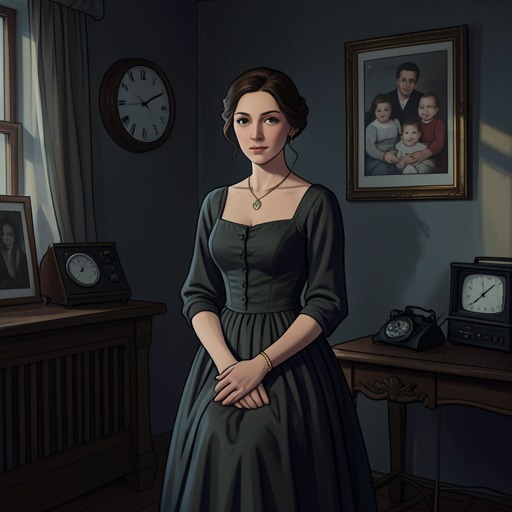
Amanda Wingfield’s nostalgic retreat into illusion
The Glass MenagerieAmanda Wingfield’s nostalgic retreat into illusion is her means of enduring a present she can scarcely accept, but it also becomes a measure of how far the family has fallen from the life she remembers. In stories of gentleman callers, planters, servants, dances, and jonquils, Amanda reconstructs her youth in the Mississippi Delta as a world of choice and status. Against the poverty and uncertainty of the Wingfield apartment in St. Louis, that bright past is both shelter and distortion: it lets her imagine a future for Laura, even as it obscures how little the present can offer.
The remembered world
Amanda repeatedly returns to her girlhood in Blue Mountain, where she says that one Sunday afternoon brought seventeen gentlemen callers, so many that the family needed folding chairs from the parish house. She recalls herself as more than a pretty face: a graceful figure was accompanied by a nimble wit and the ability to talk about matters of importance. Her callers, she insists, were gentlemen, including prominent young planters and sons of planters from the Mississippi Delta. The tally of callers and the emphasis on conversation make courtship evidence of a social world in which she could expect to be admired and to choose among prospects.
Her recollections acquire names, fortunes, and dramatic endings. Champ Laughlin later became vice-president of the Delta Planters Bank; Hadley Stevenson drowned in Moon Lake and left his widow government bonds. Bates Cutrere was shot in a quarrel at Moon Lake Casino and died on the way to Memphis, while his widow inherited thousands of acres. Amanda also remembers the celebrated Fitzhugh boy, who went North, made a fortune, and became known as the Wolf of Wall Street. She says she could have been Mrs. Duncan J. Fitzhugh, but chose the man who became her husband instead. Her memories therefore mingle romantic possibility with a ledger of wealth, inheritance, and loss: the past is not simply a succession of suitors, but a vanished system of status and security.
The play gives these memories a theatrical vividness. In one recollection, Tom remains by the portieres while Amanda addresses him as though he occupied the vacant chair at the table; Tom plays the scene as if reading from a script, and his gestures call up music and a spotlight for her. The screen legend “Ou sont les neiges d’antan?” frames her list of beaux as elegy as well as reminiscence. Yet the staging also makes the distance between memory and present visible: Amanda can revive her former self in the room, but the scene depends on performance and recollection rather than a return to the life she describes.
Objects, ritual, and performance
A yellowed voile dress, a blue silk sash, and a bunch of jonquils let Amanda turn memory into spectacle. She puts on the dress in which she says she led the cotillion, won the Cakewalk twice at Sunset Hill, attended the Governor’s Ball in Jackson, and met her future husband. Raising her skirt, she demonstrates a mincing step, briefly making the apartment a ballroom in her account. Her costume is a surviving object from the old trunk, but its faded condition also marks the passage from that remembered social life to the present.
The jonquils furnish a more expansive landscape for her recollection. Amanda describes a spring in the Delta when she had malaria fever, received invitations to parties, rode and picnicked, and became so taken with jonquils that she kept collecting them after there was no room for more. She recalls her mother warning that there was no space left and the young men helping her gather the flowers. The memory culminates in meeting the boy who would become her husband; Amanda then switches on a rose-colored lamp and places the jonquils in a bowl. The flower, the dress, and the light do more than decorate the room: they give her story a visible form, making a past of abundance and excitement momentarily present within the modest apartment.
Her performance also joins nostalgia to the family’s immediate concerns. Before the gentleman caller’s arrival, Amanda reappears in the old dress and hopes the visitors will come before it rains. She says she has given Tom extra change so that he and Mr. O’Connor can take the service car home. The old costume and flowers accompany the practical preparations for a visit whose significance lies in Laura’s prospects. Amanda’s revival of her own courtship thus doubles as an effort to make an imagined romantic future available to her daughter.
The past against economic reality
Amanda’s remembered world is structured by class and domestic labor. She recalls the servants of her Southern upbringing and speaks of a future in which she assumed she would marry a planter, raise a family on a large estate, and have servants. In the present, she tells Jim that the servants and every vestige of gracious living are gone; instead, her husband worked for a telephone company and left her uncertain of his whereabouts. The contrast does not erase the privileges her memories preserve. Rather, her nostalgia depends on precisely those privileges—servants, land, callers, and family standing—that she no longer possesses.
Her account of the old South sits uneasily beside the family’s dependence in St. Louis. When Laura cannot face the business world, Amanda fingers her large pocketbook and asks what remains for them besides dependency. She imagines unmarried women without positions living on the grudging support of relatives, confined to small rooms and eating what she calls the crust of humility. She includes herself and Laura in that feared future, then concedes that some women marry. The imagined refuge of her youth is therefore not merely ornamental: it offers a counter-image to the economic vulnerability she sees around her, while its assumptions about women’s security through marriage narrow the future she can envision for Laura.
Motherhood and the limits of illusion
Amanda’s nostalgia helps explain both her care for her adult children and the pressure she places on them. She tells Laura to remain fresh and pretty and to practice her typewriter chart or shorthand, then imagines gentleman callers arriving that afternoon. Her memories of being courted become a template for Laura’s future, although Amanda’s own story of choice and social opportunity cannot guarantee that Laura will find comparable prospects. The past reassures Amanda that courtship can lead to security; the circumstances of the present make that reassurance increasingly fragile.
Her recollection of marrying a telephone-company employee rather than a planter further exposes the gap between the life she expected and the life she received. She describes having assumed she would marry into a planter family, then points to her husband’s photograph and recalls his departure into long distances. In this telling, she can still place her marriage inside the romance of a choice, but the absent husband and the family’s precarious life tell a harsher story. Her nostalgia does not simply deny disappointment: it repeatedly circles the lost promise that gives that disappointment its force.
After the gentleman caller fails to provide the hoped-for future, Amanda is forced toward an explicit recognition of Laura’s prospects and of her own position as a deserted mother. Until then, her remembered callers and revived dress have offered a language in which hope can continue. The crisis exposes the limits of that language without making Amanda’s memories meaningless. They are at once a retreat from present hardship, a record of lost status, and the imaginative source of her determination to secure something better for Laura. Her attachment to the past remains loving and controlling in the same gesture: she wants happiness for her daughter, but keeps measuring it against a world that can no longer be recovered.