Chicago
The Glass MenagerieChicago is both the site where The Glass Menagerie first reached the stage and the city that marks a turning point in Tennessee Williams’s life. Its importance joins theatrical history to the play’s remembered world: Chicago was a setting for the labor unrest Williams invokes as social background, and its 1944 opening transformed the prospects of a play whose form challenged conventional realism.
The 1944 Opening
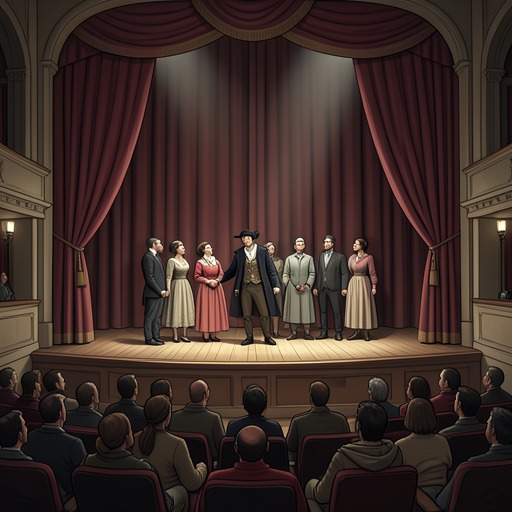
On December 26, 1944, The Glass Menagerie premiered at Chicago’s Civic Theatre, produced by Eddie Dowling and Louis J. Singer. Williams waited anxiously for the curtain amid last-minute rehearsal problems, tensions backstage, and weather severe enough to threaten the city’s operations. The date coincided with national attention fixed on the Battle of the Bulge, but Williams’s immediate concern was whether a production beset by difficulties would succeed before an audience.
The Chicago engagement was a deliberate first test before Broadway. Williams and his company chose to open there before facing New York critics, and the production subsequently moved to the Playhouse Theatre in New York City, where it ran for 563 performances. Chicago thus stands at the beginning of the play’s public success, not merely as a stop on its theatrical itinerary.
A Career Turning Point
In retrospect, Williams described the Chicago opening as an event that ended one part of his life and began another. Before it, he had traveled around the country in poverty and lived precariously in furnished rooms; after the play’s success, he was thrust into prominence and moved to a suite in a first-class Manhattan hotel. He framed this abrupt reversal through the familiar American Cinderella story, while also distinguishing his experience from the screen version of effortless success.
The opening’s consequences extended beyond Williams’s own circumstances. Reviews helped prepare the production’s move to New York, while the play’s reception established its author as a sudden celebrity and contributed to a perceived transformation in American theatre. Chicago became the point from which that change could be dated: in Williams’s account, the city’s opening brought an end to virtual obscurity and the onset of public recognition.
Chicago in the Play’s Historical Frame
The play’s setting reaches back to the 1930s, when Tom describes a middle class struggling through a dissolving economy. He contrasts revolutionary Spain and the bombing of Guernica with American labor disturbances, naming Chicago alongside Cleveland and St. Louis as cities where unrest could become violent. Chicago therefore appears within the play not only as the later site of its premiere but also as part of the social landscape recalled in its opening account.
That historical reference places domestic hardship against a wider crisis. The Wingfield family’s circumstances unfold amid economic insecurity and social confusion rather than in a sealed private world; the mention of Chicago helps give that background a specific urban geography. The city’s two roles—one within the remembered 1930s and another in the play’s 1944 theatrical history—connect the work’s subject matter to the circumstances of its arrival onstage.
Theatrical Innovation and Reception
Chicago’s premiere introduced audiences to a work shaped by Williams’s developing theatrical aesthetic. He was pursuing a more fluid dramatic structure and a sculptural arrangement of stage movement, with essential gestures and tableaux taking priority over ordinary realism. The production’s later Broadway version omitted the original script’s projected screen device, which had been conceived to emphasize a scene’s structural or emotional point; Williams accepted its omission in light of Laurette Taylor’s performance and the value of simplicity in the physical production.
The introduction presents the timing of the play’s success as significant: audiences in the 1940s, weary of realism and prosaic dialogue, welcomed Williams’s poetic language and formal experimentation. Chicago is consequently associated with more than a successful opening night. It is where a distinctive combination of memory, theatrical transformation, and lyrical drama first met a public, beginning the production history that carried the play to New York and into lasting prominence.