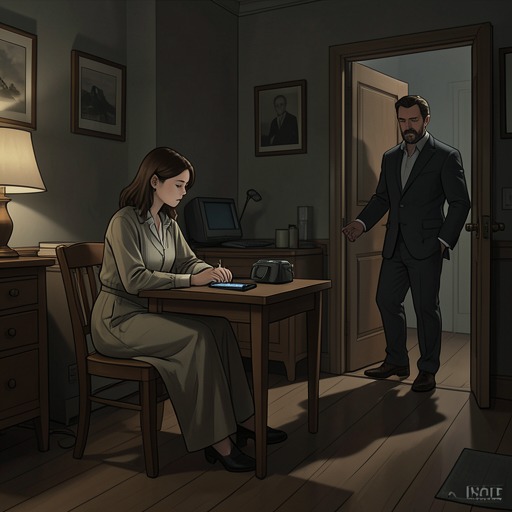
Laura Wingfield’s social isolation and shyness
The Glass MenagerieLaura Wingfield’s social isolation and shyness are not merely traits of temperament: they govern where she can go, what she can attempt, and how she imagines herself in the presence of others. A childhood illness left her with a leg brace and one leg slightly shorter than the other; the play traces how this physical difference, and Laura’s acute awareness of it, become bound up with a widening retreat from school, work, and social contact. Her glass collection offers a private imaginative refuge, but her withdrawal leaves her vulnerable when the possibility of companionship appears.
Origins and Daily Experience
A childhood illness left Laura with a physical disability: one leg was slightly shorter than the other and held in a brace. The stage direction calls for this difference to be suggested rather than prominently displayed, but its effects are made concrete in Laura’s memory of school. She attended Soldan High School on Mondays, Wednesdays, and Fridays, and recalls that getting upstairs was difficult. The brace clumped as she climbed; although Jim says he never heard it, Laura remembers the sound as thunder. The difference between his recollection and hers shows how a feature that may have passed almost unnoticed to others could dominate her own experience.
Laura describes herself to Amanda as crippled, speaking in a tone of frightened apology. Amanda rejects the word, calling her condition a slight defect and urging her to compensate through charm and vivacity. Her reassurance attempts to protect Laura from a harsh judgment, but it also shows how the family’s language frames bodily difference as something that must be overcome or made up for. Laura’s account and Amanda’s response do not make the physical condition disappear: they expose the strain between Laura’s lived sense of it and her mother’s wish to rename it.
Withdrawal from School and Public Life
Laura’s isolation becomes especially visible in the story of her abandoned business-college course. Unable to return after becoming sick on the floor, she did not attend class, yet spent the day away from home so Amanda would believe she was still going. From half past seven until after five, she moved between public places rather than the college: she went into the art museum and the bird houses at the zoo, visited the penguins every day, sometimes went without lunch to see a movie, and more recently spent afternoons in the Jewel Box, the large glass house where tropical flowers were raised. These visits reveal a capacity to find and sustain solitary pleasures, even as they form part of an extended deception about her education.
The contrast between the classroom and these places is telling. At college Laura became ill and could not continue; outside it, she found warmth, distraction, and objects of attention in museums, animal enclosures, films, and a conservatory. Yet this movement through the city did not amount to social participation. It gave her somewhere to be while concealing her absence, preserving a fragile distance from the demands of school and from Amanda’s expectations. The excursions show not an absence of interests, but interests pursued in solitude and under the pressure of hiding.
Glass Animals and the Limits of Safety
The play places Laura’s withdrawal in relation to her glass animals. She washes and polishes the collection while seated at a delicate ivory chair and a small claw-foot table; at the sound of Amanda climbing the fire-escape steps, she quickly pushes the bowl of ornaments away and sits stiffly before the typewriter-keyboard diagram, as if absorbed by it. The gesture turns private activity into something she must conceal, and the diagram becomes a makeshift display of diligence. The staging places her care for fragile objects beside her effort to appear occupied with the course she has left behind.
Laura’s glass collection is her imaginative escape, and the play aligns her with the animals on the shelf: exquisitely fragile, withdrawn from movement, and seemingly insulated from the disorder outside. That refuge is not simply emptiness or passivity. Her attentiveness to the objects and her visits to the Jewel Box show a sustained engagement with things that can be observed in quiet, solitary settings. But the security of such settings also narrows her contact with other people. Her isolation may spare her some of the strain of public life, while leaving her with few practiced ways to enter it.
Encounters and Self-Perception
Jim’s recollection of high school brings Laura’s social habits into view from another perspective. He remembers that she tended to keep to herself; she says she was not acquainted with many people and never had much luck making friends. When he asks whether she had tried to overcome her shyness, she answers that she never could. These exchanges make her isolation more than a consequence of the brace alone: Laura describes a persistent difficulty in forming friendships, and Jim recognizes a pattern of solitude that he had observed at school.
Jim interprets Laura’s lack of confidence as an inferiority complex. He compares her fear of the brace’s clumping with his own recollection that it was practically nonexistent and argues that imagination magnified what he sees as a slight physical defect. His explanation identifies one way Laura’s self-consciousness restricts her: the anticipated sound of her walking became so frightening that, as he recounts it, she gave up an education. But his perspective does not erase the concrete difficulty she describes in climbing stairs, nor does his confidence establish that the experience felt minor to her. Their different accounts keep physical circumstance and internal apprehension in tension rather than reducing one to the other.
The possibility of a closer relationship brings that tension into sharper focus. When Jim arrives, Laura’s first impulse is flight; as the visit proceeds, she enters a brief encounter with the world of ordinary social connection. The play presents her emergence as tentative, not as proof that her isolation has been overcome. Her shyness, long reinforced by withdrawal and by a sense of bodily exposure, makes the prospect of intimacy both a promise and a risk.
Meaning and Narrative Function
Laura’s isolation connects bodily difference, social expectation, and private retreat without making them interchangeable. The brace is a physical circumstance with practical consequences, including difficulty getting upstairs; other people’s attention to it, and Laura’s own painful anticipation of being heard, shape how she experiences public spaces. Her withdrawal from college and friendships cannot be explained by the leg alone, since she also describes an enduring inability to make friends and seeks solitary places where she can spend whole afternoons. The play thus gives her shyness a social geography: the staircase, classroom, and imagined social encounter are difficult to enter, while the museum, zoo, movie theater, and glass house allow her to remain apart.
The glass animals give that separation a visual form. Laura’s affinity with fragile objects suggests how thoroughly her sheltered life has come to define her, yet the details of her days prevent her from being only a symbol of fragility: she chooses places to visit, keeps returning to the penguins, and finds her own quiet ways to occupy time. The tension between this resourcefulness and her inability to sustain ordinary social participation makes her isolation consequential rather than decorative. It is a refuge, a constraint, and the condition that makes even a brief opening toward companionship feel unusually momentous.