Mr. Wingfield
The Glass MenagerieMr. Wingfield is the absent father of Tom and Laura, present in the play chiefly as a large photograph and as the remembered fact of his departure. A former telephone-company employee who left his job and family, he survives in the Wingfield apartment as a smiling image and in the family’s account of a postcard from Mazatlan that said “Hello — Goodbye!” and gave no address. That combination of cheerful portrait and unreachable life makes him a continuing force in the household: his absence is the precedent Tom fears he may repeat and the source of the family’s unresolved dependence and resentment.
Identity and Background
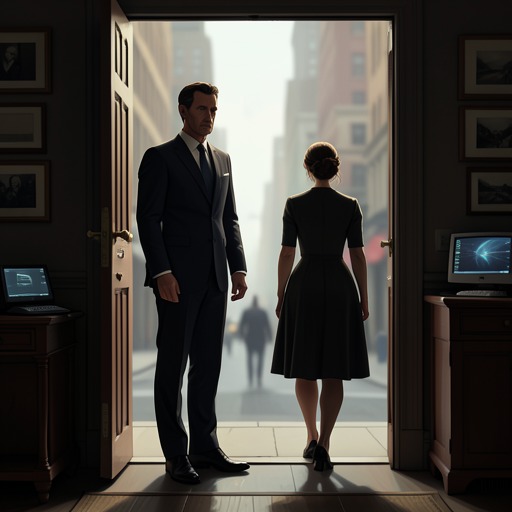
Mr. Wingfield does not appear in person. Tom identifies him as the play’s fifth character, represented by a larger-than-life-size photograph above the mantel. The portrait shows a handsome young man wearing a doughboy’s First World War cap, his face fixed in a gallant smile. In the opening description of the apartment, the smile seems permanent, as if the photographed man were destined to keep smiling forever. The image gives the absent father a constant place in the family’s domestic space without offering any possibility of reply.
Before leaving, Mr. Wingfield worked for a telephone company. Tom describes him as a man who fell in love with long distances, quit his job, and went out of town. The account makes distance both the practical fact of his departure and a defining feature of his character as the family remembers him. His former occupation, tied to communication across distance, contrasts with the final communication he sends: a brief postcard that establishes neither a return nor a way to reach him.
Departure and the Postcard
The family’s last reported contact is a postcard from Mazatlan, on Mexico’s Pacific coast. Its entire message is “Hello — Goodbye!”; it carries no address. The greeting and farewell collapse into the same two words, offering acknowledgment while closing off continued contact. Tom recounts the card as the last the family heard from his father, so Mr. Wingfield’s absence is not presented as a temporary separation followed by news of a settled life elsewhere. The play gives no further account of his whereabouts or later fate.
The photograph and postcard provide sharply different kinds of evidence. The portrait is large and continuously visible, but preserves only a youthful expression; the postcard is small in implication, but supplies the family’s last direct sign of him. Neither restores a relationship. Together they leave the household with an image that cannot change and a message that cannot be answered.
Effects on the Family
Mr. Wingfield’s departure becomes a measure of Tom’s own wish to escape. During a quarrel with Amanda, Tom points to his father’s photograph while insisting that, if he cared only for himself, he would already be gone as far as transportation could take him. He sets that imagined departure against the reality of his warehouse job, where he earns sixty-five dollars a month and remains responsible for contributing to the family. His anger draws force from the difference between the freedom associated with his father’s disappearance and the obligations that keep him at home.
Tom also names the resemblance he fears. In conversation with Jim, he calls himself like his father and refers to the grin in the photograph while saying that his father has been absent for nearly sixteen years. The comparison makes Tom’s plans a source of concealment within the household: he tells Jim that Amanda does not know of them. Mr. Wingfield’s example therefore functions as both an imagined route out and a warning about what leaving may mean to those left behind.
Amanda’s plans for Laura are likewise made under the pressure of the father’s absence. She tells Tom that he may go wherever he wishes once Laura has someone to take care of her and a home of her own, but insists that until then he must look out for his dependent sister. In her account, Laura’s failure at business college and inability to establish herself socially make her future especially uncertain. Mr. Wingfield is not present in this exchange, but the arrangement Amanda proposes—Tom remaining until Laura can depend on a husband or independent household—shows how his departure helps define the responsibilities that remain for the family.
Narrative and Thematic Role
Because the play is presented as Tom’s memory, Mr. Wingfield enters through the objects and recollections that have endured in the apartment rather than through an independent account of his life. The father’s photograph is even briefly illuminated after Tom speaks of the difficulty of escaping a confinement whose nails must be removed one by one. That stage image links the father’s fixed grin to Tom’s sense of being trapped, while leaving the photograph itself unchanged.
Mr. Wingfield’s story is a concrete counterpoint to the household’s economic and emotional constraints. Tom works for a modest wage and is pressed to support his mother and sister; Amanda worries that Laura may have no secure future without marriage or another form of support. Against those obligations stands the father who left, whose postcard names departure but supplies no explanation, address, or return. The play does not resolve that contrast by revealing what became of him. Instead, his continuing significance lies in the lives organized around the space he left behind.