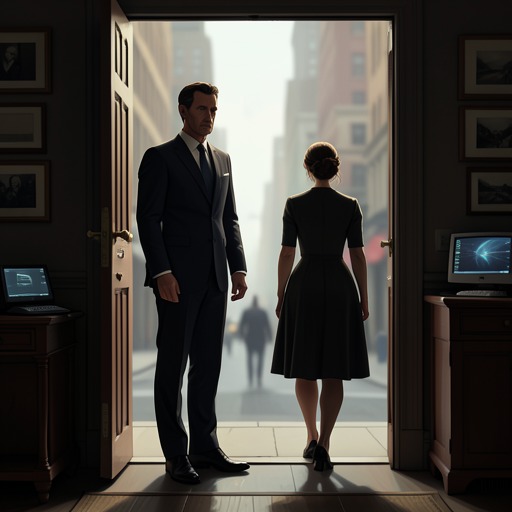
Mr. Wingfield abandons his family
The Glass MenagerieMr. Wingfield abandons his family before the play begins, leaving Amanda, Laura, and Tom behind in their St. Louis apartment. Though he never appears in person, his oversized photograph and his last postcard make his departure a continuing presence: he is both the family’s first fugitive and the model whose escape complicates Tom’s own longing for freedom.
The Departure
Mr. Wingfield had worked as a telephone man before giving up his job with the telephone company and leaving town. Tom, who narrates the play as both a character and a later teller of the family’s story, describes him as a man who fell in love with long distances. The account gives the departure a suggestive double character: it is a literal desertion, but also an early instance of the play’s recurring pull toward distance and escape.
The family’s last news of him came by postcard from Mazatlan, on the Pacific coast of Mexico. Its entire message was “Hello — Goodbye!” and it supplied no address. The brevity is decisive: the card confirms that he is alive and far away while offering no route back, explanation, or means of contact. His exit is therefore not a temporary absence in the household’s experience but an unresolved break.
An Absence Made Visible
Mr. Wingfield does not enter the action; instead, his larger-than-life photograph hangs over the mantel. The image makes him conspicuous in the family home even as his actual presence has been withdrawn. It is a portrait of the absent father, and its placement turns the domestic room into a place where the consequences of his departure remain on view.
The photograph’s smile and the postcard’s jaunty farewell suggest that he feels no regret, a contrast to the family left behind. The play’s introductory account presents him as a fifth character who appears only through this image and the story of his flight. That theatrical arrangement gives his absence a continuing force without granting him a voice or a return.
Escape and Its Inheritance
Mr. Wingfield’s departure establishes the escape pattern that shapes the family’s story: every member seeks flight, literally or through imagination. He is the first to leave the family’s constricted world, and Tom’s later choice between personal freedom and sacrifice is made harder because he has already suffered the consequences of his father’s abandonment. The resemblance between their departures does not make them equivalent; it makes Tom’s decision carry the weight of a precedent he knows intimately.
Tom eventually leaves by way of the fire escape to join the Merchant Marines, following his father’s footsteps in a different form. Yet departure does not bring uncomplicated release. Tom recognizes that leaving will press Amanda and Laura further into their own worlds, and his memories of Laura continue to burden his journey. Mr. Wingfield’s flight thus frames the play’s central tension: escape may break confinement, but it can also transfer its cost to those who remain.