New York City
The Glass MenagerieNew York City is where The Glass Menagerie’s move from its Chicago opening became a public triumph, and where Tennessee Williams experienced the abrupt material and personal reversal he later called “the catastrophe of Success.” The Playhouse Theatre run connected the play’s intimate family drama to a wider transformation in American theatre, while the city’s first-class hotel suite stood in sharp contrast to Williams’s former precarious lodgings.
Production and theatrical arrival
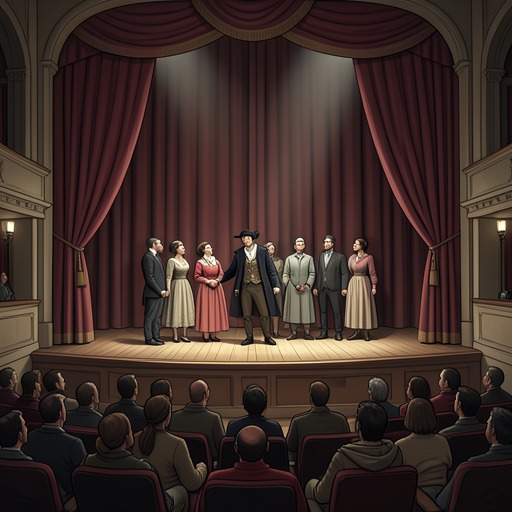
The Glass Menagerie opened at the Playhouse Theatre in New York City on March 31, 1945, after its first production at Chicago’s Civic Theatre on December 26, 1944. The New York production was staged by Eddie Dowling and Margo Jones, with setting and lighting by Jo Mielziner and original music by Paul Bowles. Its run lasted 563 performances, turning the Chicago production’s cautious first step before New York critics into a sustained Broadway success.
The arrival followed a difficult path. Williams and his company had chosen Chicago before facing New York reviewers, and the preparations included last-minute obstacles and pressure from producer Eddie Dowling and others to make significant script changes. The eventual New York run therefore registered not simply as a transfer of venue but as the outcome of persistence, strong material, fine acting, and good fortune. Audiences responded to the pathos of the Wingfield household and to Laurette Taylor’s performance as Amanda; critics were also struck by Williams’s poetic language and dramatic ingenuity.
A sudden change in circumstances
Three years after the Chicago opening, Williams described the play’s success as ending one part of his life and beginning another, with external circumstances transformed almost completely. Before the breakthrough, he had moved among furnished rooms around the country; afterward, he was living in a suite in a first-class Manhattan hotel. New York City thus represents a material reversal as much as a professional destination: precarious lodging gave way to conspicuous comfort, and virtual obscurity to sudden prominence.
Williams placed this personal change within the familiar American Cinderella story, a narrative he associated with the film industry and the national imagination. But he resisted treating his own experience as either wholly exceptional or simply ordinary. The contrast between his earlier insecurity and his new status sharpened his awareness that success could arrive with startling speed, without making its consequences easy to understand or absorb. He later named this disorienting transition “the catastrophe of Success.”
Form and theatrical context
The play’s New York reception belonged to a broader shift in American theatre. Williams was developing a more fluid dramatic form influenced in part by cinematic staging, and he argued for a sculptural drama built from restrained movement and significant tableaux rather than continuous realistic activity. In the final scene, Amanda consoling Laura offers an example of the statuesque stage image he described. His plastic theatre drew on expressionist devices but joined them to romantic lyricism, presenting a new force in a theatrical climate the introduction characterizes as static and predictable.
Williams’s production notes explain why such nonrealistic means mattered: theatrical transformation, he argued, could approach truth more penetratingly than photographic likeness. He conceived a screen for projected images or titles to accent the structurally important points of the episodic play and to clarify allusions without placing the entire burden on dialogue. The screen was omitted from the Broadway acting version, a decision he did not regret given the simplicity suited to Taylor’s performance, though he retained the device in the published manuscript. New York City was therefore the setting not only for the play’s commercial breakthrough but also for a production whose restraint and formal choices helped make its emotional force legible.
Reception and lasting significance
The introduction presents the New York success as part of a remarkable transformation in American theatre, with Williams himself becoming an immediate, if bemused, celebrity. The play’s continuing life extends beyond that original run: it has engaged celebrated actresses, been translated into many languages, inspired four film adaptations, and appeared in productions from high schools to London’s Haymarket. Its endurance is linked to the family conflicts at its center, a subject capable of eliciting recognition and emotional response across audiences.
New York City consequently occupies two related positions in the account. It is a concrete theatrical destination, identified by the Playhouse Theatre and the 563-performance run, and it is the place-name attached to Williams’s sudden passage into prominence and altered living conditions. The city’s importance lies in that convergence: the Wingfield family’s private pain reached a large public, while the playwright who had shaped it found himself living in circumstances almost unrecognizable from those that preceded the play’s success.