Tennessee Williams’s breakthrough success with The Glass Menagerie
The Glass MenagerieTennessee Williams’s breakthrough success with The Glass Menagerie abruptly carried him from precarious obscurity to national prominence, but it did not deliver the uncomplicated happiness promised by the Cinderella story. In “The Catastrophe of Success,” he recalls celebrity as a disorienting change in external circumstances that estranged him from friends, his play, and his own creative identity; leaving the hotel world for Mexico and returning to work began a recovery that acclaim itself could not provide.
The Breakthrough and Its Public Meaning
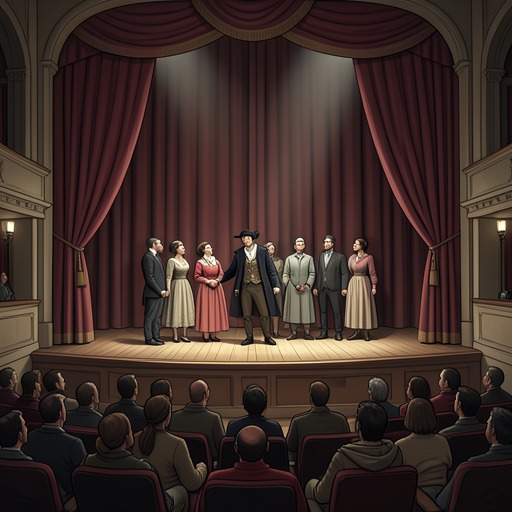
The decisive public turning point was the Chicago opening of The Glass Menagerie. Williams and his company chose Chicago before facing the New York critics, and the production reached opening night despite last-minute obstacles, including producer Eddie Dowling’s and others’ calls for significant script changes. Williams persisted. The play’s material, the actors’ performances, and what the account calls sheer good fortune helped turn his pursuit of recognition into a sudden reality.
As reviews arrived, the production prepared to move to New York’s Playhouse Theatre, where it would run for 563 performances. Audiences were deeply moved by the pathos of the Wingfield household and by Laurette Taylor’s performance as Amanda; critics and theatre enthusiasts were also fascinated by Williams himself, his Southern manner, poetic language, and dramatic ingenuity. The achievement therefore joined the play’s emotional effect to the arrival of a distinctive new playwright. Williams became an immediate, if bemused, celebrity.
Three years after the Chicago opening, Williams described the change as a break between two parts of his life. His former precarious tenancy in furnished rooms around the country gave way to a suite in a first-class Manhattan hotel. The material contrast made success legible in rooms, service, and status, but his essay refuses to treat those outward signs as proof of inner fulfilment. He sets his experience against the familiar American Cinderella myth, while insisting that sudden recognition can be neither dismissed as ordinary nor understood as a simple happy ending.
The Dislocation Behind Acclaim
The new circumstances first appeared as luxury, but their comforts quickly became alienating. In the hotel suite, the sofa seemed more revolting by morning, and a fashionable acquaintance’s $125 suit no longer fit. The room itself accumulated small mishaps: an arm came off the sofa, cigarette burns marked the polished furniture, and an open window let a rainstorm flood the suite. The maid restored order and the management tolerated late parties. Instead of making the room feel like home, its service and immunity from ordinary consequences sharpened Williams’s sense of estrangement.
Even room service lost its appeal. Food arrived in his living room on a rubber-wheeled table, and the interval between ordering and delivery drained his interest in dinner. In one telling mishap, he mistook chocolate sauce for gravy and poured it over a sirloin steak. The anecdote gives physical form to a larger reversal: abundance did not satisfy him; the elaborate provision of comfort made the experience feel remote and unreal.
Beneath these inconveniences, Williams describes a more serious spiritual dislocation. He became indifferent to people and increasingly cynical, hearing conversations as if they were old recordings played again on a turntable. Sincerity and kindness in his friends’ voices seemed to have vanished, and he suspected hypocrisy. He stopped calling and seeing them, and grew impatient with what he took to be inane flattery. Success had altered not only how others approached him but also how he interpreted their attention.
Repeated praise for the play became nearly impossible to receive. When people said they loved it, Williams could no longer manage a thank-you; the words choked him, and he sometimes turned rudely away from people who were sincere. He lost pride in The Glass Menagerie and began to dislike it, connecting that rejection to his fear that he was too lifeless inside to create another play. He describes himself as walking around dead in his shoes, with no friend he knew or trusted enough to tell what was wrong. Public acclaim thus coincided with an inability to share either gratitude or distress.
Withdrawal and a Changed Perspective
The condition lasted about three months, until late spring. Williams decided to undergo another eye operation, partly because it offered an excuse to withdraw from the world behind a gauze mask. It was his fourth eye operation; a cataract in his left eye had troubled him for about five years and required a series of needling operations, followed finally by an operation on the eye muscle. The physical procedure gave him a practical interval away from public life, although its deeper effect was not simply medical.
While he rested in hospital, friends he had neglected or affronted began visiting. In pain and darkness, he heard their voices differently: the unpleasant change he had suspected seemed to disappear, and they sounded once more sincere, kind, and understanding. The sequence complicates his earlier certainty. The visitors had not necessarily become different people; his altered circumstances changed how their voices reached him. His physical vision improved only relatively—the eye remained, in his wry formulation, with a clear black pupil in the right position, or nearly so—but he considered the operation figuratively restorative.
When the gauze mask came off, Williams found himself in a readjusted world. He checked out of the handsome hotel suite, packed his papers and a few belongings, and left for Mexico. He presents the country as a place where the false dignities and conceits imposed by success could be forgotten, and where his public self—the “artifice of mirrors”—did not exist. The departure was therefore more than a change of location: it marked a break with celebrity’s constructed identity and an effort to resume a more natural sense of being.
Return to Work and the Meaning of Success
After leaving the hotel, Williams settled for a while at Chapala to work on The Poker Night, the play that later became A Streetcar Named Desire. He identifies artistic work as the place where an artist can find reality and satisfaction, because the imagined world has an intensity that ordinary life lacks. For him, work should become not merely convenient but unavoidable. The restoration he describes is consequently tied not to another public triumph but to the conditions in which he can make something.
His preferred working environment is remote, among strangers, with good swimming; it should also demand a modest amount of effort rather than arranging every need through hotel service. The desired distance from luxury is part of a larger discomfort with the social relations that luxury exposes. Williams objects to the labor of maids, waiters, bellhops, and porters, whose service continually reminds him of accepted inequities. He recalls the image of an elderly woman struggling with a heavy pail of water down a hotel corridor to clean up after an overprivileged guest, a scene that leaves him ashamed of a social order that treats such inequality as evidence that democracy is functioning properly.
The essay’s account of the breakthrough is thus neither a denial of achievement nor a celebration of celebrity as a sufficient reward. The Chicago opening changed Williams’s material circumstances and public standing with astonishing speed, but those gains coincided with cynicism, isolation, and a loss of confidence in his own creative life. Hospital withdrawal altered his perception of friendship; departure for Mexico loosened the hold of the public persona; work at Chapala gave him a practical direction for recovery. Success becomes a catastrophe when recognition displaces the relations and artistic activity through which a life has meaning, and a turning point only when Williams can leave its trappings and return to work.