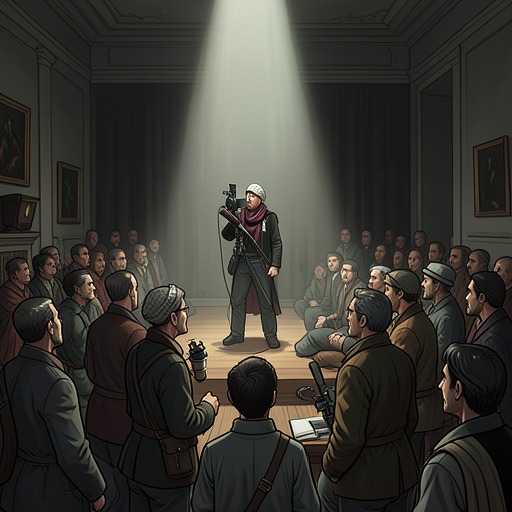
The 1930s economic depression
The Glass MenagerieThe 1930s economic depression gives the play’s private conflicts a material and historical frame: Tom’s low-paid warehouse job helps sustain the family, while Laura’s failed attempt at business college and Amanda’s anxiety about her daughter’s future expose how little economic security the household possesses. Tom describes the decade as a time when the middle class was forced to confront a collapsing economy; in the family’s daily life, that crisis appears not as an abstract statistic but as bills, constrained choices, and dependence on a single wage.
Historical and Social Background
In his address to the audience, Tom turns the clock back to the 1930s and presents the period as one in which Americans were forced to confront an economy coming apart. He describes the middle class as having failed to see its circumstances clearly until economic hardship made them unavoidable. The image makes the depression a condition of collective blindness and painful recognition, rather than merely a backdrop to one household’s troubles.
Tom places this economic crisis alongside upheaval abroad and labor unrest at home. He contrasts revolution in Spain and the destruction of Guernica with shouting, confusion, and sometimes violent labor disturbances in American cities, including Chicago and St. Louis. The play therefore sets the family’s struggles within a wider period of instability, while distinguishing that social context from the particular sources of pressure inside the Wingfield home.
Work, Income, and Household Security
The family’s dependence on Tom’s employment gives the economic background an immediate domestic consequence. During a quarrel with Amanda, Tom says that he earns sixty-five dollars a month at the warehouse and resents surrendering his aspirations to that work. Amanda, by contrast, treats his job as the family’s security and warns that losing it would jeopardize them all. Their argument turns wages into a point of conflict between Tom’s desire to leave and the household’s need for his income.
Even the light bill becomes part of this precarious accounting. Amanda asks Tom about a bill she had given him after the family received notices about it; his hesitant response leaves the payment unresolved in this moment. The exchange shows how routine expenses can intrude into family conversation, though it does not establish whether the bill is ultimately paid.
Education, Dependence, and the Future
Laura’s education is another failed route toward financial independence. Amanda recalls that she paid fifty dollars in tuition for Laura’s business-college course, but Laura became ill with anxiety during a speed test and stopped attending. Amanda describes the tuition, and the hopes and plans attached to it, as lost. The episode connects the family’s limited resources to a practical problem: the training meant to prepare Laura for work has not produced a path to employment.
Amanda fears that without a business career Laura will remain financially dependent. She imagines unmarried women living on the reluctant support of relatives, confined to small rooms and moving between family members’ homes. She frames marriage as the other possibility, and later tells Tom that he may leave only after Laura has someone to care for her and a home of her own. Her plan makes Laura’s future a condition of Tom’s freedom, binding the siblings’ prospects to an economic arrangement that Amanda cannot otherwise secure.
Nostalgia and Lost Social Standing
Amanda’s recollections of her youth in the Mississippi Delta supply a pointed contrast to the family’s present circumstances. She remembers seventeen gentlemen callers on one Sunday and prominent young planters among her admirers, including wealthy families and men associated with substantial property. Her stories evoke a world of courtship, social distinction, and material comfort; they do not describe the family’s present finances, but reveal the elevated expectations against which Amanda measures her changed life.
The contrast becomes especially explicit when Amanda recalls that she expected to marry a planter and raise a family on a large estate with servants. Instead, she married a telephone-company worker who later left and traveled without her knowing where he was. In the present, she tells Jim that domestic service and the signs of gracious Southern living are gone. The remembered hierarchy of planters and servants thus stands against the family’s dependence on Tom’s modest pay and Amanda’s anxious efforts to plan for Laura.
Significance in the Play
The depression is both an expressly named historical setting and a pressure felt through the family’s ordinary decisions. Tom’s wish to escape the warehouse conflicts with the need for his wages; Laura’s withdrawal from business college narrows her prospects; and Amanda’s solution depends on finding Laura financial support through marriage. These pressures give economic insecurity a relational force: choices about work, education, and departure become arguments about who must provide for whom.
Amanda’s nostalgic stories do not erase that material reality. Their abundance of callers, land, and servants instead sharpens the distance between the past she recounts and the family’s present dependence. By setting those memories against wages, tuition, and a disputed light bill, the play makes economic decline visible in both the household’s practical constraints and the old social world Amanda continues to invoke.