The Glass Menagerie’s Chicago premiere
The Glass MenagerieThe Glass Menagerie’s Chicago premiere, held at the Civic Theatre on December 26, 1944, turned a precarious production into Tennessee Williams’s breakthrough. Its importance lay not only in the play’s eventual success, but in the conjunction of domestic pathos with a new theatrical method: memory was made visible and audible through music, selective light, gesture, and the possibility of projected images rather than through photographic realism alone.
Preparation and Opening Night
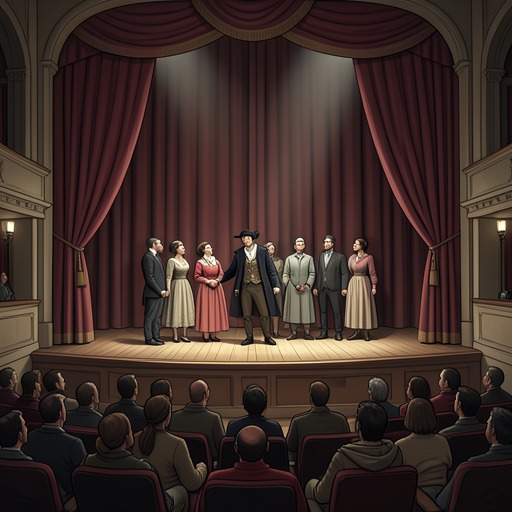
The premiere arrived under pressure. Williams waited nervously for the curtain while last-minute rehearsals had gone badly, feuds backstage threatened the actors’ onstage chemistry, and icy weather had nearly shut down Chicago. The strain revived the playwright’s memory of the Boston opening of Battle of Angels, a disastrous production four years earlier that had left him humiliated and deeply discouraged. This time, despite the obstacles, the company proceeded with the play’s first production.
Eddie Dowling and Louis J. Singer produced the Chicago staging; Dowling and Margo Jones staged it. Jo Mielziner designed and lighted the setting, and Paul Bowles composed the original music. Williams and his collaborators had chosen Chicago as a proving ground before facing New York critics. The decision made the opening a practical test as well as an artistic event: the production had to survive unsettled rehearsals and a difficult lead-up before the play could make its case to a wider audience.
A New Stage Language
The play’s theatrical design challenged the dominance of straightforward realism. Williams described his developing aesthetic as a plastic theatre: stage movement could be reduced to essential gestures and composed attitudes, while poetic transformation, rather than a photographic likeness, could approach truth more penetratingly. The production’s formal ambition therefore did not mean an escape from reality. Its unconventional methods were intended to interpret experience by changing its visible form.
The published script preserves a screen device that was omitted from the original Broadway acting version. Magic-lantern slides bearing images or titles were to appear on a section of wall between the front room and dining room, marking the structural emphasis of particular scenes and making allusions more legible without placing the full burden on dialogue. Williams accepted the device’s omission from the Broadway production, where Laurette Taylor’s performance made physical simplicity especially suitable, but retained it in print as a record of the original conception.
Music and lighting extended that approach beyond the spoken text. The recurring tune called “The Glass Menagerie” was designed to return between episodes as a thread connecting the narrator’s separate time and place with the story he tells. Its delicate, almost distant quality carries both the surface liveliness of life and an underlying sorrow, with the fragility of spun glass concentrated in its sound. The music is most closely associated with Laura and becomes clearest when the action turns toward her.
The lighting likewise departs from naturalistic illumination. The stage remains dim while shafts of light isolate selected figures and areas, sometimes directing attention away from the apparent center of action. During the quarrel between Tom and Amanda, for example, Laura receives the clearest pool of light despite having no active part in the argument; in the supper scene, her silent figure on the sofa remains the visual center. The production’s final image fulfills this design: while Tom speaks outside, Amanda comforts Laura in slow, graceful gestures, and Laura finally lifts her head to smile at her mother before blowing out the candles.
Reception and Consequences
The opening’s success emerged from the play’s material, the acting, Williams’s persistence, and what the introduction calls sheer good fortune. Reviews arrived as the production prepared to transfer to New York City, where it opened at the Playhouse Theatre on March 31, 1945, and ran for 563 performances. The movement from a troubled Chicago opening to an extended New York run marked a sharp reversal from Williams’s earlier failure and established the play as a major theatrical success.
The production also helped alter the terms of American stage drama. Audiences in the 1940s, weary of realism and prosaic dialogue, responded to Williams’s poetic language and formal invention in a theatrical climate described as static and predictable. Critics and theatre audiences were moved by the Wingfield household’s pathos and by Laurette Taylor’s performance as Amanda, while the playwright himself became an object of sudden attention. Williams later described the change as being pulled from virtual obscurity into prominence by what he called “the catastrophe of Success.”
The Premiere’s Lasting Significance
The premiere’s historical significance rests on the joining of experiment and emotional accessibility. Its stage devices did not displace the family drama; they gave its remembered experience a theatrical shape. A selective beam could make Laura central even when she was silent, music could carry nostalgia across episode breaks, and the final interplay between Tom’s speech and the family’s unseen-from-his-position comfort could hold separation and tenderness together.
The production’s influence also belongs to a broader history of theatre’s changing expectations. Williams drew on unconventional techniques, including elements associated with European expressionism, but combined them with romantic lyricism and an emphasis on representing reality through transformation. The Chicago opening introduced that combination to the public and began the play’s passage from a risky first production to a lasting work of American theatre.