The Wingfields’ father’s photograph
The Glass MenagerieThe Wingfields’ father’s photograph is the play’s enduring image of a man who left his family and remains present only as a portrait. Its handsome, smiling face hangs over the living room, silently marking the absence at the center of the Wingfield household. As Tom’s memory-play moves between domestic routines and imagined escape, the photograph becomes both evidence of the father’s departure and a model for the son’s eventual journey—and for the guilt that journey cannot erase.
Appearance and Place in the Apartment
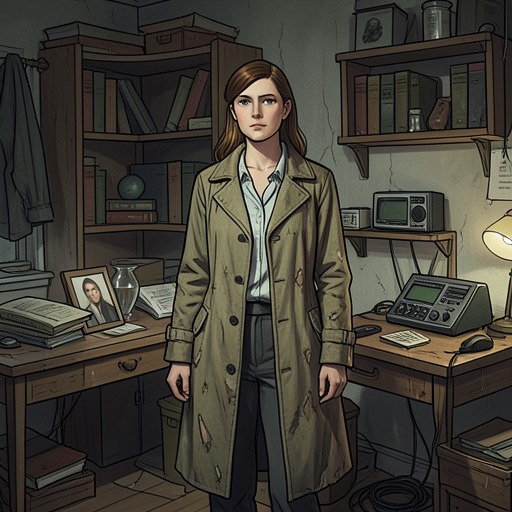
The portrait is a large, blown-up photograph displayed on the living-room wall to the left of the archway into the dining room. It shows a very handsome young man wearing a doughboy’s First World War cap, smiling with a permanence the play makes unsettling: the expression seems to promise that he will be smiling forever. It is not tucked away as a private keepsake. The household and the audience encounter it in a central shared space, where it presides over the rooms in which Amanda, Laura, and Tom live.
That domestic setting brings the photograph into view alongside the objects and routines that define the family’s confined life. The living room also serves as Laura’s sleeping room, with the sofa unfolding into her bed; an old-fashioned whatnot holds scores of transparent glass animals, while a typewriter and instructional charts stand beneath the wall-mounted portrait. The photograph therefore occupies a room shaped by both family memory and practical necessity: an image of the man who departed is fixed above a crowded space in which the remaining family must make do.
The Man Preserved in the Image
Tom introduces the absent father as the fifth character, one who never appears in person but remains visible in the larger-than-life photograph over the mantel. He was a telephone man who fell in love with long distances, left his job with the telephone company, and went away. The portrait preserves him as a handsome, gallant young man; the play’s account of his life, by contrast, defines him through movement and abandonment.
The last news the family received from him was a picture postcard from Mazatlan, on the Pacific coast of Mexico. It bore only the words “Hello — Goodbye!” and no address. The postcard gives the family a place and a farewell, but no means of finding or answering him. Set beside the permanent grin in the portrait, that brief message sharpens the contrast between a face that seems never to change and a man whose departure remains unresolved.
A Silent Presence in Family Life
The photograph does not speak, but the characters’ attention to it gives it an active place in the family’s emotional life. After Tom resists Amanda’s appeal to think about the future and steps onto the landing to smoke, Amanda is left alone with her husband’s picture. Her glance makes the portrait a point of contact with the marriage and life she did not expect: she had imagined marrying a planter, but instead married the telephone man whose smiling image now remains after his departure.
Amanda later recounts that history to Jim while pointing to the portrait. She identifies the pictured man as the telephone worker who fell in love with long distance, and says that he now travels somewhere she does not even know. In the same conversation, she recalls her former expectation of gracious living and the planters who had been her gentlemen callers. The photograph thus anchors her recollection in the room, while her account connects the young man’s departure to the loss of the future she had imagined for herself.
Its presence also frames Tom’s own sense of resemblance and resentment. Speaking privately with Jim, Tom calls himself like his father and links that likeness to the father’s grin and nearly sixteen years of absence. The portrait offers Tom a visible image through which to describe a feared inheritance: not merely a resemblance of face, but the prospect of leaving the family as his father did. Tom admits that his mother does not know his plans, making the silent image a particularly charged witness to the escape he is concealing.
Recurrence and Dramatic Meaning
The portrait is more than a stable piece of set dressing because the play makes its visibility change with the action. During a scene with Laura and Tom, the father’s grinning photograph lights up just after Tom describes the difficulty of getting out of a nailed-up coffin without removing a nail. The lighting briefly draws the absent man into the scene at the moment Tom voices his feeling of entrapment. The image does not explain or resolve that predicament; it intensifies the connection between the father’s departure and the son’s desire for an exit.
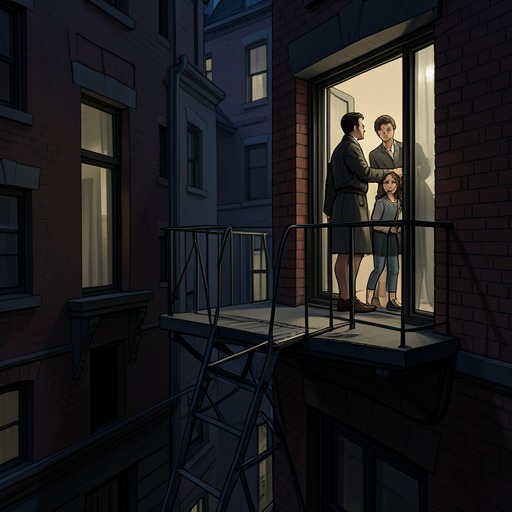
At the play’s close, the father’s picture remains part of the action even as attention shifts between Tom outside on the fire escape and the family inside. During Tom’s closing speech, Amanda comforts Laura on the sofa. Once her words can no longer be heard, Amanda’s manner appears dignified and tragically beautiful; her gestures are slow and graceful, and after Laura lifts her head to smile at her mother, Amanda glances briefly at her husband’s picture before withdrawing through the portieres. Laura then blows out the candles, ending the play. The portrait’s brief return of attention binds Amanda’s present grief to the absent husband whose departure shaped the family’s life.
For Tom, the father’s image becomes a point of comparison that departure cannot make final. Tom eventually leaves St. Louis and follows in his father’s footsteps, traveling from place to place. Yet his closing account says that movement does not restore what was lost: familiar music or a piece of transparent glass can bring Laura back to him, and he tries to escape that memory by crossing the street, going into a movie theater or bar, or speaking to a stranger. The portrait’s fixed smile therefore carries an irony. The father appears to have vanished into distance, but his example persists in Tom’s life, while Tom’s own flight remains haunted by the sister he could not leave behind.