Tom Wingfield–Laura Wingfield sibling relationship
The Glass MenagerieTom Wingfield–Laura Wingfield sibling relationship is the play’s central bond of care under pressure: Tom is expected to secure Laura’s future, yet his longing to escape the Wingfield apartment makes that responsibility feel like a confinement. His departure changes their relationship from daily proximity to an enduring, painful attachment. In the closing speech, travel carries him far from home but cannot carry him beyond Laura’s memory.
Identity and Background
The siblings’ relationship is presented within a family with few secure prospects. Amanda recalls that Laura’s attempt at business college ended in failure after fright made her sick, and that Laura also failed to find a place among the young people at church: she spoke to nobody, and nobody spoke to her. In Amanda’s account, Laura’s days have narrowed to handling pieces of glass and playing the old records left by her absent father. The account makes clear why Amanda sees Tom as more than a son living at home: she treats his sister’s dependence as a claim on his future.
Amanda’s fear is not abstract. She imagines the alternative for unmarried women as a life of dependence on relatives, confined to a small room and sustained by grudging help. She asks whether this is the future she and Laura have mapped out, then adds that some girls marry. The prospect of marriage is therefore presented as an escape route from economic dependence, while the family’s immediate practical hope rests on Laura finding a husband who can provide a home of her own.
Care and Obligation
Amanda makes the terms of Tom’s obligation explicit: once Laura has someone to care for her, a marriage and an independent home, Tom will be free to go wherever he wishes, by land or sea. Until then, she insists, he must look out for his sister because she is young and dependent. She frames his desire to leave as selfishness, but her argument also reveals how little room the family’s circumstances leave for any of them to choose freely. Laura’s dependence becomes the reason Tom must stay; Tom’s staying, in turn, is treated as the means by which Laura might eventually become independent.
The relationship is not only an arrangement imposed by Amanda. When Tom returns late, Laura finds that his bed is empty and opens the door as he struggles to locate his key. He is unsteady, and the objects spilling from his pockets include movie ticket stubs and an empty bottle. Laura calls to him and asks where he has been. The moment places her in the role of the sibling who notices his absence and meets him at the threshold, even as the scene’s details expose Tom’s restless life outside the apartment.
Escape and Memory
Tom’s eventual departure does not end the bond. In his closing speech, he says that he did not go to the moon but much farther, and describes leaving Saint Louis, descending the fire escape for the last time, and following his father’s footsteps. He travels from city to city, but motion proves unable to restore what was lost at home. The repeated image of distance turns escape into a failed separation: the farther Tom goes, the more clearly the remembered relationship persists.
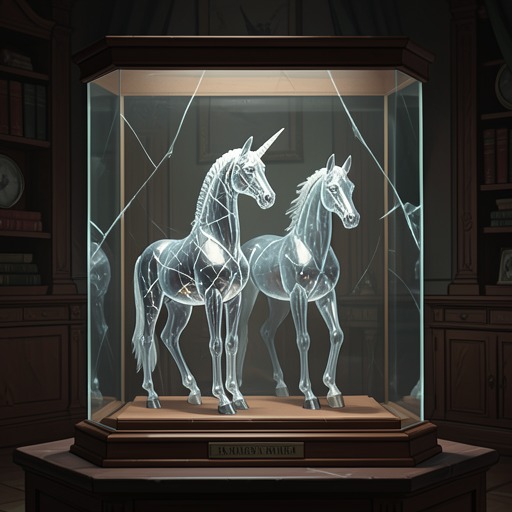
That persistence arrives through sensory fragments rather than a reunion. A familiar piece of music or a piece of transparent glass can bring Laura back to him. He imagines walking at night in an unfamiliar city, alone before finding companions, and seeing a shop window filled with colored glass and delicate bottles like pieces of a shattered rainbow. In that instant, his sister touches his shoulder in memory and he looks into her eyes. The glass that recalls her also connects the traveling adult to the sister whose days Amanda had described as absorbed in glass objects.
Separation and Significance
Tom admits that he tried to leave Laura behind but became more faithful to her than he intended. When memory returns, he responds by reaching for a cigarette, crossing the street, going into a movie house or bar, buying a drink, or speaking to the nearest stranger—anything that might extinguish the candles associated with Laura. The actions do not erase the memory; their urgency measures its hold. His physical escape and emotional attachment remain in conflict, with neither simply cancelling the other.
The play closes by bringing the separated siblings together in its theatrical design while keeping them apart in the story. As Tom speaks, Laura is shown inside the apartment, huddled on the sofa, while Amanda comforts her. Laura eventually lifts her head to smile at her mother; Amanda glances at the father’s picture and withdraws. Tom’s narration then asks Laura to blow out her candles and says goodbye. Laura performs the final action, ending the play, while Tom’s words make clear that the farewell has not ended his attachment. Their relationship is thus defined by an unresolved asymmetry: Laura remains at home, and Tom leaves, but memory keeps returning him to her.