Tom Wingfield–Mr. Wingfield father–son relationship
The Glass MenagerieTom Wingfield’s relationship with Mr. Wingfield is a bond formed largely through absence: a father who left the family becomes a photograph, a postcard, and finally a model for his son’s departure. Tom follows Mr. Wingfield into a life of movement, but the play’s ending distinguishes imitation from escape. The son travels far and still cannot leave his sister—or the past represented by the family home—behind.
The Father Who Left
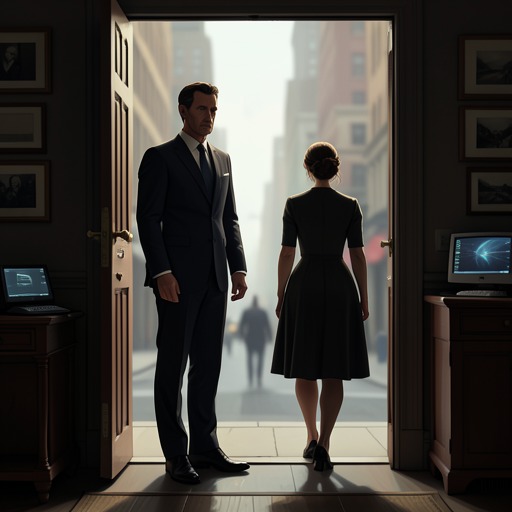
Mr. Wingfield is the play’s unseen fifth character, present only through a larger-than-life-size photograph over the mantel. Tom identifies him as a telephone man who fell in love with long distances, gave up his job with the telephone company, and left town. The account makes distance more than a feature of his work: it becomes the governing image of his life and the inheritance his son will later take up.
The family’s last news of Mr. Wingfield is a picture postcard from Mazatlan, on the Pacific coast of Mexico. Its two-word message, “Hello — Goodbye!” carries no address. The postcard offers a greeting and a farewell without opening a way back; like the photograph, it preserves a sign of the father while emphasizing his unavailability. His absence has lasted nearly sixteen years by the time Tom speaks of him to Jim.
An Inheritance of Escape
During a fierce quarrel with Amanda, Tom measures the life he feels trapped in against the father who is already gone. He insists that he hates the warehouse and the Continental Shoemakers, describing its celotex interior and fluorescent tubes, and says that for sixty-five dollars a month he gives up his dreams. When Amanda accuses him of thinking only of himself, Tom points to his father’s picture and argues that, if selfishness alone governed him, he would already be gone. The comparison turns the photograph into more than a family relic: it is the visible precedent against which Tom defends his own frustrated desire to leave.
Tom’s language also reveals the cost of treating his father as a pattern. In speaking privately with Jim, he calls himself like his father and links that resemblance to the father’s long absence and grinning photograph. He tells Jim he will not be there, but Jim challenges him as merely talking and asks how Amanda would feel; Tom answers that she does not know his plans. The exchange places Tom’s wish for departure alongside the family ties his father abandoned, without making the two departures morally or emotionally identical.
Following His Father’s Footsteps
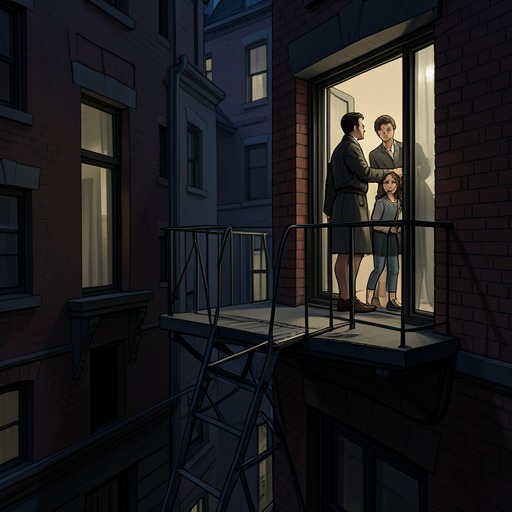
Tom’s closing speech supplies the outcome that his earlier threats only anticipate. After writing a poem on a shoe-box lid, he is fired; he leaves St. Louis, descends the fire escape for the last time, and follows in his father’s footsteps. He travels widely, describing cities as brightly colored leaves torn from their branches. The movement is real, but it brings no settled freedom: Tom says he would have stopped, yet something keeps pursuing him.
What pursues Tom arrives without warning and may be a familiar piece of music or a piece of transparent glass. In a strange city, he imagines passing a lit shop window filled with colored glass and tiny bottles, delicate as fragments of a shattered rainbow; at that moment his sister seems to touch his shoulder, and he turns to meet her eyes. The image gathers the play’s fragile objects and remembered sounds into the form of an encounter that travel cannot prevent. Tom’s declaration that he tried to leave Laura behind but is more faithful than he intended to be makes the limits of his father’s example explicit: he can repeat Mr. Wingfield’s departure, but he cannot make absence erase attachment.
The Meaning of the Resemblance
The father–son resemblance is therefore both action and contrast. Mr. Wingfield’s departure establishes the route Tom eventually takes, and the father’s photograph remains present during the argument in which Tom imagines escaping. Yet Tom’s final account is not a simple celebration of the freedom his father appears to embody. Although Tom crosses cities and seeks distraction in movies, bars, drinks, and conversation with strangers, memories of Laura return and drive him to keep moving.
The play closes by holding departure and fidelity together. As Tom speaks, Amanda silently comforts Laura; Laura raises her head to smile, and Amanda glances toward Mr. Wingfield’s photograph before withdrawing. Laura then blows out the candles. Tom ends with a farewell, but the image of his sister’s return makes that goodbye unresolved: the son has followed his father into the distance, while the family bond the father left behind continues to claim him.