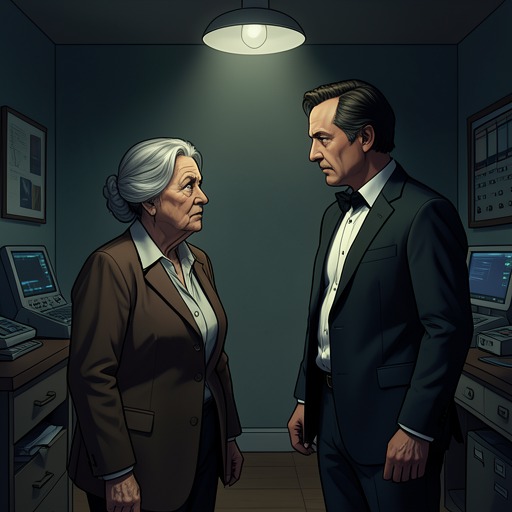
Tom and Amanda's fight over Tom's escape
The Glass MenagerieTom and Amanda's fight over Tom's escape is the play’s sharpest domestic collision between a son’s desire to leave and a mother’s fear that his departure will undo the family’s fragile security. Tom’s job, the household’s bills, Amanda’s abandoned hopes for Laura, and the broken glass collection all converge in a quarrel that makes escape feel both necessary and costly.
Background: Money, Work, and Limited Choices
The argument grows out of material pressures as well as personal frustration. Tom works at a warehouse, where he says he earns sixty-five dollars a month, and Amanda insists that jeopardizing his job would endanger everyone’s security. Later, her question about a light bill she had given him several days earlier returns the family’s finances to the foreground: even in an ordinary exchange, Tom’s contribution and the household’s expenses remain inseparable.
Amanda’s alarm has another source. Laura has left business college after being unable to face its demands, and Amanda mourns the fifty dollars paid for tuition, along with the hopes and plans she had attached to her daughter’s career. She imagines the alternative as lifelong dependency: unmarried women without positions living on reluctant support from relatives, confined to small rooms and eating what she calls the crust of humility. Marriage, she concedes, may offer another possibility, but she cannot make it a plan. Her anxious question about what the two women will do for the rest of their lives turns Laura’s withdrawal into a pressure on Tom as well.
The family’s predicament sits against the play’s broader account of the 1930s. Tom’s opening narration describes an economy that has failed ordinary people and recalls labor disturbances in cities including Chicago and St. Louis. That context does not erase the household’s particular circumstances: here, the crisis is rendered through tuition lost, a warehouse wage, the light bill, and Amanda’s fear of having no dependable future for herself and Laura.
The Argument Escalates
The quarrel begins with Tom asking what he is supposed to do, while Laura stands apart with clenched hands and a panicked expression. Amanda’s objections to his conduct and Tom’s sense that he has no life he can call his own quickly turn the dispute into a struggle over who has the right to set the terms of his life. One flashpoint is Amanda’s confiscation of his books. She explains that she returned a novel she considered indecent; Tom laughs, and Amanda responds with a categorical rejection of what she calls filth in her house.
When Tom tears open the portieres, the stage reveals what the quarrel has interrupted: his typewriter and manuscripts lie in disorder on the table, and Amanda, in curlers and an old bathrobe associated with the absent Mr. Wingfield, faces him in the room. An overturned chair and their shadows thrown onto the ceiling make the domestic scene visibly unsettled. The stage direction suggests that Amanda’s interruption of Tom’s creative work probably precipitated the argument, connecting his claims to independence not only with the warehouse job but also with writing he is trying to do at home.
Tom explains that he cannot bear the warehouse or the prospect of spending his life in its fluorescent-lit interior. He describes the daily routine as surrendering his dreams and possibilities for his wage, and says Amanda’s repeated morning calls make him think of how fortunate the dead are. He contrasts his own continuing presence with that of his father, whose photograph he points to as he insists that, if he thought only of himself, he would already be gone wherever transportation could take him. Amanda grabs his arm as he tries to pass; Tom tells her not to hold on to him. The argument gives physical form to the conflict: she tries to keep him in place, while he tries to get through the door.
Escape as Joke and Threat
Amanda asks where Tom is going, and he says he is going to the movies. When she calls that an excuse, he answers by inventing a string of criminal identities: an opium-den visitor, a hired assassin, a gang leader, a gambling-casino regular, and a figure called El Diablo. He casts the warehouse worker by day as an underworld ruler by night, making his account so extravagant that it reads as provocation rather than a credible explanation of his plans. His joke turns the mother’s suspicion into an opportunity to show how little she knows about the life he imagines beyond the household.
The fantasy also lets Tom articulate the violence of feeling trapped without offering a practical route out. He imagines enemies dynamiting the family home and tells Amanda that he would welcome its destruction; he then pictures her going over Blue Mountain with seventeen gentlemen callers. His insults expose the quarrel’s emotional injury, but they do not settle the argument about what he will actually do. The scene leaves his departure a threat and a desire, not a completed escape.
The Glass Collection and the Aftermath
Tom’s attempt to leave becomes clumsy and destructive. He grabs his overcoat, struggles to put it on, tears its shoulder, and throws it across the room. It strikes the shelf holding Laura’s glass collection, and glass breaks. Laura cries out for her menagerie and covers her face. A screen legend naming the collection follows the sound of the break, giving the damaged object a distinct place in the scene rather than treating it as incidental household disorder.
The broken glass makes the quarrel’s cost visible to Laura, who has stood between her mother’s expectations and her brother’s anger. Yet Amanda is still stunned by Tom’s insult and barely notices what has happened. When she recovers, she says she will not speak to him until he apologizes. The immediate consequence is therefore not reconciliation: the quarrel ends with a damaged collection, Laura’s distress, and a demand for apology, while the practical question of Tom’s future remains open.
Significance
The fight binds together the play’s principal pressures without resolving them. Amanda fears that Tom’s job is the family’s remaining source of security and that Laura’s abandoned career leaves the women dependent; Tom experiences that same job and household duty as a confinement that consumes the life he wants to lead. Each sees a real cost the other cannot accept. His imagined escape offers no reassuring plan, while her appeal to security cannot answer his sense that staying means giving up his dreams.
In the play’s memory form, the argument is not presented as neutral domestic realism. Tom’s introduction explains that the action returns to the 1930s and that a memory play is dimly lit, sentimental, and accompanied by music. The quarrel’s red-lit room, heightened shadows, screen legends, and shattered glass belong to that openly shaped recollection. Within it, the break in Laura’s collection gives Tom’s outburst a consequence beyond the mother and son: the struggle over whether he can leave reaches the fragile world of the sister caught between them.