Unicorns
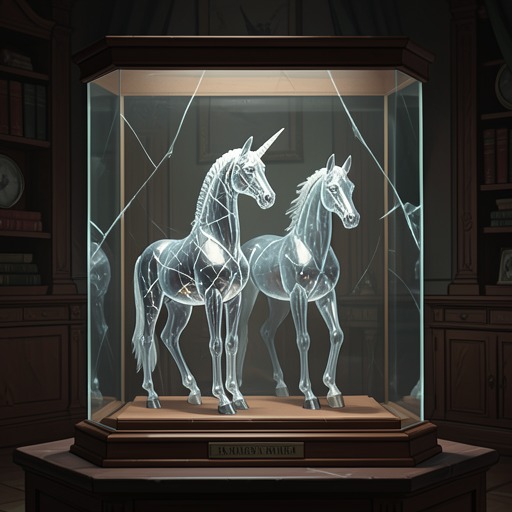
The Glass MenagerieThe unicorns in Laura Wingfield’s glass menagerie are miniature glass animals, and the single unicorn stands apart from the ordinary horses through the horn on its forehead. Laura identifies it as her favorite; after Jim O’Connor accidentally breaks the horn, she imagines the change as an operation that makes the creature feel less freakish and more at home with the other horses. Its altered form gives the scene a delicate, unresolved emblem of difference and belonging: the unicorn becomes more like its companions, but only through breakage.
Appearance and Place in the Collection
Laura describes the glass menagerie as a group of tiny animal ornaments and offers Jim an example, identifying it as one of the oldest. When he asks what kind of creature he is looking at, she directs his attention to the single horn on its forehead. Jim recognizes it as a unicorn and remarks that unicorns are extinct in the modern world. Their exchange defines the creature through a distinction: it is a horse-like animal, yet its horn marks it as unlike the other horses and out of place in the modern world.
Laura says she should not be partial, but the unicorn is her favorite. That preference makes the figure more than an interchangeable piece in the collection. It is a carefully cherished object, singled out among the ornaments Laura has shown Jim. When Jim reaches toward it, the scene places the vulnerable miniature within the space of their encounter: its shine attracts attention, but its glass construction also makes its vulnerability immediate.
Difference and Imagined Isolation
Jim’s question about whether unicorns are extinct turns the horn into a sign of difference as well as a physical feature. Laura already knows they are extinct; Jim then imagines that the unicorn must feel lonesome. The play does not give the glass animal a voice or an independent history. Instead, the exchange lends it a possible feeling through Jim’s remark, while the animal remains a delicate object in Laura’s collection.
That imagined loneliness becomes especially suggestive when Laura later describes the unicorn’s altered condition. Its singularity has made it conspicuous among ordinary horses; after the horn is gone, Laura says, it can feel more at home with them. The creature’s place in the collection thus connects distinction with isolation and likeness with acceptance, without settling whether becoming more like the others is a comfort, a loss, or both.
The Broken Horn
During the visit, the glass unicorn falls and its horn breaks. Jim hopes the damaged piece is not Laura’s unicorn; she confirms that it is and stoops to pick it up. The accident changes the object itself, turning the scene’s earlier talk of an extinct, lonely creature into a concrete alteration. Jim acknowledges that he caused the damage and apologizes; Laura does not treat it as a tragedy.
Laura explains that glass breaks easily, however carefully it is handled, and that traffic jars the shelves and makes things fall. Her explanation places the accident within the ordinary risks of keeping fragile ornaments, rather than presenting it as deliberate destruction. The detail also makes the break part of the menagerie’s continuing vulnerability: care cannot guarantee that the figures will remain intact.
After the Break
Laura answers the loss of the horn by saying the unicorn is now like all the other horses. She then imagines that it had an operation to remove the horn so that it would feel less freakish. The language does not undo the physical break; it gives the damage a consoling interpretation. Jim and Laura laugh together, and Laura says the altered animal will feel more at home among the hornless horses.
The scene’s change is double-edged. The unicorn loses precisely the feature that made it distinctive, yet Laura presents that loss as a route to companionship. Her suggestion that the operation might be a blessing in disguise turns an accident into a possibility of adaptation, while the laughter allows the pair to share the idea without erasing the object’s fragility. Jim responds by telling Laura that he is glad she has a sense of humor and that she is surprisingly different from anyone else he knows. The exchange moves from the changed creature to his perception of Laura, but the unicorn’s new resemblance to the other horses remains the scene’s central image of difference made more socially legible through damage.
Narrative Significance
The unicorn’s broken horn gives physical form to a tension between singularity and belonging. Before the accident, its horn distinguishes it from the other horses; after it breaks, Laura imagines that it can join them more easily. The object does not simply symbolize isolation or acceptance: the same change that lessens its difference also records an irreversible break in the glass.
Because the unicorn belongs to Laura’s fragile collection and is her favorite, Jim’s accidental damage carries a personal consequence within their meeting. Laura responds neither by denying the break nor by treating it as ruin. She acknowledges the loss, jokes about an operation, and imagines the creature at home with its companions. The unicorn’s altered shape therefore holds together vulnerability, difference, and the possibility of accommodation, while leaving the cost of that accommodation visible.