Wingfield apartment
The Glass MenagerieThe Wingfield apartment is the physical and theatrical center of Tom Wingfield’s memory play: a ground-floor home whose confined rooms gather the family’s economic anxieties, Amanda’s hopes for Laura, and Tom’s desire to leave. Its alley entrance and fire escape frame departure as part of daily life, while its glass collection, work-related charts, and absent father’s photograph preserve the pressures and memories that shape the household. The apartment is not presented as a neutral setting. Its architecture and stage transformations make the family’s confinement, and the emotional force of Tom’s recollections, visible.
Setting and Architecture
The apartment occupies the rear of a large, hive-like tenement in an overcrowded lower-middle-class district. It faces an alley and is reached by a fire escape, whose name carries an unintended poetic meaning in a building associated with human desperation. Narrow alleys flank the tenement, running between tangled clotheslines, garbage cans, and neighboring fire escapes. The play uses these side alleys for exterior entrances and exits, so the apartment’s boundaries are connected to routes of movement beyond it.
The home is divided into a living room and a dining room. Nearest the audience, the living room also serves as Laura’s sleeping space: the sofa unfolds into her bed. A wide arch separates it from the dining room, with transparent portieres functioning like a second curtain. This arrangement makes the apartment’s domestic spaces distinct but visually permeable, as if private family life can never be fully screened from view.
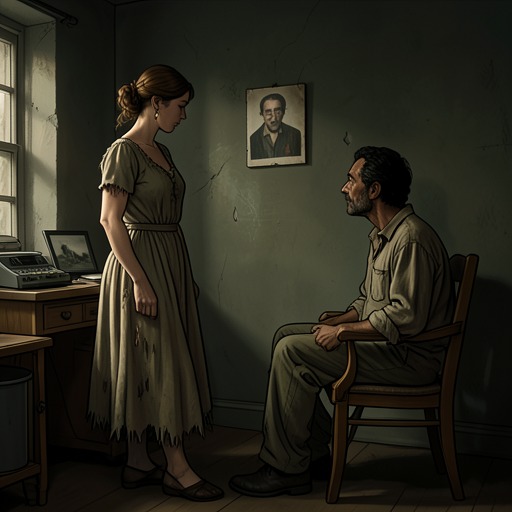
The living room’s old-fashioned whatnot holds scores of transparent glass animals. Nearby hangs a large photograph of the father, shown as a handsome young man in a First World War doughboy’s cap, smiling beneath a typewriter keyboard chart and a Gregg shorthand diagram. An upright typewriter stands below the charts. Together, these objects set the fragile glass collection beside practical signs of work and education, while the father’s image keeps an absent family member present in the room.
A Home Shaped by Memory and Performance
The apartment is presented through memory rather than strict realism. Tom’s recollection gives the scene a dim, poetic quality: some details are omitted and others enlarged according to their emotional importance. Music accompanies memory, and the stage setting reflects that principle rather than claiming to reproduce an ordinary room exactly.
At the opening, the audience sees the tenement’s dark rear wall. As Tom finishes his opening commentary, that wall becomes transparent, revealing the apartment within. The audience watches the dining-room scene through both the building’s transparent exterior wall and the transparent portieres; during the scene, the fourth wall slowly rises out of sight. This staged unveiling turns the home into something exposed to observation, even as the play marks it as a construction of Tom’s memory.
The exterior wall remains raised through the play and returns only at its very end, during Tom’s closing speech. The apartment is thus framed at once as a particular family home and as a remembered space that the performance can disclose, conceal, and finally close off. Its theatrical openness does not dissolve its confinement; it makes that confinement legible.
Economic Pressures Inside the Home
The apartment’s intimate family conflicts belong to a wider social background. Tom sets the story in the thirties, describing an American middle class confronting a dissolving economy. He contrasts labor disturbances in American cities, including Saint Louis, with revolution and the bombing of Guernica in Spain. This historical frame does not make the household’s problems interchangeable with those events; it locates the family’s precarious choices within a period of economic and social strain.
Inside the apartment, money and employment give that strain specific form. Amanda recalls that the fifty dollars spent on Laura’s business-college tuition, together with her hopes for Laura’s future, has been lost after Laura could not continue. She fears a future in which her unmarried daughter will depend on relatives and lack a secure place of her own. Her question about what remains for them is not abstract: the family has given up on a business career after the experience caused nervous indigestion, and she can imagine dependency as their remaining prospect unless marriage offers another possibility.
Tom’s warehouse job is another measure of the household’s dependence on wages. He says that for sixty-five dollars a month he gives up what he dreams of doing and becoming, while Amanda warns that jeopardizing his job would threaten the security of them all. The apartment is therefore both refuge and point of pressure: the family shares a home whose continued security is tied to work Tom resents and Laura’s uncertain prospects.
The light bill brings the household’s financial precariousness into a small domestic exchange. Amanda reminds Tom of the bill and the notices they have received; his brief acknowledgment leaves the practical matter hanging between them. Alongside the lost tuition and Tom’s wages, the bill shows how economic insecurity enters the apartment not only through arguments about the future but through recurring household obligations.
Family Memory and the Meaning of Departure
The apartment’s objects and rooms carry the family’s unfinished past. The father’s photograph hangs above the room, and Amanda describes the phonograph records he left as a painful reminder of him. His smiling image remains fixed on the wall while Tom points to it during their argument and imagines being gone as far as transportation can reach. The photograph makes absence part of the apartment’s visible furnishing; Tom’s response turns it into a comparison between the father’s departure and his own frustrated wish to escape.
The fire escape gives that wish a physical route. Tom enters in merchant-sailor clothing, crosses to it, and addresses the audience from the threshold. Later, after an argument with Amanda about his job and the family’s security, he says he is going to the movies. At the close, he recalls that he left Saint Louis and descended the fire-escape steps for the last time, following his father’s footsteps and traveling in an effort to recover what had been lost. The apartment’s exit thus links an early image of possible movement to the later account of actual departure.
Departure does not end the apartment’s hold on Tom’s memory. In his closing speech, he describes being pursued by reminders that may take the form of familiar music or a piece of transparent glass. He imagines Laura touching his shoulder, and acknowledges that he tried to leave her behind but remains more faithful to her than he intended. Inside the apartment, Laura is huddled on the sofa as Amanda comforts her; Amanda’s gestures become slow and graceful, and Laura eventually lifts her head to smile at her mother. Laura then blows out the candles as Tom’s speech ends. The return of the father’s photograph, the glass imagery, the fire escape, and the final domestic tableau makes the apartment more than the place Tom left: it is the remembered home his journey cannot put behind him.