Černopolní
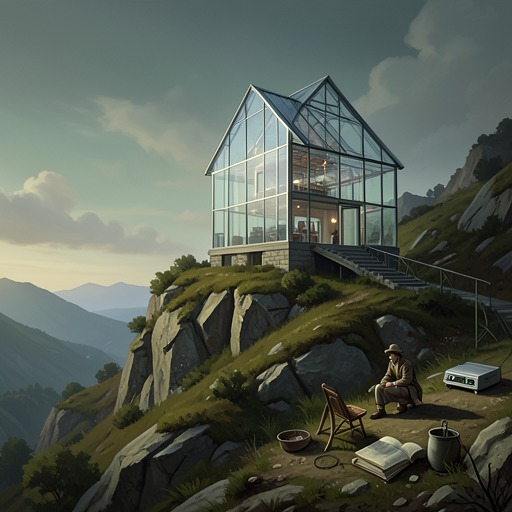
The Glass RoomČernopolní is the steep hillside above Město where the Landauer House is built, a place whose commanding view first promises openness and possibility, then witnesses the conversion of a private modernist home into an instrument of Nazi racial administration and, later, a state-owned children’s gymnasium. Its identity is inseparable from the house: the hill sets the scene, while successive uses of the building reveal how power can remake a place without erasing its earlier meanings.
Setting and prospect
When Viktor Landauer asks Rainer von Abt to imagine a family home, he describes a steeply sloping site overlooking the whole city. Below the hill lies Lužánky Park, formerly known by its Austrian name, Augarten; as Viktor observes, the world there has two names, Austrian and Czech. The view belongs to a city shaped by overlapping languages and histories, and the house is conceived to meet that prospect rather than withdraw from it.
After lunch, Viktor drives Liesel and von Abt up Černopolní to inspect the plot. From a gravel lay-by, roofs stretch away like a choppy sea toward the Špilas fortress. Beyond the gate, meadow falls first gently and then steeply toward trees; a large house is faintly visible below, with Parkstrasse and the park beyond. The damp, blustery weather blurs the view through Liesel’s spectacles, but she asks whether the position is not fine. The hillside is presented as both a physical challenge and an expansive canvas for the proposed home.
Building on the hillside
Construction begins in March, after the ground thaws into mud. A mechanical excavator cuts into the slope, leaving the hilltop scarred and crevassed; a ramp of planks stabilizes the descent into rust-coloured soil as hard as rock. The foundations require piles driven into the hard-pan and a concrete base. Steel pillars arrive from Gossen in Berlin, and the vertical supports are assembled from four riveted angle-beams to form cruciform columns. Their construction is so unusual that the narration suggests a private house may never before have been built in this manner.
The project proceeds alongside the growth of Liesel and Viktor’s family. The house advances through steel beams, poured concrete, and the enclosure of space, while delays, material shortages, and workforce problems stretch through summer and autumn. Once Italian travertine is laid upstairs and the wide living-room glass is fitted, the empty space between the concrete floors becomes the Glass Room. Light reflects from glass and chrome and reaches into the garden; the hillside house turns its prospect into an interior experience of openness.
A modernist home, repurposed
The house’s later history reverses its intended domestic function. Under Nazi occupation, the Landauer House is transformed into a biometric research centre. Upstairs rooms become offices, the kitchens are converted into a laboratory, and a basement room is prepared for an X-ray machine. Anthropometric equipment is placed before the onyx wall: scales, a height stand, and a chair fitted with suspended steel rulers. The dining area becomes a photographic studio, with drapes and lights arranged around its curved panelling. Even the Bösendorfer piano remains, restored by a Jewish piano tuner whom Stahl has engaged.
The hillside’s residential setting thus becomes the stage for an institutional invasion of the home. The house’s light, open rooms and carefully designed surfaces are reorganized for measurement, photography, and documentation. Its physical features do not disappear; they are commandeered. The contrast between a family dwelling conceived around space and possibility and rooms adapted to classify and record people makes the building’s changing use a concrete expression of the changing order imposed on the city.
From gymnasium to architectural heritage
In a later period, the Landauer House serves as a children’s gymnasium in the Blackfield district, a residential area of bourgeois villas overlooking Lužánky Park and the city centre. A newspaper correspondent acknowledges the value of providing sick children with a healthy environment but questions whether an architectural treasure should be used for that purpose. The article identifies the house as the Landauers’ work, designed by Rainer von Abt in the late 1920s and regarded as his masterpiece and his last European work before he fled to the United States in 1938.
The gymnasium is also a lived space rather than merely a disputed monument. Tomáš calls it the Glass Room; the word he uses for room can also mean peace, quiet, or tranquillity. After work, he finds light and stillness there with Zdenka, and sometimes watches her dance classes. The building’s meaning shifts again: once a private home and then a Nazi research centre, it accommodates treatment and ordinary intimacies under state ownership. The same glass enclosure associated with modernist openness becomes a place of practical care and personal refuge.
Restoration and remembered place
By 1990 the house exists, in the narration’s image, fixed in time like a fossil. Repairs are poorly done; some original furniture is brought back from the Moravian Museum, while updated bathroom fittings are described as ruined. The Glass Room’s window panes, however, are replaced with plate glass, restoring the space’s lucid splendour. Visitors include trade-union groups and dignitaries from fraternal Soviet states, followed later by tourists and architecture students interested in von Abt’s place in modernism.
Shortly after the fall of the Iron Curtain, Marie Delmas travels from Paris to Město after encountering a photograph of the house in a book on modern architecture. Its image is not simply an architectural record for her: the caption, “La Villa Landauer, the south elevation,” brings her to a place bound to her own memory. Černopolní therefore serves as more than a prominent site above the city. Across construction, appropriation, treatment, preservation, and return, it holds together the house’s successive lives and the personal histories that its enduring form can unexpectedly call back.