Černovice aerodrome
The Glass RoomČernovice aerodrome is the tense threshold at which the Landauer family’s escape from Město turns from a plan into a departure. As German forces occupy the airfield and the scheduled flight is cancelled, Viktor secures a way onto a Swissair flight to Zurich; the family boards, while Hana and Oskar remain behind. The aerodrome makes physical what the farewell names: some can cross the border, and others are left in place.
The Road to the Airfield
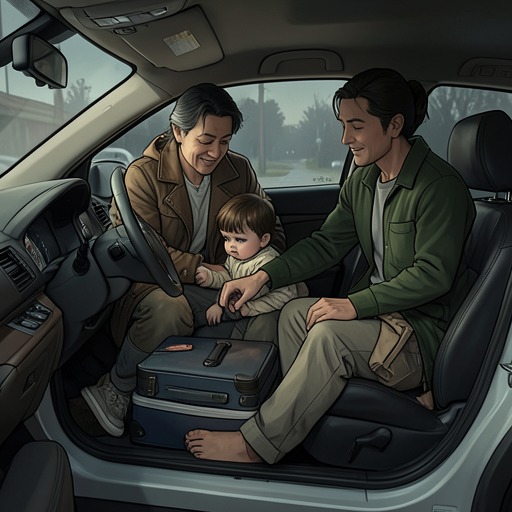
The family reaches the aerodrome by convoy, passing army vehicles and turning into the tunnel beneath the railway line, away from the city centre and towards Černovice. At the airfield, grey vehicles bearing iron crosses stand around the perimeter, armed soldiers patrol, and entry is granted only after Viktor presents the tickets and explains the problem. The departure is not a simple journey to an airport: every step depends on negotiation with the occupying force.
The building is crowded with people pressing around airline desks as Czech policemen try to maintain order and German soldiers stand guard. Viktor waves the family’s tickets above the crowd, but an announcement in German and Czech reports that the Air France flight from Paris has been cancelled, with German spoken first. Through the windows, the family sees its aircraft on the apron: its Swiss cross and bright metal fuselage set against the dull grey Luftwaffe planes marked with the Hakenkreuz.
A Departure Secured
The uncertainty briefly opens the possibility that the family may have to return to Město. Liesel clings to Hana, who now seems strong after having recently appeared fragile, and admits to herself a suppressed hope that the flight will not go: that they might turn back to the quiet comfort of the Glass Room. The prospect of safety therefore carries its own cost. Leaving means abandoning the home and the familiar life the family is still reluctant to relinquish.
Viktor returns with a stern but satisfied expression, and a trolley of suitcases is already being pushed towards the plane. He says Laník can go and urges the family to move before the authorities change their minds. The announcement that the Swissair flight to Zurich will leave in fifteen minutes converts a precarious negotiation into a narrow window for escape. As the children head for the gate, Martin repeats excitedly that they are going to fly.
The People Who Remain
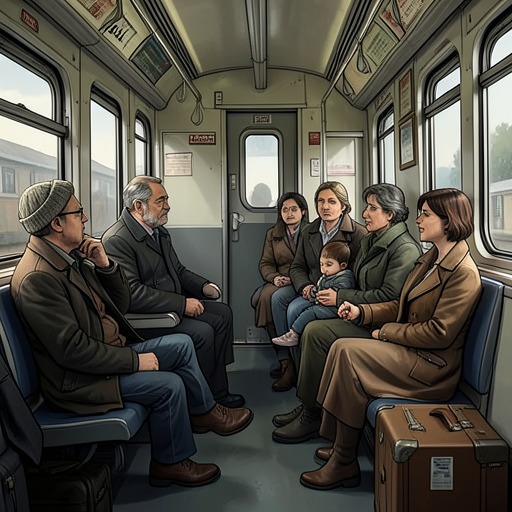
At the doorway, a border guard checks the travellers’ papers. Katalin and Marika’s Nansen passports are glanced at and handed back with a shrug; when the guard asks Hana for her passport, she has none. She explains that they are just friends and the people left behind. The contrast is stark: Katalin and Marika pass the checkpoint with documents, while Hana and Oskar follow the departing family like a couple at a funeral, unable to find words for the separation.
The airfield’s function in the story is thus more than transportation. It is a place where escape depends on tickets, official permission, and papers, and where the group’s relationships are divided by those conditions. The Swiss flight carries the Landauer family towards refuge, but the departure also fixes the other half of the scene: Hana and Oskar stay behind, and the farewell makes exile a separation between people as well as a passage across a border.