Špilas Castle
The Glass RoomŠpilas Castle is both a feature of Město’s skyline and a fixed point within the changing uses of the Landauer House. Seen from the house’s expansive Glass Room and later exposed beneath Soviet flares, it connects architectural openness to the violence and political upheaval unfolding beyond the windows. Its appearances do not make the fortress the centre of the action; instead, it gives the city’s distant history and immediate danger a visible, recurring presence.
A Landmark Across the City
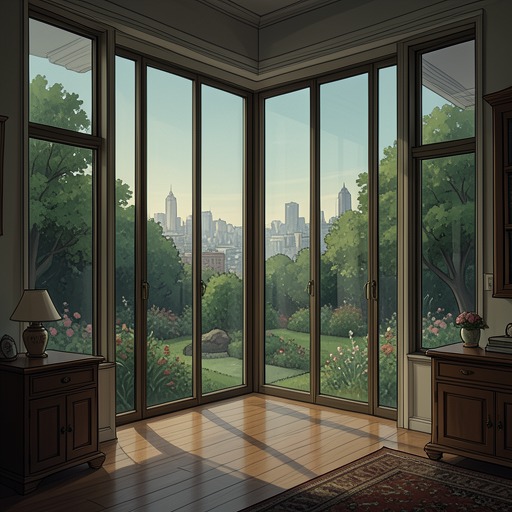
In the Landauer House’s south-facing living room, light and space are organised around a view across Město to Špilas Castle. The room measures 230 square metres and has two entire walls of glass, making the city and its landmark part of the domestic interior. That view belongs to a house designed for a family, but the building’s later transformations make the fortress visible from a space repeatedly taken over by new occupants and purposes.
The castle’s place in the panorama also measures the distance between the protected vantage of the house and the city beyond it. The windows open the room to a broad prospect, but the view is not a guarantee of safety: wartime bombing destroys the original plate glass, which is eventually replaced with smaller panes. The relationship between glass and skyline thus changes from a modernist promise of openness to a record of the damage the city has endured.
The Castle During the Soviet Advance
As Soviet forces approach Město, the castle becomes a point by which residents recognise the city under threat. From the upper terrace of the Landauer House, Laník and his sister watch Soviet twin-engined bombers circle above on a fine spring Sunday. Red stars mark the aircraft; distant concussions and smoke interrupt the otherwise clear sky, and the planes disappear eastward, leaving smoke rising over the railway station. The castle is part of the urban scene beneath them, though the immediate signs of attack are elsewhere.
At night, a small aircraft repeatedly seeds the darkness with flares. Their harsh light exposes Špilas Castle, church spires, and the roofs of the old town, turning familiar outlines into a starkly illuminated landscape. The flares recur over several nights while the aircraft moves at will and explosions appear below. The castle is not described as the target; its sudden visibility instead shows how the advancing war commandeers the night and makes the whole city an object of observation.
The battle for Město is later experienced from the basement of the Landauer House, where sight is severely limited. Laník stands on a chair to peer through a basement window and reports smoke over Špilas Castle, but little else can be seen. Shells tear overhead, the ground shakes, plaster falls, and nearby gunfire and explosions offer only uncertain clues to where fighting is taking place. The distant landmark supplies one fragment of a view, while the people sheltering below remain unable to grasp the battle as a whole.
Landmark, Heritage, and Changing Use
After the war, Špilas Castle remains part of the view that establishes the Landauer House’s architectural character. A later account of the building describes the living room’s southern light, its glass walls, and the outlook across the city to the castle. The house’s chrome supports, onyx partition, and functional flooring are presented alongside that prospect: the building’s modernism is not an isolated interior style but a deliberate opening onto Město.
The house’s own history complicates any simple contrast between a preserved monument and a changing city. It is built for the Landauer family, seized and transformed into a biometric centre, and later used as a children’s gymnasium. After repairs, it becomes a place visited by groups from the Soviet states and by tourists and architecture students. In this shifting account, Špilas Castle serves as a stable feature of the cityscape, while the house beneath the view repeatedly changes hands, function, and meaning.
The castle’s narrative significance lies in this contrast between apparent permanence and historical exposure. From the bright living room it belongs to a commanding view; under flares and above a smoky battlefield it becomes part of a city whose familiar landmarks cannot shield its inhabitants from war. Its recurrence binds the architectural story of the Landauer House to Město’s wider history without suggesting that the fortress itself escapes that history.