Anschluss
The Glass RoomThe Anschluss, Nazi Germany’s annexation of Austria, transforms a neighbouring republic into a province of the German Reich and sends refugees across the border into Czechoslovakia. In the novel, the event arrives first as conflicting reports and public images, then as a radio announcement heard in the Glass Room; its consequences make political upheaval visible in the city’s streets and expose the distance between private concern and the scale of the crisis.
Conflicting Reports and Public Images
As the crisis unfolds, radios carry news and rumour through bars, cafés, and living rooms. Reports claim that the Austrian army has resisted, that hundreds have died, and that riots and street fighting have broken out in Vienna. Denials quickly follow: there is said to be no unrest, and Chancellor Schuschnigg has ordered the army not to resist. The novel gives no stable account behind this rush of assertions; uncertainty itself is part of how the invasion reaches those listening beyond Austria.
The following day, photographs show German troops crossing the border and police marching into a Tyrolean town as villagers raise their arms in the Hitler salute. One photograph depicts a peasant woman crying. German newspapers call her tears joyful; Czech newspapers interpret them as despair. The same image thus becomes a contest over what the annexation means, with no neutral explanation able to settle the difference.
The Announcement in the Glass Room
That morning, Viktor and Liesel listen to Austrian radio in the Glass Room. The broadcast carries the crowd at Vienna’s Heldenplatz, with drums, bands, and Hitler’s voice announcing the union. Austria is no longer an independent republic: it has become an eastern province of the greater German Reich, and the name Österreich gives way to Ostmark. The news crosses into the calm of the house without softening what it signifies: a country’s political identity has been overturned overnight.
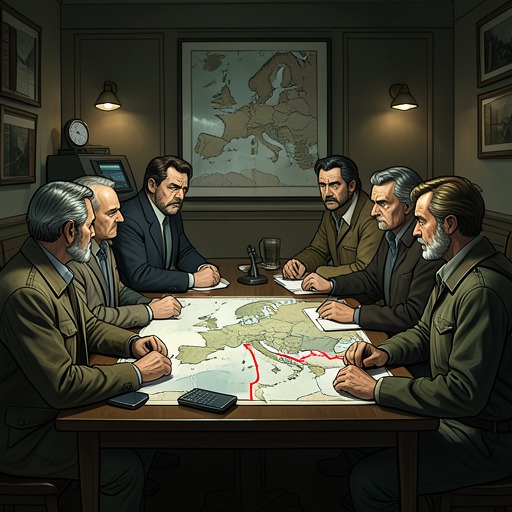
Viktor paces with a copy of Lidové Noviny, invoking the treaties of Versailles and St Germain as he calls the annexation illegal. Yet he hears the impotence in his own protest. The agreements seem remote, like relics from another age, and the question that troubles him is what further action will follow if this one is permitted. His reaction registers not only outrage but the collapse of confidence that treaties alone can restrain power.
Refugees and the Limits of Private Help
The consequence arrives as a movement of people across the southern border from Vienna and other Austrian cities. Men, women, and children enter by train and car or travel on foot, pushing handcarts and carrying suitcases. The narration depicts them appearing at doors and street corners and finding whatever places of refuge are available. Their arrival turns a distant annexation into an immediate humanitarian crisis in the city.
Viktor says that something must be done. The Glass Room’s ample space becomes, in his eyes, a reproach: the refugees will not come there to find shelter or sleep. Liesel replies that the problem belongs to governments, not individuals, and asks what they can do. The exchange leaves the need unmistakable but does not resolve it; concern for the displaced confronts the limits of a private household’s capacity to help.
Retrospect and Political Consequences
The novel’s later account of the family’s history places the crisis within a much longer experience of displacement and lost contact. Looking back, Liesel recounts that the family heard that a woman in their circle had been arrested and deported in 1942, while they were in Cuba. After the war, the expulsion of Germans and the movement of displaced people made information difficult to obtain; then the Iron Curtain made the country seem to have vanished from view. This later recollection does not turn those events into immediate consequences of the Anschluss, but it shows how the political upheavals that follow fracture families and obstruct reunion.
In a later visit connected with a proposed handover of the house, city officials invite Liesel to witness the transfer and describe the invitation as part of a changing political climate and an opening toward the West. Martin warns that accepting could amount to recognizing the city’s legal ownership of the property. The invitation therefore carries both a possibility of renewed relations and an unresolved dispute over dispossession. Against that history, the Glass Room’s image as a place of balance and reason, seemingly beyond time, contrasts with the political decisions that alter lives and the difficult work of acknowledging their consequences.