Architectural heritage versus living use
The Glass RoomArchitectural heritage versus living use is the dispute over whether the Landauer House should be treated as a monument to its architectural past or as a space whose value lies in its present purpose. The building’s successive lives—as a family home, a Nazi research facility, a children’s physiotherapy gymnasium, and a proposed museum—make preservation inseparable from ownership, political memory, and the needs of those who inhabit or use it. The novel refuses an easy choice between reverence for the house and ordinary use: both can keep the building alive, while either can also obscure the lives and conflicts held within it.
From Home to Contested Heritage
The house’s architectural significance is set against its practical beginnings and changes. Its growth proceeded alongside that of the Landauers’ baby: steel beams were laid, concrete poured, and interior space enclosed, while construction delays, material shortages, and disputes prolonged the work through summer and autumn. When the shell was completed, it inspired apprehension rather than celebration. From outside, it looked like a warehouse; inside, it was unfinished, with bare concrete, dusty floors, plain white walls, and single bulbs hanging from the ceiling. Its later status as an architectural treasure was not inherent in an instantly recognizable monument. It was built through the house’s design, its changing uses, and the stories attached to it.
The building’s interior made its modernist qualities tangible. A later account describes the living room’s 230 square metres, two glass walls, and view across the city toward Špilas. Chrome pillars, cream linoleum, and a partition of onyx slabs separated the sitting area from the library. The original furniture had largely disappeared, but the structure remained substantially intact. Even the windows carried a history of use and damage: the original plate glass was destroyed by a wartime bomb blast and replaced with smaller panes, although the mechanism that once lowered two window frames into the basement was still working. Architectural restoration therefore meant more than recovering an appearance; the building’s surviving fabric recorded the events that had altered it.
The house’s uses changed with political power. During the Nazi occupation, its rooms were adapted for research: offices occupied the upper floor, the kitchens were being converted into a laboratory, and the basement was prepared for an X-ray machine. The Glass Room’s onyx wall became the setting for anthropometric equipment, while its dining area was turned into a photographic studio. Later, the house served as a hospital gymnasium for children receiving physiotherapy. These conversions make the building more than a container for successive historical episodes. Each new use reorganizes its spaces and assigns them a different purpose, while the earlier house remains present in the rooms that have been put to other ends.
The Case for Use—and for Preservation
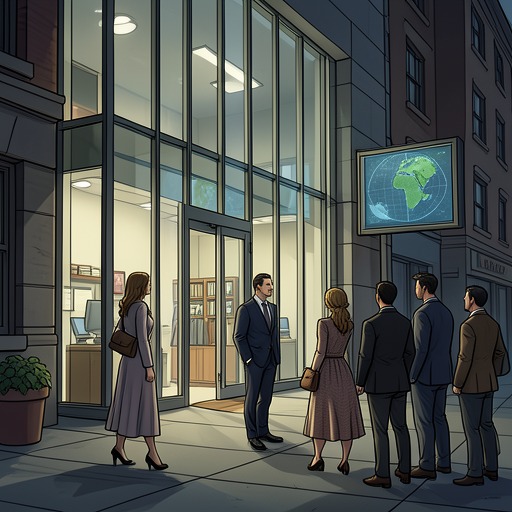
The dispute becomes explicit when a journalist tells Tomáš that the Landauer House is important in architectural terms and that people want to restore it as a museum. Tomáš counters that its present function matters more: it is valuable as a gymnasium, he argues, but impossible as a house and worthless as a museum. To him, a museum resembles a church in that both serve as memorials to something finished—either the past or religion—and are therefore a kind of fantasy. His position is not simply hostility to architecture. He loves the gymnasium as the Glass Room, a place of light and stillness in which he can be with Zdenka after work. For him, the building’s meaning is made in its ongoing use, not secured by converting it into an exhibit.
The newspaper article about the house stages the other side of the argument without dismissing the children who use it. Its correspondent calls Město a treasure house of architecture and presents the Landauer House as a masterpiece by Rainer von Abt, but acknowledges that the building is currently a children’s gymnasium. The article expressly says that sick children deserve the best environment for their treatment; its question is whether that care must take place inside an architectural treasure. This framing makes the disagreement one of competing public goods, not a simple opposition between culture and indifference. The gymnasium provides a real service, while the house’s design is presented as an inheritance that should be recognized and made available to a wider public.
The people who define the building’s value have their own histories and interests. The State Committee for Architectural Heritage, appointed by the city council, investigates how the past should be treated; its representative tells the journalist about the Landauers and von Abt. Laník, formerly the caretaker and by then a local District Committee official, recalls maintaining the building through wartime bombing and says that he and his sister defended it against the Nazis before handing it over to Soviet forces. He hopes that the public will be allowed to enjoy what had once been a privilege of the few. His account makes preservation sound like a democratic opening, but it also sits beside Liesel’s later distrust of Laník and her feeling that he had spied on her. The person who claims to have safeguarded the building is not a neutral custodian in the memories of its former residents.
Ownership, Return, and Political Memory
The proposed public handover brings architectural heritage into direct contact with property and exile. The authorities of Město invite Liesel to witness the handover, with the city offering to pay her expenses. Her son Martin warns that accepting could amount to de facto recognition of the city’s legal ownership of the property. Veselý, who delivers the invitation, presents it as part of a changed political climate: the country wants more normal relations with its neighbors, to open to the West, and to acknowledge past errors. Martin sees an effort to use his mother in a political game as well as to confirm the confiscation. The house’s future as a public monument is thus bound up with the unresolved question of who has the right to claim it.
Liesel’s own response holds attachment and reservation together. In a letter to Hana, she says that she will accept the invitation, despite the difficulty of travel and her concern about the political situation, because she longs to be in the house again. She is glad it may be kept as a museum of some kind, although she dislikes the term: to her, the house is itself a work of art, and perhaps a memorial to von Abt, Viktor, and the self she once was. This is not the same as treating the museum as a substitute for home. The building can preserve a connection to her former life, but it also marks that life as something lost and transformed into public memory.
The possibility of return emerges against a history that cannot be repaired by an invitation. Liesel’s family had left in 1938. Years later, she explains that her relatives believed Hana had died after hearing of her arrest and deportation in 1942, while the postwar expulsion of Germans and displacement of people trying to return made information difficult to obtain. The Iron Curtain then seemed to erase the country from their reach. In that context, a public ceremony at the house may signal a political opening, but it cannot undo lost years, uncertainty, or dispossession. The building becomes a point where private bereavement and public efforts at historical acknowledgment meet without becoming the same thing.
Museum, Living Space, and the Limits of Restoration
The house is eventually preserved and presented as a museum, but its restoration is incomplete and uneven. In 1990 it stands fixed in time and space like a fossil. Repairs are done badly; some original furniture is retrieved from the Moravian Museum and returned approximately to its former places, while updated bathroom fittings are described as ruined. The Glass Room’s damaged panes, however, are replaced with plate glass, restoring the space’s full clarity. Visitors include trade-union groups and dignitaries from Soviet-allied states, followed by occasional tourists and architecture students interested in von Abt. The building is made accessible as heritage, but its visitors do not necessarily bring the family’s knowledge or memories with them.
That distinction surfaces when Marie Delmas arrives after seeing a photograph of the house in a book on modern architecture. She has come from Paris because the image resembles a place lodged in her memory. At the house, an attendant explains that the Landauers left in 1938 and that the building belongs to the city: it is now a museum. Yet the narration rejects the idea that the museum has made the place inert. The Glass Room remains vibrant and alive, its piano, children’s sounds, and adults’ grief linking public architecture to lived experience. Marie’s return, followed by her recognition of Ottilie, makes the building a meeting place for histories that official labels cannot contain. The novel’s final image of the Glass Room as a space that seems to deny time is not a claim that its past has disappeared; it is a reminder that the building continues to hold more than one time, use, and claim at once.