Austria under Anschluss
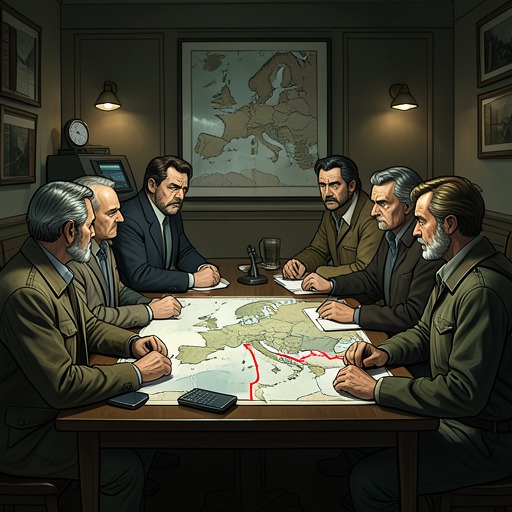
The Glass RoomAustria under Anschluss marks the moment when political annexation becomes an intimate, continent-wide upheaval. The takeover is first heard through contradictory reports, then seen in photographs and broadcast from Vienna: Austria ceases to be an independent republic and becomes Ostmark within the greater German Reich. In the Landauer household, the news exposes the impotence of legal guarantees, raises the question of Kata’s whereabouts, and foreshadows a refugee crisis in which borders, papers, and official discretion will decide who can move and who is separated from family.
Rumour, photographs, and the broadcast
Across the city, radios carry a fast-changing account of events. Rumours claim that the Austrian army has resisted, that hundreds have died, that Vienna is in turmoil, and that fighting has broken out between National Socialists and the police. Denials arrive almost as quickly: there is said to be no unrest, and Chancellor Schuschnigg has ordered the army not to resist. The conflicting reports make the takeover difficult to grasp even as it unfolds.
The following day, newspapers print photographs of German troops crossing the border and police marching into a Tyrolean town as villagers give the Hitler salute. One photograph shows a woman in tears. German newspapers describe them as tears of joy; Czech newspapers read them as tears of despair. The same image becomes a small emblem of the uncertainty surrounding public response: even visible evidence is made to serve opposing accounts.
That morning, the Landauers listen to Austrian radio in the Glass Room. The broadcast carries the crowd at Vienna’s Heldenplatz, drums and bands, and Hitler’s voice announcing Anschluss. The political change is stated with stark finality: Austria is no longer an independent republic but an eastern province of the greater German Reich, its name changed from Österreich to Ostmark.
The takeover inside the Landauer household
Viktor responds by pacing the Glass Room with the latest edition of Lidové Noviny and invoking the treaties of Versailles and St Germain. He insists that the annexation is illegal, but hears how powerless the claim sounds. The treaties seem to belong to another age, detached from the immediate force of events. His question about what may happen next conveys a fear that the takeover is not an isolated breach but a precedent.
That public crisis also brings a private absence into focus. As the news arrives, Viktor wonders where Kata is. The narrative does not provide her whereabouts at that moment; the unanswered question instead connects the political upheaval to the personal ties and vulnerabilities of those caught within it.
Borders and the refugee crisis
The takeover is followed by a movement of people across the southern border. Refugees arrive from Vienna and other cities by train, car, and on foot, carrying what possessions they can manage. The account presents their arrival as a visible transformation of the city: people appear in streets and alleyways, at doors and on corners, bringing fear and uncertainty into ordinary urban life.
A later border crossing shows how the new political landscape is enforced in practice. At a checkpoint, Viktor presents the family’s papers to a German official. The official’s uniform and title, Feldgendarmerie, contrast with Viktor’s orderly piles of documents: legal status is examined by a person whose authority rests on the regime now controlling movement. During the inspection, Katalin is taken away for further questioning despite carrying a refugee passport, while her daughter Marika is led after her. Viktor protests that Katalin’s papers are in order, but the official warns him that continuing to object could lead to his own detention. The family is pushed back toward the train, and Katalin and Marika’s suitcases are taken away.
Political rupture and lived consequence
The transition from Austria’s annexation to the later inspection of refugee documents gives the event its wider significance. The broadcast declares a territorial and political change; its consequences are measured in displacement, uncertain passage, and the possible separation of families. Papers may establish a claim to entry, but they do not ensure that officials will honour it. The contrast between Viktor’s appeal to treaties and his later inability to secure Katalin’s passage shows how quickly formal protections can lose force when the authority applying them has changed.
The narrative also places the annexation amid the changing boundaries of ordinary life. A returning visitor later remarks that passport control has appeared where previously there was none, calling the new restriction an ironic cost of a world supposedly moving forward. Against the hopeful language of progress, Austria’s transformation into Ostmark and the refugees’ subsequent ordeal reveal a harsher measure of change: political borders can be created overnight, while those forced to cross them remain exposed to decisions made at the checkpoint.