Battle and Soviet capture of Město
The Glass RoomThe Battle and Soviet capture of Město end German control of the city after a brief but disorienting battle, while transforming the Landauer House into a refuge and then a Soviet military position. The novel makes the change tangible through the people sheltering underground, the sounds of fighting overhead, and the Red Army’s arrival at the front door. Its consequences return decades later, when an invitation to witness the house’s handover turns liberation into a question of property, political memory, and belonging.
Approach of the Red Army
In spring, reports of the advancing front reach Město by way of conversation and rumor. At the pub, Novotný tells listeners that more than three hundred thousand Soviet troops are moving north after the fall of Budapest and Vienna. Nurses returning from the hospital bring accounts of the war’s human cost, while reports of the Red Army’s stalled crossing of the Morava river place the fighting close to the city. These fragments make the front feel at once distant and imminent: a military advance heard about in public, then gradually registered in the ordinary life of the house.
The shift from rumor to immediate threat comes when Soviet bombers appear above Město. Laník and his sister watch from the upper terrace of the Landauer House as aircraft marked with red stars cross the city and anti-aircraft fire rises toward them. The planes continue east, but smoke appears over the railway station. Their passage changes the meaning of shelter: the house is still standing, yet the battle has entered its view and its daily calculations.
That evening, Laník and his sister move their belongings permanently into the basement. German forces dig trenches and build tank traps in the streets; guns are placed at intersections, and reinforcements arrive from the north. Reports of fighting elsewhere, including the fall of Berlin and Hitler’s death, circulate alongside preparations for the city’s defense. With public life largely displaced into cellars, money loses practical force and people search for necessities through barter. The basement is both a store of hoarded supplies and a place to survive the approaching battle.
Fighting in and around the house
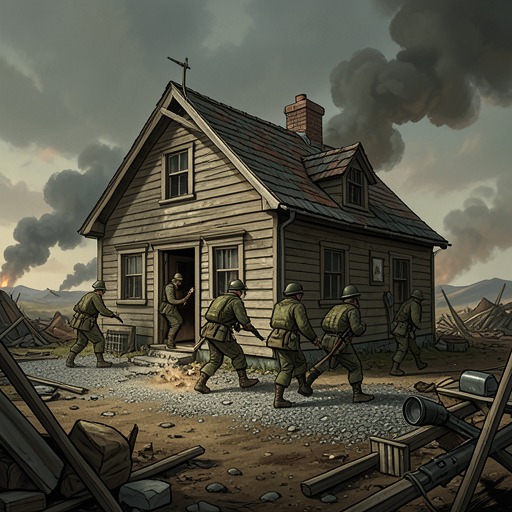
The battle itself lasts little more than a day. Gunfire comes from the south and west, shells pass over the house toward the northern suburbs, and aircraft fly low above the roofs. From the basement window, Laník watches traffic moving north and tells his sister that the Germans are leaving. Yet the fighting remains difficult to locate: smoke hangs over the Špilas fortress, nearby gunfire and an explosion suggest activity near the hospital, and the family cannot tell what is happening beyond the concrete shelter.
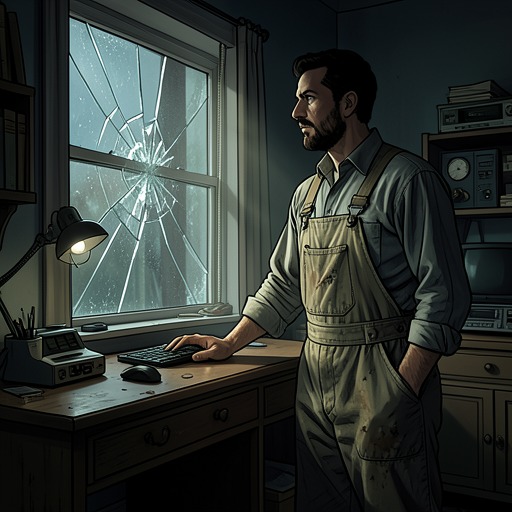
As the battle draws closer, Laník leads his sister farther into the basement’s inner rooms. The power is out, and a candle gives only partial sight of the furniture stored there. When footsteps and machine-gun fire sound directly overhead, they crouch in darkness and keep quiet. His sister takes his hands and calls him Joška, the childhood diminutive she used when she rocked him to sleep. The familiar name briefly links the danger above them to a much earlier intimacy between siblings; when the firing subsides, they still cannot know who has taken the ground above.
The change becomes visible only after Laník cautiously climbs upstairs. In the former Glass Room, daylight enters through gaps in the tarpaulin he has rigged, while the battle has receded toward the hill. At the front door, he encounters a Soviet woman officer pointing a pistol at him. He offers her a bottle as a present to the victorious Red Army, using several words for comrade to make himself understood. Her caution gives way when she recognizes the offered drink, and the encounter becomes an unexpected welcome rather than a confrontation.
Occupation of the Landauer House
Soviet soldiers enter the house and bring their equipment into the Glass Room. A dozen young men and three women occupy the space, while others guard horses outside. They set up machine guns, a mortar, grenade launchers, and rifles, then strip and clean the weapons; oil smears the floor. Laník’s sister protests at the disruption, and the soldiers laugh. The house that had served as shelter during the battle is now being used by the army that has captured the city.
The officer asks Laník whether his sister is his wife. He clarifies that she is his sister, a distinction the officer can understand. The officer identifies her rank as starshyna, or sergeant-major, and recounts the places her unit has crossed on its way to Město: Rostov, Odessa, Jassy, Kishinev, Bucharest, Budapest, and Bratislava. Her account places the city at the end of a long military advance. The capture is not represented as an abstract transfer of power alone; it arrives through exhausted people, their equipment, their horses, and the new demands they make on a private home.
Return, invitation, and contested memory
Decades later, the city’s authorities invite Liesel to witness a handover connected with the house, offering to pay her expenses and presenting an invitation conveyed by the ambassador. The visit is framed by the city as part of a political opening and a desire to restore normal relations with its neighbors. Veselý describes a willingness to discuss past errors and invokes socialism with a human face. Martin, however, warns that accepting could amount to recognizing the city’s legal ownership of the property. The invitation therefore makes public reconciliation and private property claims inseparable.
The family’s response is shaped by losses extending beyond the house. Liesel explains that her relatives had believed Hana dead after hearing of her arrest and deportation in 1942. In the confusion after the war, amid the expulsion of Germans and the movement of displaced people, the family could not establish what had happened. The Iron Curtain then cut off further knowledge. Against that history, the news that Hana is alive makes the proposed visit more than a formal ceremony: it reopens a family past that exile and political division had seemed to close.
At the house, Liesel is crowded by people and asks Hana to take her outside. A speech is beginning about the building’s place in European architecture, but Liesel’s recollection of Laník complicates any celebratory account: she says he had always frightened her and that she thought he spied on her. Hana answers that he is now a Party official, using his advancement to describe the persistence of the political order that followed the war. The Soviet capture thus remains present in the later visit not only as liberation from German forces but as the beginning of another fraught political history.
The house as a frame for history
The battle’s immediate shift is from German defense to Soviet occupation, but the novel resists treating that change as a clean resolution. The Landauer House passes from family shelter to military accommodation and later becomes the object of an official handover invitation. Each use leaves a different claim on the building: lived home, wartime refuge, occupied space, and architectural heritage. The later dispute over whether Liesel’s presence would recognize the city’s ownership shows that commemoration cannot by itself settle the material consequences of confiscation and exile.
The Glass Room gives this history a formal counterpoint. In the later gathering, the room is described as a place of balance and reason, framed in straight lines and seemingly beyond time. That ideal of timeless space stands against the battle’s sequence of rumor, bombardment, hiding, and occupation, and against the decades of political change that follow. The capture of Město enters the house as a concrete event, but its meaning keeps changing as the people connected to the building attempt to remember, return, and decide what a handover can actually repair.