Closure of the biometric research center
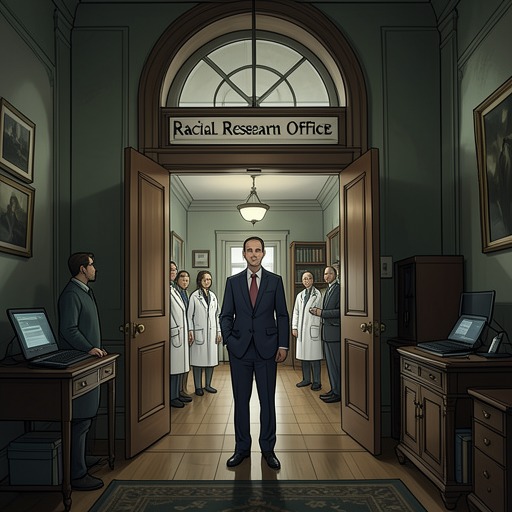
The Glass RoomThe closure of the biometric research center ends its attempt to turn human difference into measurable racial diagnosis, but not the apparatus built to pursue that aim: the staff and files are dispersed, and the Hollerith machines are sent to a new camp complex near Oświęcim. The center’s dissolution reveals the gap between the regime’s demand for a usable racial distinction and the research’s failure to establish one, while showing how the tools of classification can survive the institution that assembled them.
Background and Method
The center’s work begins with people brought in groups of roughly a dozen, divided by sex and approximate age. Reception staff record birth, language, religion, race, nationality, illness, and conditions in a subject’s ancestry. The forms are described as confidential and the work as pure science, but the selected categories already frame individual lives as material for racial classification.
Subjects proceed through tests of shapes and patterns, medical examinations, and extensive anthropometric measurements. Paired staff position each person at a stadiometer, measure height and body dimensions, and use callipers to record head measurements. Skin and eye colour are assessed against charts and models. The procedures insist on standardization and exactness; their cool, orderly performance makes the Glass Room itself seem an image of scientific precision.
Yet the method cannot produce the certainty its language promises. When the Reich Protector visits, Stahl explains that a disease associated with Jewish populations does not occur in all Jews and may also appear among non-Jews. The laboratory therefore tries to identify racial categories through minute combinations of physical traits, with Hollerith machines intended to sort the accumulated data. The qualification exposes a fundamental difficulty: the researchers’ measurements do not yield a simple boundary between the groups the regime insists are distinct.
Classification at Scale
The center’s work feeds into a larger system of records and processing. In April, Stahl reviews returns for 672 people: 316 classified as Slav, 239 as Aryan, and 112 as Mischlinge of varying degrees, while Roma and Jews are counted separately in an addendum. The figures turn the encounters in the Glass Room into administrative categories, even as Stahl’s attention shifts from the monthly totals to the file on Hana Hanáková.
Punch cards are duplicated and sent toward Prague, then Berlin, where machines are expected to sort, assemble, and analyze records at a rate of 150 cards a minute. The promised discovery of patterns and keys to human identity gives computational speed the appearance of scientific authority. But the center’s eventual closure makes plain that processing more data cannot settle the political question that governs the inquiry: whether its classifications can confirm distinctions the authorities take as self-evident.
Decision and Dispersal
News from the Reich Protector’s office ends the project: the center is to close, and its personnel are to return to their former occupations. A confirmation from Berlin gives the reason. The research is deemed unjustified because it has failed to find a scientific means of distinguishing Nordic, Slav, and Semitic populations. The decision treats that failure as evidence that the work is flawed, while asserting that common sense already proves the difference. The contradiction is stark: the institution is dismissed not because its categories are politically imposed, but because its instruments cannot make them measurable.
The closure is carried out through a physical dismantling. Staff pack their suitcases, receive rail passes for Berlin, Jena, and Leipzig, and travel to the station. Instruments and furniture are packed; files are boxed for transfer to Berlin; furniture is redistributed to offices in Město, Prague, and Warsaw. The machines are unscrewed from the garage floor and loaded onto trucks for a new undertaking: the camp complex being established in Silesia near Oświęcim.
Significance
The center’s failure does not bring its tools or records to an end. Its files enter another administrative destination, while its Hollerith machines are redirected to a camp complex. The movement from a research institution in a confiscated modern house to a new camp undertaking links the language of scientific measurement with the machinery of persecution, without making the center’s stated research and its successor use identical.
The closure therefore has a double meaning. It marks the collapse of a particular effort to give racial ideology the authority of measured proof; at the same time, the redistribution of its equipment shows how readily instruments of classification can be repurposed. The center cannot deliver the certainty its officials demand, but its records, machines, and habits of sorting remain in circulation.