Contingency and the recurring wheel of fate
The Glass RoomContingency and the recurring wheel of fate names the novel’s recurring challenge to the belief that lives follow a design. For Viktor Landauer, coincidences may look like predestination when viewed afterward, but they arise from neutral, capricious chance; once they occur, however, their consequences are real and inescapable. The idea links the scattering of people by war to intimate encounters and unsettles Viktor’s conviction that he can shape the future to his will.
Chance Without Providence
Watching Liesel and Ottilie cross the lawn, Viktor considers how people displaced by occupation and flight are scattered like dice. At a railway station in Město, helpers organize arrivals, and among thousands of possible destinations and encounters one person finds another. What had seemed an almost impossible coincidence becomes certain simply because it has happened. The passage refuses both a providential explanation and the idea that chance must be malicious: events are contingent, indifferent, and consequential.
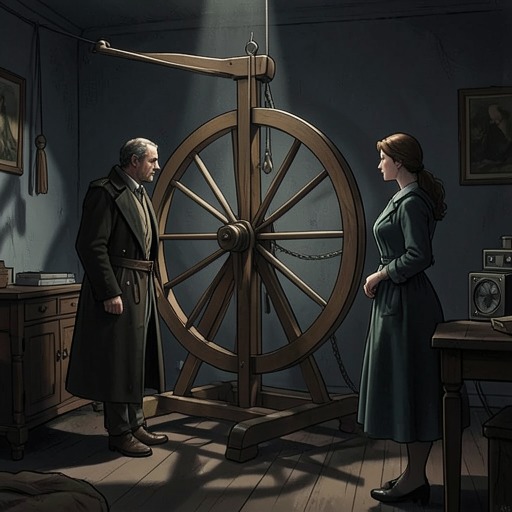
The image of streams extends the thought beyond human decisions. Currents and turbulence suggest forces moving beneath an apparently ordinary surface, while dark depths conceal what has been lost. The metaphor remains open rather than explaining events away: life continues as usual even while the world is falling apart, and ordinary talk about gardening can coexist with catastrophe. The recurring wheel of fate turns without announcing a purpose.
Viktor and Benno: A Past Encounter Recalled
The idea returns when news reports German troops massing on the border and the Czechoslovak army mobilizing. Viktor remembers his earlier bureaucratic service behind the front line, at a military headquarters in Graz, and the soldiers sent toward death. Among them was Liesel’s brother, Benno, whom Viktor encountered by chance where Benno’s unit was assembling on a parade ground.
Their surprised recognition did not make the meeting supernatural or ordained; Viktor reflects that people’s paths cross and their journeys intersect by coincidence. He and Benno spoke about home and family, including Liesel, then fourteen or fifteen. Benno told Viktor that his sister had a crush on him. The news turned Viktor’s attention toward a possibility he had never imagined: that he might be admired, even loved. The conversation ended when Benno’s unit called him away. Viktor watched him climb into a lorry and wave; no one from home saw Benno again.
The memory makes the approaching war sound like a repetition: engines and preparations seem to reach Viktor from beyond the hill as they did before. Yet the recurrence is not a guarantee that history will unfold identically. Viktor finds himself caring less about the danger beyond the house than about what is happening in the chata and on the lawn, where Liesel and Kata play with the children. The contrast places the large machinery of war beside the fragile, immediate claims of domestic life.
The Future as Contingency
When Kata says she is confused and fears that things will go wrong, Viktor reassures her, but the narration undercuts the comfort of reassurance. Whether the future goes well is not theirs to decide. Viktor has long acted on the principle that the future can be handled, manipulated, and bent to his desires; he now recognizes how false that belief is. The country is poised for disaster, and the future is already happening as he stands before Kata.
His unspoken love makes the abstract idea intimate. Looking through branches at fragments of sky, he thinks that he loves Kata but cannot bring himself to say it aloud. The feeling resembles flight: a sudden elevation and lightness, but also a sense that one’s material existence rests on a whim. The same contingency that makes historical displacement unpredictable makes private happiness vulnerable. Chance does not prevent love; it denies Viktor the certainty that love, or any other force, can secure what comes next.
Narrative Significance
Across these moments, chance connects a wartime dispersal, a meeting that altered Viktor’s understanding of himself, and a present in which he cannot command either political events or his own future. Repetition supplies no assurance of fate: the sounds of mobilization recur, but lives intersect through particular accidents, and the consequences become fixed only afterward. The motif’s force lies in that tension between indifference and consequence—events may have no design, yet those caught in their turning must live with what has happened.