Exile and departure from home
The Glass RoomExile and departure from home in the novel are not a single journey but an unsettled condition: the Landauer family escapes immediate danger, yet distance from Město turns safety into suspension, memories into uncertain images, and even the passage of time into a measure of what has been lost. Its political reality is just as concrete. Borders, visas, and refugee papers determine who may move, but possession of documents cannot guarantee that a family will remain together.
Flight, borders, and precarious freedom
The experience of departure begins to alter the meaning of freedom even before exile settles into daily life. When Rainer von Abt returns from Vienna, he describes the newly imposed border control as an irony of a supposedly advancing world: a border now divides places that had previously been connected without one. Liesel answers that such restrictions are a small loss compared with the freedoms people have gained, but Rainer turns the exchange toward her own condition by asking whether she is free. The question links political change to private constraint without treating the two as equivalent. A border is an official barrier; freedom within a life is less easily measured.
For the Landauers in Switzerland, the difference between refuge and home is registered against the surrounding catastrophe. War reaches them through newspapers and wireless reports: armies march, people die, refugees flee, and Paris seems to disappear beneath a flood of destruction. Switzerland appears as an island amid these waters, but the image conveys exposure as well as shelter. The family is safe for the moment, yet the disaster surrounding that safety remains present in every report. Liesel’s reaction to the news that Vítězslava Kaprálová has died intensifies the sense of a past being dismantled: another part of the past is gone, and the young are dying as surely as the old. Looking from the bright lake, Liesel sees the wreckage of lives around her and wonders how long her own island of safety will last.
The suspended time of exile
The family’s Swiss refuge has its own geography and rhythm. In their third summer there, wicker chairs and a large red, white, and blue umbrella are carried down to the lakeside. The lake’s changing surface marks the day—from early reflections, through metallic blue daylight, to violet evening and black night. This is not the nimble time of home but a leaden time, measured through alterations in the water. The place can resemble neither paradise nor hell: exile occupies an uncomfortable interval between the two, protected from some dangers but deprived of an ordinary life and a settled future.
Letters make that interval more painful because their arrival lags behind the lives they describe. A letter from Hana that is already more than a month old reaches Liesel only after events mentioned or anticipated in it may have changed. Liesel recognizes the irony of exile in this disparity: what is happening now may still lie in the future for the person who receives the news. As years pass, the house on Blackfield Road grows difficult to imagine. Scenes from home blur at their edges until memory loses context and begins to resemble imagination. Liesel recalls Viktor’s trick for photographing film stars: a faint smear of Vaseline on the lens softens the image. Exile makes fact seem to undergo the same transformation. The past is not simply recalled; it becomes less sharply distinguishable from what the mind supplies.
That uncertainty takes a physical form in Liesel’s dreams. She dreams of flesh, hair, glass, and chrome, of buildings populated by people and people made into buildings. On waking, the images vanish as quickly as night’s shadows in the heat. The cicadas outside begin in pulses like an engine starting, then build into a steady mechanical scream by midday. The scene gives dream and exile a shared structure: both offer images that cannot be held securely, while the world outside continues with an impersonal, relentless rhythm. Liesel writes to Hana, but the letters go nowhere. They collect in her desk as Europe becomes sealed off by war, turning communication into another unrealized passage across a boundary.
Domestic life without a settled home
The family tries to make a life in Switzerland, but ordinary routines do not dissolve their longing for Město. Liesel writes that the tedium of exile is unbearable. The children play cards and chess, and they learn Lexicon, a word-making game, in English because the family expects to build a new life in America. Martin becomes a little sailor with Viktor, and there is swimming. These activities resemble the elements of a holiday, yet Liesel insists that the appearance is misleading: the family continues to long for home, friends, and relatives. Their provisional education and recreation are oriented toward a future elsewhere rather than a life rooted in the present.
Displacement also rearranges relations within the household. While Viktor is often away working on projects and determined that the family leave for America, Liesel sometimes loses patience with the children and blames Katalin for failing to keep them in order. Katalin, who did not choose exile and resents Viktor’s decision that she accompany the family, tells Liesel that the place feels little more than a prison. Conflict is followed by reconciliation: tears, protest, embraces, kisses, and whispered apologies. Their domestic closeness is real, but it unfolds under conditions neither woman chose. The repeated movement from anger to making up shows how exile can intensify dependence even as it makes the shared household feel confining.
The letters also preserve an intimacy that cannot be restored by proximity alone. In one delayed message Hana recalls the past and expresses regret that she gave Liesel reason to turn to someone else, wishing they could begin that time again. By the time Liesel reads it, the words belong to an earlier moment. The emotional force lies partly in this mismatch: the letter carries a confession and a desire to be reunited, but distance and delay prevent Liesel from knowing what Hana’s present circumstances are. Exile separates people not only across space but across unequal versions of the present.
Documents and the limits of passage
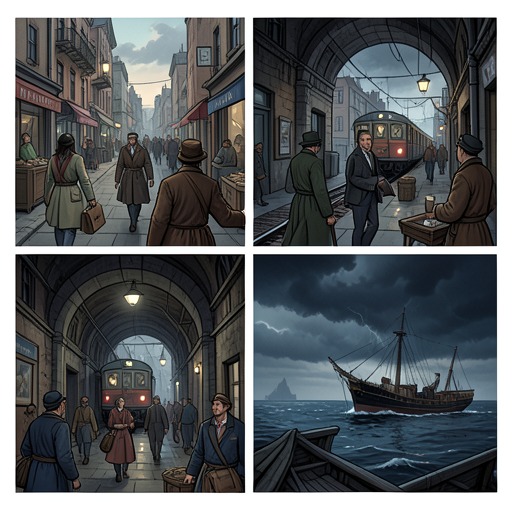
At the railway checkpoint, displacement becomes an encounter with officials empowered to decide whether papers will count. The family waits while soldiers search the train, open doors, and remove luggage; rumors spread that passengers without documents have been taken away. Relief rises as most travelers pass the desks, but fear persists because no one knows whether their turn will bring the same outcome. A uniformed member of the Feldgendarmerie demands documents from Viktor, who lays out papers in neat piles for himself, his wife, their children, Katalin, and her daughter. The passports and French transit and Spanish visas present the family’s case as a carefully assembled hand; the tickets follow, but the outcome remains uncertain.
Katalin’s papers do not protect her from the official’s discretion. When she says that she has only what she has, Viktor explains that she is in their employ. The soldier rebukes Viktor for speaking and summons another official. After the officials examine Katalin’s passport and visas, a uniformed figure takes her by the elbow toward a hut. Marika cries out for her mother, and Liesel pulls the child close, promising that she is with them and will be looked after. The scene makes the difference between a document’s formal validity and its practical power immediate: the papers are inspected, but the decision still separates mother and child from the family traveling with them.
When Marika is also led away, Viktor shouts that Katalin’s papers are in order and that she is traveling on a Nansen passport. The official warns him to return to the train or risk detention. Viktor points out that the same documents had sufficed to enter France and would suffice for Spain; the crowd presses forward, preoccupied with avoiding its own removal. The official tells him to move on and suggests the delay may be temporary, but offers no certainty. A young soldier pushes the family toward the carriage and carries off Katalin’s and Marika’s suitcases. The immediate consequence is a forced separation made more intolerable by its administrative ambiguity: the family is told to wait, but is given no assurance that waiting will reunite them.
Narrative significance
Exile in these episodes is defined by the gap between nominal safety and secure belonging. Switzerland shelters the Landauers while war closes around Europe, yet their refuge remains temporary, their communications delayed or undelivered, and their plans directed toward another country. The border scene makes the same instability bureaucratic and bodily. A refugee passport, transit visas, and tickets can be displayed in orderly piles, but the people who hold them remain subject to inspection, intimidation, and detention.
The recurring images of water and blurred vision give this condition a temporal dimension. The lake changes color as days pass, while memories of home lose their edges; letters cross the distance too slowly to match the lives they describe. Together, these details present departure not as a completed escape but as an ongoing loss of orientation. The exiles are physically removed from home, emotionally bound to it, and unable to know when—or whether—their present uncertainty will end.