Fall of the Iron Curtain
The Glass RoomThe Fall of the Iron Curtain provides the historical opening for Marie Delmas’s journey to Město, where she encounters the Landauer House as both a restored modernist landmark and the place of a childhood memory she has never been able to explain. The political transition appears not as an abstract milestone but as a change in who can travel, what can be seen, and how a private past can return to view.
Historical Opening and the House
By 1990, repair work at the house has been done badly. Some original furniture, recovered from the Moravian Museum, has been returned to approximately its former places; updated bathroom fittings have been ruined. The Glass Room, however, regains its lucid splendour when its window panes are removed and plate glass restored. The building seems fixed in time and space, like a fossil: restoration makes it visible again, but does not erase the damage accumulated around it.
The house is visited first by small, uninterested groups from the fraternal Soviet states, mainly trade-union parties and visiting dignitaries. Later come occasional visitors from outside the region: adventurous tourists with a vague interest in architecture and students concerned with Rainer von Abt’s place in modernist history. These visitors approach the house as a monument or architectural subject. Marie’s arrival, shortly after the Iron Curtain falls, gives the same restored building a different meaning: for her, it is not merely an object of architectural interest but the image of a lost, barely understood home.
Marie’s Journey and Recognition
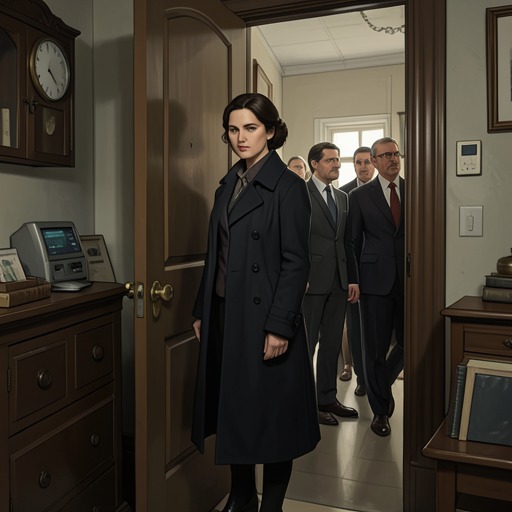
On a cold, wet day in March, Marie travels from Paris to Prague and onward to Město. She is a small, inconspicuous passenger, unnoticed by those travelling with her. For most of her adult life, she has worked as a concierge in a Paris apartment block, within a world bounded by the streets of her twentieth-arrondissement quartier, its church, market, park, and the cemetery where she visits her husband’s grave every Sunday.
Her reason for making this foreign journey is a coincidence. In the public library on rue Sorbier, she leafs through a book on modern architecture and sees a photograph that matches an image in her memory. The caption identifies it as the south elevation of Villa Landauer. The printed photograph gives the remembered view a hard, definite form, but recognition does not supply a clear account of how it belongs to her life. She recalls the scene as one might recall a childhood dream: with little context, and with confusion and contentment attached to it.
A Private Past in a Public Place
Marie’s history reaches behind the Sisters who brought her up. She has kept secret a childhood that seems to belong to another life, populated by figures she only partly apprehends and shaped by a language she has not entirely lost. Her German is limited, and her syntax remains childish and undeveloped, yet she can still speak it. At Město railway station she uses German to ask where she might find a hotel; as she walks through the Old Town, she asks for directions in the same language.
The contrast between her halting German and the restored, lucid Glass Room gives the return its central tension. The house can be repaired and displayed, and its architectural history can attract visitors, but Marie’s connection to it remains fragmentary and private. The fall of the Iron Curtain makes the journey possible; it does not resolve the childhood past that has drawn her there. Instead, the political opening brings a forgotten personal history into contact with a building newly visible to the outside world.