France
The Glass RoomFrance is both refuge and corridor in the Landauers’ flight from Europe, a country they enter with hopes of safety but cannot treat as a home. Its landscapes and railway stations mark the westward progress of exile; its transit rules also expose how fragile that progress is, as officials’ decisions can separate people who hold documents that appear valid.
A Temporary Refuge
After a period of stasis in Zurich, the family moves west to Le Grand Hôtel Vevey, a grand Biedermeier hotel on Lake Geneva. The change is deliberately provisional: they have a hotel rather than a house, and Liesel cannot imagine where they will be a week later. From her room she looks across the larger, darker lake toward the French shore, whose forested mountains and snow-covered peaks seem close but do not offer a simple route onward. The family expects to travel by train, not boat, first toward Geneva and across France to Bilbao, where the transatlantic liners depart.
In a letter to Hana, Liesel describes the repeated bureaucratic delays and says they expect to travel via Lyon in five days. She can see France from her room and finds the place French after Zurich, associating it with old men in berets and red wine at breakfast. Viktor prefers being there because, he says, he wants to shake off the past and what he calls Germanic nonsense. France thus becomes a setting for a hoped-for break with the past, even as the family’s onward journey makes clear that this stay cannot provide permanence.
Transit by Train
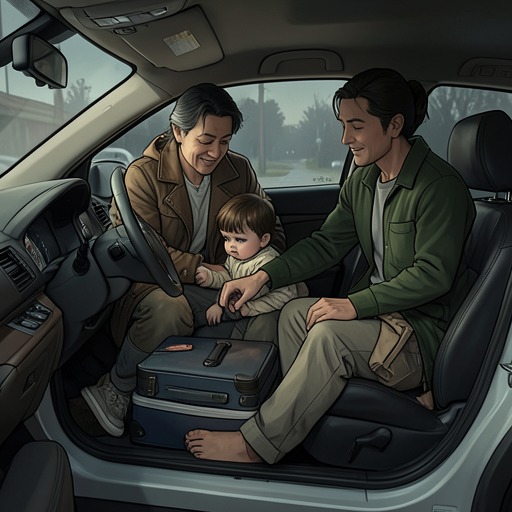
The departure from France is shaped by crowded railway travel and a dense collection of papers. The family boards a train whose compartments are full elsewhere, with passengers standing in the corridor and arguing in German and French over scarce sleeping space. Their own compartment has six bunks, but the lack of a restaurant car and sleeping-car comforts makes the journey a measure of how far their circumstances have fallen from the life they once knew. The attendant takes their tickets, passports, French transit visas, and Spanish entry visas; documents make movement possible on paper, while the crowded train makes its cost immediate.
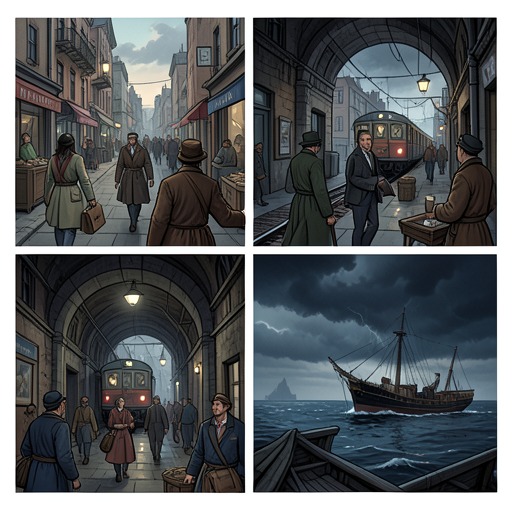
As the train crosses France, the children play a game of naming objects in the countryside and predicting what they will see next. The route passes Carcassonne and proceeds at walking pace through Toulouse, where uniformed police line the platform. Passengers trade conflicting theories about where they will change trains, whether they will have to leave the train at the Spanish border, and whether papers will be checked. The rumors cannot settle what the journey’s actual procedures will be. That uncertainty becomes more than an inconvenience when soldiers appear at a station in the afternoon: Liesel cries out at the sight, and Katalin whispers that she had thought the Germans were in the north and the French in the south.
The Border and the Documents
At the inspection, the family’s papers are examined by a German field gendarme. Viktor lays them out in neat piles and identifies the group as himself, his wife, their two children, the children’s nanny, and the nanny’s daughter. The official asks for tickets as well as documents. In the scene, travel papers resemble a hand dealt at poker: they are necessary to make a case for passage, but they cannot guarantee its outcome.
Katalin’s refugee passport is not enough to prevent her detention. When an official questions her, Viktor attempts to answer for her, but is told not to speak. After officials confer over her passport and visas, a uniformed man leads Katalin toward a hut. Marika cries for her mother; Liesel pulls the child close and says she is with the family and they will look after her. Viktor protests that Katalin has a Nansen passport and that her papers were accepted for entry into France and Spain. The official warns him that he too could be detained if he does not return to the train. The crowd’s pressure to survive helps turn the family away from the confrontation, while soldiers take Katalin’s and Marika’s suitcases. French transit is therefore shown not as secure passage but as a stage in a journey where legal status can be challenged and a family divided despite its efforts to comply.
Borders, Belonging, and Exile
France’s place in the narrative is defined by the gap between geographical nearness and practical access. From the hotel, the French shore appears only a few miles away, yet the family must travel by an indirect railway route, through changing authorities and uncertain checks. The new border controls that von Abt encounters on a journey back from Vienna sharpen this tension: he remarks on the irony of a world moving forward while creating a border where none had existed before. For Liesel, the claim that new freedoms may compensate for this loss does not resolve the question of whether she herself is free.
Across these episodes, France is neither a final destination nor a dependable guarantee of safety. It offers the Landauers a temporary pause, a visible route west, and the transit documents needed to continue; at the same time, the journey through its stations leaves their movement exposed to delay, military power, and decisions made at checkpoints. Its narrative significance lies in that contradiction: France is close enough to suggest escape, but passage through it remains precarious, and the family cannot assume that paperwork will keep those traveling together from being separated.