Genetic disease, disability, and eugenics
The Glass RoomGenetic disease, disability, and eugenics form a sustained conflict between bodily experience and the political meanings imposed upon it. The novel presents a child’s inherited, progressive illness through a father’s account of her development and loss of abilities, then places that account beside the language of racial hierarchy and the decision to kill her. Elsewhere, illness and vulnerability appear in settings shaped by poverty, refugee status, and contested public care. Together, these episodes resist the idea that a diagnosis or bodily difference can explain a person’s worth, while showing how easily such differences can be made instruments of exclusion.
Erika’s illness and its course
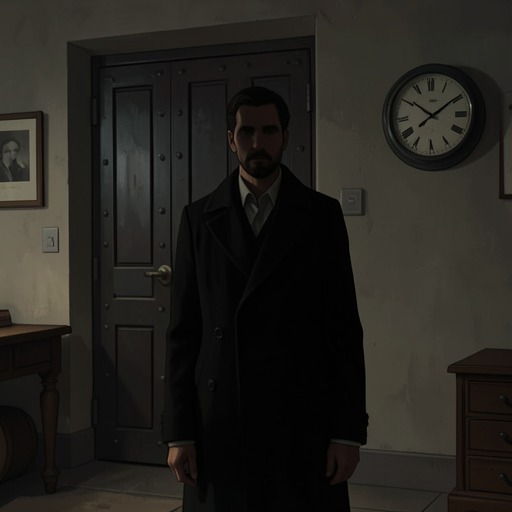
In a confession to Hana Hanáková, a man reveals that he and Hedda had a daughter, Erika, despite having previously said there was no child. He remembers her first six months as a period of apparently ordinary development: she smiled, laughed, recognized her parents, reached toward them, and began to grasp toys. Her decline came gradually. She stopped smiling and responding, lost the ability to grasp, and could no longer hear. The account makes the disease legible not as a single diagnosis but as a sequence of losses measured against skills Erika had already acquired.
The condition is identified as infantile amaurotic congenital idiocy, with blindness among its symptoms. The man describes signs on Erika’s retina, loss of head control, unresponsiveness, spasms, and convulsions. Specialists told the parents that she would continue to lose bodily functions and would probably die at four or five; they offered no cure. His image of a clock being wound backward gives the decline a particular shape: development is not merely arrested, but undone, as capacities that had appeared are progressively lost.
He explains the cause as an inherited recessive mutation. A chemical substance accumulates in the brain and disables nerve cells, according to the account he gives of the specialists’ explanation. Both parents carried the same mutation, which was brought together in their union. The explanation locates the condition in inheritance and biology; it does not make the child’s life reducible to a moral failing or a measure of human value.
From diagnosis to eugenic violence
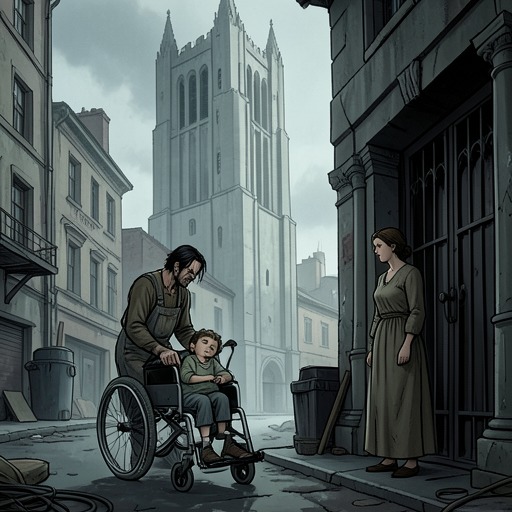
When Erika was four, her parents drove from Munich to a facility that the father calls a kind of clinic. On arrival, snow covered the area. Staff had been expecting them; after identity checks and a short wait, a nurse took Erika away. The parents tried to say goodbye, though he says they felt that, emotionally, they had already lost their child months earlier as the illness advanced.
The institution’s euphemistic appearance does not soften what follows. The father tells Hana that Erika was killed by injection, using morphia and scopolamine, and says he thinks it was for the best. The scene establishes the outcome without presenting it as a cure: the act is the deliberate ending of a disabled child’s life. His continued faith that science will eventually solve problems coexists uneasily with his account of a system that used medical authority to carry out a killing.
The surrounding political language exposes the logic that turns a specific inherited condition into a claim about an entire people. The father calls it a “Jew disease” and invokes “degeneracy,” moving from a genetic explanation to an antisemitic judgment about Jews as a group. Hana challenges the premise by asking whether such a category exists. The novel therefore sets the language of biological mechanism against the language of racial ideology: an account of inheritance is made to serve a claim of collective inferiority, although the latter does not follow from the former.
The story also records the human consequences within the family. A few days after Erika was taken away, Hedda returned early from the conservatory and died by suicide. The father’s account connects this loss to a bereavement that had begun during Erika’s decline but does not offer an easy resolution or consolation. Hana’s attentive presence allows him to speak about what he says he has never told anyone else; her response is quiet uncertainty rather than a ready judgment. The telling gives the hidden child and the family’s grief a place in the narrative without pretending that disclosure repairs what happened.
Vulnerability beyond the diagnosis
Other episodes broaden the novel’s attention from genetic illness to the conditions that determine who can find safety and support. When Katalin recalls receiving money from Viktor, she refuses to express shame. She explains that without a job, secure rent, or a reliable way to provide food and clothing for her baby, her choices looked different. Her account does not describe a genetic condition; it shows instead how poverty and responsibility for a child can narrow a woman’s options. The novel’s treatment of vulnerability thus includes social circumstances as well as disease.
At a gathering in the Glass Room, refugees are brought before an audience as if they were actors in a small theatre. Among them are a middle-aged couple with two children and a woman with her young daughter. The girl’s cracked spectacle lens and the family’s crumpled clothes mark hardship, while the adults’ placement before spectators turns their need into a public display. The scene draws attention to the difference between being seen and being helped: the refugees’ presence makes their circumstances visible, but they have little control over how they are presented.
That imbalance becomes concrete when officials examine Katalin’s passport and visas. Viktor tries to speak for her, but a soldier tells him he was not asked to speak. An official leads Katalin away, while her daughter cries for her mother. Liesel holds the child close and assures the officials that she is with them and will be looked after. The episode places family separation, precarious documentation, and the authority of the state in the same scene. It shows that the risks faced by a mother and child cannot be understood through any single label: their safety is shaped by refugee status, official scrutiny, and who is able to intervene.
Medical space, public care, and social meaning
The novel’s later discussion of the Landauer House offers another contrast between ideals of order and actual human use. A newspaper piece calls it an architectural treasure but notes that it is serving as a children’s gymnasium, where sick children receive treatment. It acknowledges the importance of their care even as it asks whether such treatment should take place inside a building considered architecturally significant. The controversy makes preservation and present use competing claims, rather than treating a building’s value as separate from the people who depend on it.
The article describes the house’s large living room, two glass walls, chrome supports, and onyx partition, while noting that wartime bombing destroyed the original plate glass and that smaller panes replaced it. The physical space carries evidence of damage and change, even as the preservation debate risks making it an object to be admired. When people crowd around Liesel at a later gathering, she feels trapped and asks Hana to take her outside. The remembered Glass Room’s apparent openness does not prevent pressure or confinement; its architecture cannot, by itself, guarantee humane conditions.
Significance
Across these episodes, the novel keeps distinct the existence of impairment, the experience of care, and the political judgment imposed upon both. Erika’s diagnosis explains the physical course described by her father, but it cannot justify her killing or the antisemitic generalization attached to it. The refugee scenes show different forms of vulnerability produced not by inheritance but by material scarcity and state power. The children’s treatment in the Landauer House adds a further question: whether institutions and public memory can make room for living needs instead of reducing people to spectacles, classifications, or obstacles to preservation.
The motif of rational order sharpens this conflict. The father tells Erika’s story in the Glass Room, a space he associates with proportion and reason, yet the account contains both the limits of medical knowledge and a lethal decision presented through administrative efficiency. Elsewhere, the orderly inspection of documents ends with a mother being taken away from her child. The novel does not equate medical explanation with eugenic ideology; it shows how claims of reason can be recruited to conceal a moral choice, and how the worth of vulnerable people is tested by what institutions do after naming their condition or status.