German occupation of Brno (Město)
The Glass RoomThe German occupation of Brno (Město) is shown through the seizure and repurposing of the Landauer House: a modernist family home becomes property of the Protectorate and then a centre for Nazi racial research. The occupation’s force lies not only in the decree that removes the house from its owners, but in the remaking of its rooms and equipment for a new institutional order. Across later decades, its return to other uses and its eventual preservation expose the unresolved distance between architectural restoration, historical recognition, and restitution.
Seizure and the language of legality
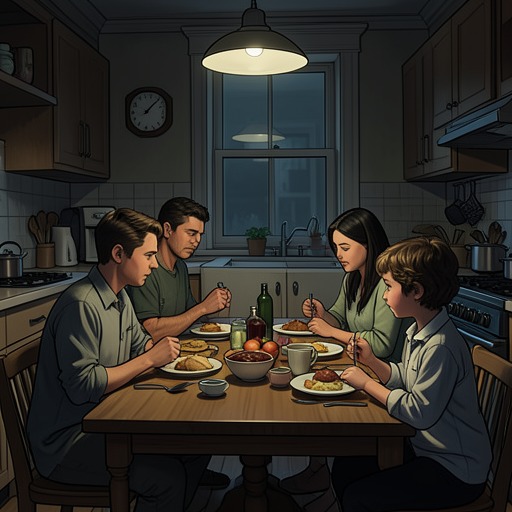
At breakfast, Viktor tells Ottilie that the house is no longer theirs: it has become the property of the so-called Protectorate under a decree issued in the name of the Reich Protector of Bohemia and Moravia. Ottilie asks whether that means Hitler; Viktor explains that the signatory is Hitler’s representative. The brief exchange makes political power tangible to a child as a change in who owns her home.
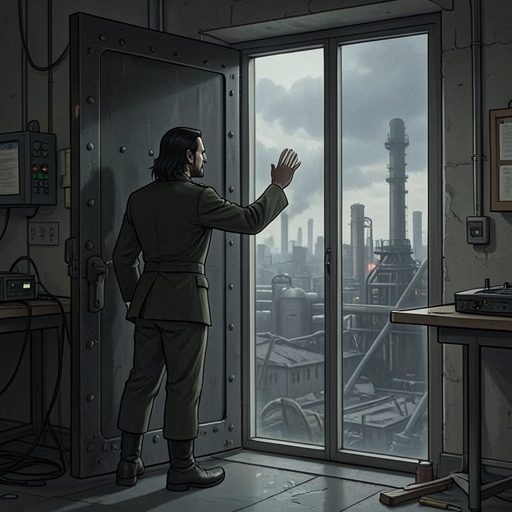
The occupation is also staged through the arrival of Hauptsturmführer Stahl. He leaves his car and walks up the hill to the house, where a custodian, Laník, refuses to open it on the ground that it belongs to the council. Stahl answers resistance with a performance of procedure: he presents a German-language requisition order transferring ownership from the Municipality of Město, points to its stamps and signature, and insists that the seizure is legal and connected to the war effort. The document’s official appearance does not make the transfer consensual. Stahl’s offer to enter peaceably is backed by the assurance that they will get inside one way or another.
The house converted into a research centre
The day after Stahl’s arrival, lorries bring furniture and office equipment to the house. A guard hut goes up inside the gate, and a sign bearing a Hakenkreuz identifies the installation as the Rasse- und Siedlungshauptamt’s research facility for biology. The change is administrative as well as physical: the private residence is now marked, guarded, and staffed as an arm of the occupying regime.
The rooms are rearranged to serve anthropometry and racial classification. Upstairs becomes offices; the kitchens are converted into a laboratory, and a basement room is prepared for an X-ray machine. In the Glass Room, curtains divide the open space, while scales, a height-measuring stand, callipers, and a chair fitted with steel rulers make bodies available for measurement. The dining area becomes a photographic studio, with drapes and lights set against the curved panelling and a Rolleiflex camera on a tripod. The Bösendorfer piano remains an incongruous remnant of the family’s life in the house; a Jewish tuner has restored its tones, but its presence cannot restore the room’s former purpose.
The garage, once used for two Landauer cars, is filled with large Deutsche Hollerith machines, and soldiers carry boxes of files into the main building. The converted house thus joins the measurement of people to the processing and storage of records. Its modern rooms and equipment, designed for domestic life, are made to serve a coercive system that presents racial categorization as scientific work.
A building under successive regimes
The occupation is one turn in the house’s long change of function. The novel first contrasts the measured progress of construction with the faster growth of the baby: steel beams are laid, concrete poured, and rooms enclosed, while delays over materials and labour prolong the work through summer and autumn. When the shell is finally complete, it looks less like a home than a warehouse, and the family enters spaces still bare and unfinished. The building’s later seizure therefore reverses a painstaking process of making a private home: the same open plan can be divided, equipped, and assigned to a new authority.
In a later period, the Landauer House serves as a children’s gymnasium. A newspaper account identifies it as an architectural treasure in the Blackfield district, overlooking Lužánky Park and the city centre, and recalls that Rainer von Abt designed it in the late 1920s as his last European work before fleeing to the United States in 1938. The building’s public use now differs sharply from the Nazi research centre, but it remains subject to institutional control. Tomáš calls the gymnasium the Glass Room, finding in the Czech word for room an additional sense of peace and quiet. For him, the light-filled space offers a respite from his work with children disabled by disease; the same room that once held instruments of classification becomes a place for movement and private attachment.
Return, ownership, and memory
After the fall of the Iron Curtain, the city invites Liesel to witness a handover, presenting the invitation as part of a political opening and an effort to acknowledge past errors. Her son Martin warns that accepting could amount to recognizing the city’s legal ownership of the property. The exchange leaves a central question unresolved: a public gesture toward reconciliation may also ask the dispossessed family to validate the outcome of confiscation.
The invitation brings a wider history of loss into the present. Liesel recalls that her family believed someone close to them had died after an arrest and deportation in 1942, when they were in Cuba; postwar confusion, the expulsion of Germans, displacement, and the Iron Curtain had prevented them from learning the truth. Her recollection sets the house’s contested ownership within a history of families scattered by persecution and political upheaval, rather than treating its return as a simple architectural matter.
When Liesel revisits the house, the crowd around her in the Glass Room feels oppressive, and she asks Hana to take her outside. The room’s openness, once a defining feature of its design, cannot prevent the pressure of public ceremony or memory. In 1990 the house is repaired, original furniture is returned approximately to its former positions, and the Glass Room’s plate-glass panes are restored. Yet the building remains fixed in time like a fossil, receiving visitors as an architectural exhibit. Its lucid, seemingly timeless space persists alongside the histories that repeatedly changed who could own it, enter it, and decide what it was for.