Glass, transparency, and concealment
The Glass RoomGlass, transparency, and concealment are bound together by the Glass Room, whose modernist promise of light, clarity, and rational order becomes inseparable from hidden betrayal, persecution, and violence. The house makes people visible without making their circumstances understood: its transparent walls can frame refugees as a spectacle, its reflective glass can seal a room against the outside world, and its dreamlike transformations turn the architecture into a vessel for memories that cannot be made clear by looking alone.
The Glass Room’s Rational Ideal
For Viktor Landauer, the Glass Room embodies reason. Its ordered proportions and open space seem to offer a world in which everything can be understood through dimension and balance. That ideal is also voiced in his remembered description of the house as transparent and full of light. Yet Liesel’s memory of the same declaration is shadowed by the knowledge that Viktor was concealing his affair with Katalin. While he spoke publicly of transparency, his trips to Vienna took him into the opaque privacy of hotel rooms. The house’s clarity is therefore not simply false; it is an ideal that cannot guarantee honesty in the lives lived inside it.
The contrast becomes spatially explicit when the room is repurposed. A surveyor enters with plans for an open-plan living space and dismisses the house as impractical; later, Stahl sees the same immense, bright interior as an ideal laboratory. Its glass windows admit what he calls the cold light of reason, while its lack of domestic cosiness suits his vision of a future-oriented institution. The same architectural openness that once expressed a private family’s modern aspirations can thus be appropriated for bureaucratic and racial classification. The room’s clean lines do not prevent abuse; they can help make institutional control appear orderly.
Visibility, Refuge, and Exposure
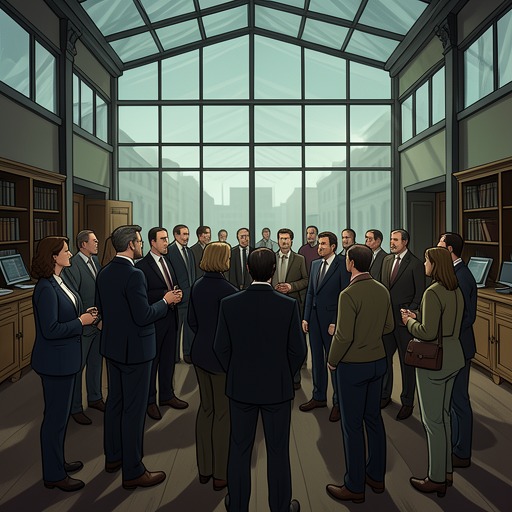
The Glass Room also becomes a theatre of compelled visibility. At a committee gathering, three adults and three children are brought in from the dining area and arranged before an audience. The refugees do not enter as autonomous participants: they obey the secretary’s instructions, bewildered by their sudden appearance before the assembled onlookers. Their crumpled clothes, the bespectacled girl’s cracked lens, and the younger child’s shabby floral dress make their vulnerability conspicuous. The architecture gives the audience an intimate view, but seeing them does not itself amount to understanding their needs or accepting responsibility for them.
Katalin’s presence among the refugees exposes a different gap between appearance and knowledge. Viktor recognizes her in the room, where she stands close to him, but the public scene cannot explain the hidden history between them. Years later, she tells Liesel that Viktor sometimes gave her money when she could not find work, pay rent, or provide clothes for her baby. She refuses the shame Liesel’s questioning seems to invite: poverty and the need to keep herself and Marika housed had shaped her choices. What had been invisible within Viktor’s idealized home becomes speakable, although the disclosure brings pain rather than simple clarity. Liesel remembers the housewarming speech about transparency alongside the concealed affair, and recognizes that the contradiction had been present from the moment Viktor saw Katalin in the Glass Room.
Secrecy is also bound to the unequal conditions under which people can choose what to disclose. A woman explains that she had wanted to tell someone about her child, but feared that the truth might drive him away; when she finally reveals it, she insists that she no longer wants to hide. The child is not treated as a scandal by everyone around her: some visitors bring sweets and play at being family. In a separate encounter, Katalin explains that taking Viktor’s money was not a source of shame when she had been struggling to find work and afford food, rent, and clothes for Marika. These moments complicate any easy equation of concealment with deceit: withholding can be a response to vulnerability, while disclosure depends on whether a person has reason to expect safety.
Reflections, Institutions, and Violence
When the Glass Room becomes a biometric laboratory, its windows and measuring devices give the space a new coercive function. The surface that had promised openness now reflects and encloses. After Stahl rapes a woman there, he sees her not as a person harmed by him but through the dehumanizing categories of Nazi racial ideology, imagining her as an alien and supposedly degenerate body. The glass behind her has ceased, in his perception, to be transparent: it reflects only the room’s interior and the two figures within it. Her handprints remain spread across the pane, with a smear of blood. The image turns the room’s reflective surface into a record of violence, not a window onto mutual understanding.
A later scene gives the room’s changing light an uncanny force. With the curtains drawn, the laboratory is empty and staged, its desks, chairs, and measuring devices waiting in darkness. A woman presses a button; a concealed electric motor draws the curtains back, and evening sunlight floods the instruments and furniture. On the onyx wall, the light gathers in the stone and turns it red and gold, like fire. The effect was not designed or anticipated; it became visible only when sunlight and stone happened to meet. The transformation is beautiful, but its associations are ominous: the room appears at once elemental and hellish, its orderly surfaces carrying an image that its designers did not plan and cannot reduce to rational intention.
The Glass Room as Dream and Memory
The house’s final symbolic transformation is expressed through a one-letter change: der Glasraum becomes der Glastraum, the Glass Room becomes the Glass Dream. In the dream, familiar elements such as white and black and the gleam of chrome shift shape while remaining recognizably themselves. The verbal metamorphosis captures the instability of a place that has been home, laboratory, memory, and spectacle. The architectural space does not simply preserve the past; it recombines its materials into images whose meanings remain unsettled.
Across these changes, transparency is neither a reliable virtue nor a simple illusion. Glass permits a public gaze that can expose refugees without helping them, admits the light that transforms the onyx wall, and becomes an opaque mirror behind the victim of violence. Meanwhile, the most consequential facts—the affair, the pressures shaping Katalin’s choices, and the brutality concealed beneath institutional rationality—are not made legible by the room’s openness. The recurring contrast between clear architecture and concealed conduct makes the Glass Room a measure of the limits of visibility: seeing a surface, or even standing inside a space designed to reveal, is not the same as knowing what has happened there.