Hana tells of giving birth to and losing her daughter at Ravensbrück
The Glass RoomHana tells of giving birth to and losing her daughter at Ravensbrück in a confession that makes private grief an encounter with historical violence. In the Glass Room of the Landauer House, she reveals to Zdenka Vondráková that she bore a child in the camp, named her Světla, and never saw her again. The story does not resolve the loss: it makes the absent child, and the history that took her, present between the two women.
The confession in the Glass Room
Hana begins by lifting her coffee, sipping cautiously, and setting the glass down with exaggerated care. She says that she has never told anyone. The restraint of the gesture gives way to the blunt fact: she had a baby in the camp, in Ravensbrück. Zdenka had expected them to return to their previous conversation about Hana’s love and the difficulties surrounding it; instead, she is confronted with a history she did not know. Her startled repetition of the word baby marks the gap between the conversation she anticipated and the disclosure she has received.
Hana says she wanted Zdenka to know, and presents the knowledge as a fragile gift. When Zdenka asks who fathered the child, Hana identifies him as the German scientist she had mentioned before. She explains that she had believed herself barren: she had longed for a child, but had not conceived with her husband or with other men with whom she had been involved. The pregnancy was therefore both a longed-for possibility and a bewildering outcome. The father wanted nothing to do with the child; Hana did. Her account makes clear that the bond began not in safety or certainty, but in a life already shaped by thwarted hopes and an unequal, coercive world.
Arrest, birth, and separation
Hana’s account moves from pregnancy to arrest and deportation. She says that she was first taken to a place in Austria near Linz, then put with others onto a train of cattle trucks that crossed Germany. They ended in a desolate camp north of Berlin, though the prisoners did not know where they were. Hana recalls the barbed wire, rows of huts, and disorder of the camp. In that chaos, women in her hut cared for her; women giving birth and women looking after one another were among the things that happened there.
The child was a girl. Hana remembers her dark hair, her wrinkled face, and a short, sharp cry that seemed like a gasp for air. She named her Světla, meaning light in the darkness. The name gives expression to the love Hana found in circumstances she describes as hell: the baby’s arrival did not make the camp less brutal, but it gave Hana a relationship she held on to within it.
The separation came almost immediately. The baby was placed at Hana’s breast and tried to feed, but Hana had no milk. The child was then taken away, and Hana never saw her again. Hana distinguishes this from what happened later, when a maternity hut allowed women to keep their babies for as long as they could, as long as the children lasted. When Světla was born, Hana says, the babies were simply taken. The distinction places her loss within the camp’s changing arrangements without softening its finality: whatever hope the later practice might suggest, it did not reunite Hana with her daughter.
Survival and the wound of memory
After Světla was taken, Hana imagined that the child might somehow survive and that they would meet again when the war was over. She knew this hope might never be fulfilled, but it became a reason to stay alive: if Hana died, her part in the imagined reunion could not happen. In retrospect, she says that Světla saved her life. The statement does not claim that hope repaired the loss. It shows instead how the imagined future gave Hana a reason to endure a present in which she had been deprived of her child.
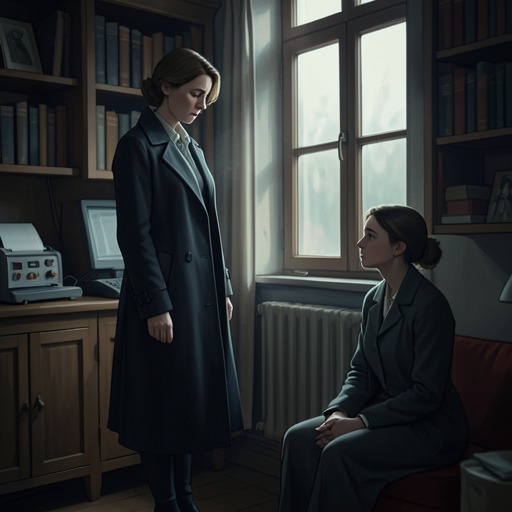
The telling itself is painful. Hana’s face becomes rigid, like that of a mourner at a graveside, and she looks away through the window. When she describes the baby being taken, the Glass Room seems to lose its air; afterward, Hana weeps quietly, without convulsion or display. She tells Zdenka that she has never disclosed any of this before and that, by knowing it, Zdenka knows everything about her. The scene makes speech a form of exposure, but not a cure: the secret is no longer borne alone, while the separation remains untouched.
Witnessing and the weight of history
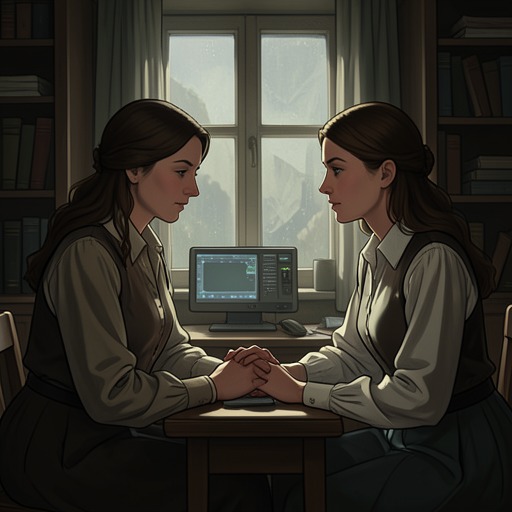
Zdenka’s response is bodily before it can become consoling language. Hana’s confession strikes her almost like a blow; she feels tears sting and can manage only Hana’s diminutive name, Haničko. She is silent, struggles to breathe, and cannot find words of comfort. When Hana begins to weep, Zdenka goes around the table and puts her arms around the older woman. The movement does not undo what happened. It makes Zdenka a witness to a grief that, until this moment, Hana had kept from everyone.
The disclosure overturns the meanings the Glass Room seems to promise. The room appears to invite openness and truth, yet Hana’s revelation is a secret carried into it decades later, and Zdenka cannot make the horror speakable simply by hearing it. Its glass, concrete, chrome, onyx wall, tropical-hardwood partitions, and milky ceiling lights hold the material past in the present. Designed by Rainer von Abt as a modern space, it becomes, as Hana weeps within it, a room imbued with history.
The narration sets Hana’s testimony against Tomáš’s denial of history and the myth of Ondine: beside the remembered birth, the child’s removal, and the mother’s continuing grief, those abstractions become a mere fancy. History is not safely past or reducible to an idea; it is present in Hana’s face and in the act of telling. Světla remains absent, but the name Hana gave her and the hope that helped her survive ensure that the child’s brief life is not erased from the story.